Spiritual Jazz
When the saxophone prays, even the smoke drops to its knees.
Get your song in Spiritual Jazz
Make yours in this styleHear it before you pay.$19 USD · your first song for $5.50 USDIf it doesn't move you, we give you your money back · 7 days.
Spiritual Jazz is a style from the Smoke and Midnight family. 105 BPM, Experimentation 36, Style strength 92.
What is Spiritual Jazz?
Modal harmonies, celestial harp, and a saxophone reaching for the divine. Spiritual jazz: jazz transformed into prayer, transcendent, deeply felt, and beautiful enough to touch the sacred.
How it sounds
It is a quarter past five in the back of a club where the air smells of old wood, melted wax, and the last finger of whiskey no one is going to finish. Light cuts in sideways through the wide slats of the blinds, slicing the dense smoke into sheets of dusty amber that settle on the grand piano. There is no audience left; only the musicians remain, slumped on folding chairs, sweat darkening the cotton at their armpits, shirtsleeves rolled to the elbow.
The harp sits back in the corner, a frame of carved wood and taut strings that seem to hum before anyone touches them, resonating with the sheer weight of the room. The saxophonist steps forward and sets the mouthpiece against his lips. There is no rush in his posture. The first sound is not a note, but a long breath passing through the metal tube to warm the brass, a thick sigh that fills the space before the Dorian mode begins to drift.
The horn does not perform; it reaches upward, cutting past the ceiling, hunting for the exact gap between one note and the next where time stalls out. The rhythm keeps no strict pulse; it is a slow tide, a low thrum rising from the planked floor straight through the soles of your shoes. Every key pressed down lets out a small mechanical click that mingles with the drone of the low end. The music refuses to march toward an ending: it expands, opens outward, swelling until the walls of the room seem to dissolve inside the sound.
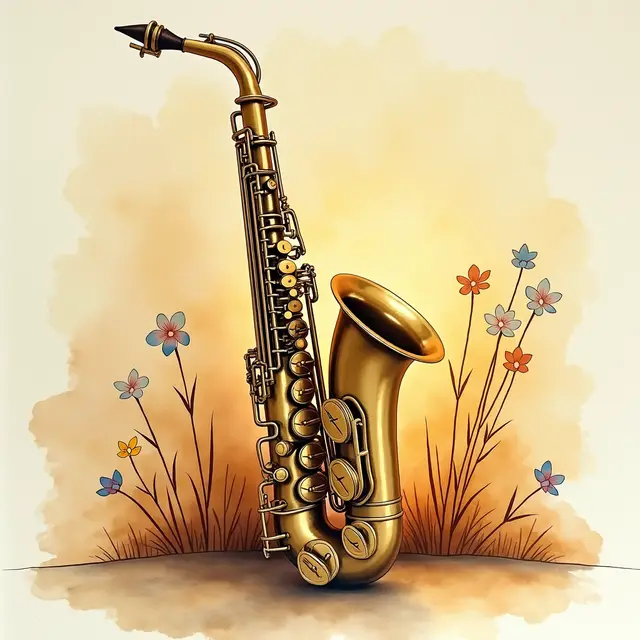
Palette: warm gold / amber / flowers in orange and blue
- BPM
- 105 BPM
- Family
- Smoke and Midnight
- Serial
- HUM-30
- Rarity
- Rare
- Style strength
- 92
- Experimentation
- 36
Typical structure
[Intro] harp → [Theme] → [Solo] extended sax → [Climax] → [Outro] serene
The data above is merely the surface of the recipe, the part left out on the counter for everyone to see. What remains hidden is the hardest technical hurdle in this style: how to keep the pursuit of transcendence from tipping into empty solemnity, and how to make modal dissonance float without letting the song dissolve into aimless noise. That lives inside a secret distillate of eight unpublishable parameters that the engine crosses directly with your specific history. When it finishes, an internal judge measures the lyrics against six canons and sends back for repair anything that smells of cliché or forced reverence. The horn can be bought anywhere. The prayer cannot.
How a lyric in this style thinks
A lyric in spiritual jazz does not construct a narrative or demand resolution; it serves as a vessel for meditation, releasing the voice into an elastic, modal space where words function like incantations rather than storytelling. The genre turns vocal delivery into an extension of the instrumentation, prioritizing breath, sustained vowels, and repetitive mantras over complex rhyme schemes or linear plots. When vocals appear in spiritual jazz, they do not lead the ensemble from behind a spotlight; they rise from within the acoustic texture, hovering alongside the breath of a saxophone or the resonant decay of a harp.
Emotion in this discipline arrives not through sudden harmonic shifts or dramatic drops, but through patience and steady accretion. Lines are kept short, cyclical, and deeply spacious, allowing long pauses where the instrumental room tone and modal drones take ownership of the sound. Repetition is central: repeating a single phrase six or eight times strips away its literal meaning, leaving behind pure spiritual resonance. The rhythm is unbound by strict meter, swinging between a fluid 105 BPM pulse and a loose rubato feel where the cadence of the words dictates the movement of the double bass and soft cymbal scrapes.
The sensory world of spiritual jazz is rooted in raw physical acoustics and deep sanctuary quiet. It is built on warm amber light, polished wood, thumbed brass mouthpieces, taut harp strings, and the audible mechanical click of piano keys under gentle pressure. You will hear the artist breathing into the reed before the first pitch speaks, the low thrum of wood beneath a standing bass, and the soft sheen of brushed cymbals. It completely avoids synthetic pop gloss, crisp mechanical grid timing, aggressive vocal pitch correction, and urban synth textures.
Structurally, the form follows a sacred arc rather than a commercial verse-chorus formula. A track opens with an unmetered intro dominated by harp or modal piano chords, laying down an ink black backdrop of open fifths and Dorian modes. From there, the main theme enters—a clear, singular melodic statement spoken or played with unhurried authority. The piece then unfolds into an extended sax solo or vocal chant, building toward an emotional climax driven by rising volume and harmonic intensity rather than structural complexity, before descending into a serene, tranquil outro where the sound slowly dissolves back into silence.
What separates genuine spiritual jazz from a generic ambient track is conviction and acoustic gravity. Generic imitations rely on superficial jazz chords and bland atmospheric pads without establishing a true modal center or allowing the phrasing to breathe. Authentic craft requires treating every note and lyric as a deliberate act of seeking. The phrasing must sound as though the performer is reaching for something just out of earshot, using silence as a structural instrument and treating the recording space not as a studio, but as a sacred hall where nothing is rushed.
- SAX SEEKING THE DIVINE
- JAZZ AS PRAYER
- INSTRUMENTAL
Sample excerpt
dust on the window ledge indigo light across the floorboards you left the kettle half full and I did not turn the burner on we sat until the shadows lengthened and the trumpet found its low tone
the heavy hours have loosened their grip we let the silence do the speaking now amber light upon the wooden chair nothing left to prove or break
Workshop note — This verse relies on minimalist observations of domestic objects to build an atmosphere of quiet reconciliation without resorting to grand statements. The rhythm moves with a slow, breathing cadence that leaves wide spaces between phrases, mimicking the improvisational pauses of a muted horn. Notice how avoiding emotional clichés keeps the weight firmly grounded in concrete, everyday details.
Sample excerpt written by MUSAI Song. Your lyrics are written from scratch, based on your story.
When to choose this style
Choose this card when you need to tell the story of a quiet reconciliation that requires no speeches, an apology that took years to arrive, or a loss that no longer burns as an open wound, but has settled into a quiet wisdom. It fits when thanking someone who stayed silent while everything else made noise. Use it for an anniversary where memory has stopped chasing sharp details and seeks instead the peace of what survived the years. It works for the moment someone decides to put down an old guilt they were never meant to carry.
Do not choose it for fresh anger, sudden vengeance, or a violent split: spiritual jazz has no teeth, it neither bites nor rushes to strike. It fails completely for loud triumphs or birthday bashes meant for dancing and losing control. If you want a dense nocturnal atmosphere with a steady walk for the late hours, the card is Jazz Nocturno.
Your story in this style
MUSAI Song writes original lyrics from your story, in the Spiritual Jazz style, and delivers the finished sung song, the ready-to-use style recipe, and an illustrated art plate with its numbered certificate, private by default; public only if its owner publishes it.
- Original lyrics written from your story
- A finished sung song, ready to play and share
- Art plate with a unique seal and a numbered certificate, private by default; public only if its owner publishes it
Frequently asked questions
What BPM is Spiritual Jazz?
Spiritual Jazz usually runs at 105 BPM.
What does Spiritual Jazz sound like?
Modal harmonies, celestial harp, and a saxophone reaching for the divine. Spiritual jazz: jazz transformed into prayer, transcendent, deeply felt, and beautiful enough to touch the sacred.
What song structure does Spiritual Jazz use?
[Intro] harp → [Theme] → [Solo] extended sax → [Climax] → [Outro] serene
How do I write Spiritual Jazz lyrics?
Tell MUSAI Song your story and pick Spiritual Jazz: it writes original lyrics for this style at 105 BPM, you edit them word by word, and you get the song sung in Spiritual Jazz, with an illustration of the song and its numbered certificate. $19 USD per song, one-time payment.
Explore more styles
- Acid Jazz
- Afro-Cuban Jazz
- Bebop
- Big Band
- Boogie-Woogie
- Bossa Nova
- Cabaret
- Chicago Blues
- Classic Blues
- Cool Jazz (West Coast)
- Delta Blues
- Exotica Lounge
- Gypsy Jazz
- Hard Bop
- Jazz Funk
- Jazz Fusion
- Jump Blues
- Late-Night Jazz
- Latin Jazz
- Lounge
- Modal Jazz
- New Orleans Jazz
- Nu-Jazz
- Organ Trio
Your idea or story, sung in this style
Card · secure payment via Stripe, charged in USD
If it doesn't move you, we give you your money back · 7 days