Bossa Nova
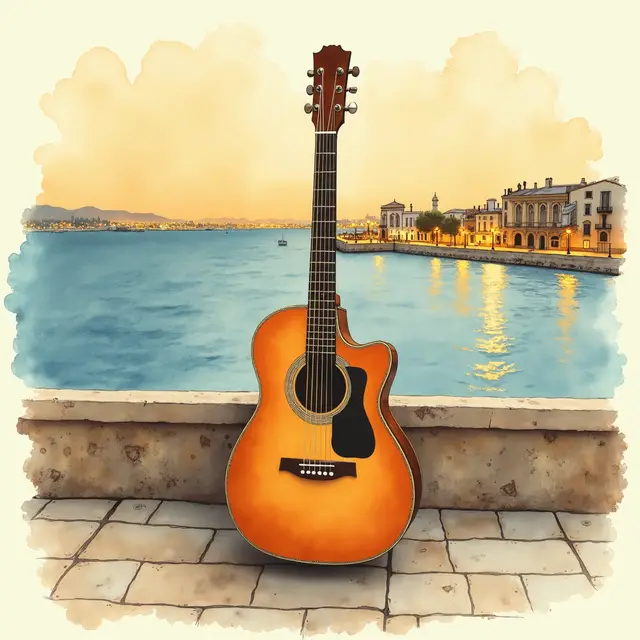
The ocean in the background isn't scenery — it's a co-writer.
Get your song in Bossa Nova
Make yours in this styleHear it before you pay.$19 USD · your first song for $5.50 USDIf it doesn't move you, we give you your money back · 7 days.
Bossa Nova is a style from the Smoke and Midnight family. 130 BPM.
What is Bossa Nova?
A whispering guitar and a voice as soft as a Rio de Janeiro breeze. Bossa nova, the barefoot sophistication of Brazil, is elegant, serene, and endlessly cool.
How it sounds
It is half past nine on a December night in Ipanema, yet there is no chill; the breeze blows in from the ocean heavy with salt and a warm moisture that clings to the skin like a long caress. You are sitting on the low edge of a terrace, bare feet resting against the asphalt that still holds the heat of the afternoon. Three feet away, someone tunes a nylon-string guitar with a lazy, almost absent gesture, repeating the same minor ninth chord over and over until the air itself seems to bend around the sound.
On the table sits a heavy glass with ice cubes already melting next to a thin slice of lime, droplets of condensation sliding slowly down to trace dark paths across the wood. There is no rush to begin singing. When the voice enters, it refuses to raise its volume for attention; it glides just above the syncopation of the fingers, so close to the ear it feels like a secret whispered in a dark room, even beneath the open sky.
The lights of the coastal avenue glow in the distance through motionless palm trees, blurred smears of old gold pulsing to the quiet rhythm of the beat. The world out there keeps rushing with its dull urgency, but here time has grown dense, a thick oil moving with an elegance so natural it aches, as though someone were quietly reminding you of something you lost without noticing.
Palette: gold / sea blue / cream
- BPM
- 130 BPM
- Family
- Smoke and Midnight
- Serial
- HUM-05
- Rarity
- Epic
Typical structure
[Intro] guitar → [Verse] → [Chorus] → [Piano Solo] → [Final Verse]
The details above can be copied in a minute. What cannot be copied is the surgical precision of subtraction: how many notes to strip from a chord so the harmony suggests sorrow rather than declaring it, or how to stretch the vocal syncopation exactly half a beat behind the guitar's pulse so the melody floats without losing its footing. That lives in an internal distillate of eight unpublished parameters, and the engine crosses it with your story before a single line is written. Upon completion, an internal judge measures the lyrics against six dimensions of the canon and orders repairs on anything that sounds too obvious. The ninth chord is found anywhere. Barefoot elegance, no.
How a lyric in this style thinks
A bossa nova lyric does not confess — it admits. The distinction matters. Confession implies urgency, a need to be heard, a voice climbing toward the listener. Admission is quieter: the words arrive already settled, as though the speaker has lived with the truth long enough that speaking it costs nothing dramatic. That is the fundamental contract of bossa nova. The emotion is real, often aching, but it has been distilled until all the turbulence has evaporated and only the residue remains — precise, luminous, still.
The base tone sits somewhere between tenderness and melancholy without tipping into either. Longing is present, but it has been domesticated into something that can share a table with you. Structurally, bossa nova tends toward brevity and restraint: a short intro where the nylon guitar establishes the harmonic world, a verse that plants one image and lets it breathe, a chorus that doesn't erupt but simply opens slightly, like a window rather than a door.
The piano solo, when it appears, functions as an emotional parenthesis — the thing the lyric couldn't quite say, handed off to the instrument. The final verse returns not to repeat but to confirm, the same words now carrying the weight of everything that came between.
Line length in this genre stays short to medium, rarely running past ten or eleven syllables. The rhythm doesn't drive forward with the insistence of pop; instead, it glides across the syncopated guitar pattern, landing on unexpected beats in a way that feels conversational rather than metered. Repetition in bossa nova is gentle and deliberate — a phrase returned to twice, maybe three times, each time arriving at a slightly different emotional angle, the way you might return to a view from a terrace as the light changes. The voice stays low, intimate, almost spoken, never pressing for emotional response. This is not a vocal style that announces itself; it leans close.
The sensory field is specific and coastal. The genre lives in condensation on glass, salt air, warm asphalt after dark, the amber blur of streetlights through still palm fronds, ice melting without sound, bare skin against warm stone. These are textures of unhurried time. What bossa nova never uses is anything jagged, industrial, or frantic — no gravel, no neon, no crowd noise, no clock ticking with urgency. The world in a bossa nova lyric is always slightly slowed, as though someone has added viscosity to the evening itself. Objects appear singly and with clarity: one glass, one hand, one window. Multiplicity dilutes the mood.
What separates a genuine bossa nova lyric from a generic imitation is the quality of restraint under pressure. A lesser version of the genre reaches for the emotional note directly — names the grief, announces the love, explains the loss. A real lyric in this style circles the feeling without ever landing on it squarely. The listener arrives at the emotion through a concrete detail: the way the ice has almost fully melted, the hand that reached out in the half-light and then withdrew, the chord that keeps repeating until the air bends around it.
Trust the image. Trust the syncopation. If the lyric needs to raise its voice to be felt, it has already left bossa nova territory and wandered somewhere the barefoot sophistication of this genre cannot follow.
- WHISPERING GUITAR
- CARIOCA ELEGANCE
Sample excerpt
You left your keys upon the white porcelain plate By the cold cup of black coffee from eight Now the breeze stirs the curtain made of loose linen And I watch how the slow afternoon is beginning
There is no noise when a house loses its guest Just the tide coming in against the stone chest We traded our summer for amber and shade And left all the heavy words unsaid
Workshop note — This sample relies on quiet everyday objects like porcelain plates and linen curtains to anchor an emotional parting in physical reality. The lines move with a gentle, syncopated swing, avoiding loud declarations in favor of understated observation. Bossa nova lyrics must remain conversational and detached from melodrama, letting the subtle rhythm carry the melancholy.
Sample excerpt written by MUSAI Song. Your lyrics are written from scratch, based on your story.
When to choose this style
Choose this card when your story needs to state something heavy without raising its voice. It works for a mature reconciliation where reproaches have faded into a quiet acceptance of past damage. For saying goodbye to a place or a person with the distinct certainty that affection survives the parting. For telling a painful truth with the grace of someone who has already wept everything they had to cry and now only watches the tide.
For a love that requires no fanfare because it rests entirely in small everyday routines: shared coffee in silence, a hand reaching out in the half-light. Do not pick it for a violent breakup, a frantic grief, or a loud celebration; bossa nova does not know how to shout or carry the weight of rage without shattering. If you need an urgent, bare-boned confession, the card is Jazz Nocturno.
Your story in this style
MUSAI Song writes original lyrics from your story, in the Bossa Nova style, and delivers the finished sung song, the ready-to-use style recipe, and an illustrated art plate with its numbered certificate, private by default; public only if its owner publishes it.
- Original lyrics written from your story
- A finished sung song, ready to play and share
- Art plate with a unique seal and a numbered certificate, private by default; public only if its owner publishes it
Frequently asked questions
What BPM is Bossa Nova?
Bossa Nova usually runs at 130 BPM.
What does Bossa Nova sound like?
A whispering guitar and a voice as soft as a Rio de Janeiro breeze. Bossa nova, the barefoot sophistication of Brazil, is elegant, serene, and endlessly cool.
What song structure does Bossa Nova use?
[Intro] guitar → [Verse] → [Chorus] → [Piano Solo] → [Final Verse]
How do I write Bossa Nova lyrics?
Tell MUSAI Song your story and pick Bossa Nova: it writes original lyrics for this style at 130 BPM, you edit them word by word, and you get the song sung in Bossa Nova, with an illustration of the song and its numbered certificate. $19 USD per song, one-time payment.
Explore more styles
- Acid Jazz
- Afro-Cuban Jazz
- Bebop
- Big Band
- Boogie-Woogie
- Cabaret
- Chicago Blues
- Classic Blues
- Cool Jazz (West Coast)
- Delta Blues
- Exotica Lounge
- Gypsy Jazz
- Hard Bop
- Jazz Funk
- Jazz Fusion
- Jump Blues
- Late-Night Jazz
- Latin Jazz
- Lounge
- Modal Jazz
- New Orleans Jazz
- Nu-Jazz
- Organ Trio
- Piano Jazz Trio
Your idea or story, sung in this style
Card · secure payment via Stripe, charged in USD
If it doesn't move you, we give you your money back · 7 days