Gypsy Jazz
Six strings and an alley are enough to invent a whole continent.
Get your song in Gypsy Jazz
Make yours in this styleHear it before you pay.$19 USD · your first song for $5.50 USDIf it doesn't move you, we give you your money back · 7 days.
Gypsy Jazz is a style from the Smoke and Midnight family. 180 BPM, Experimentation 30, Style strength 94.
What is Gypsy Jazz?
An acoustic guitar galloping the pompe rhythm and a virtuoso solo that soars. Gypsy jazz is the bohemian elegance of Parisian cafés: fast, joyful, and dazzling.
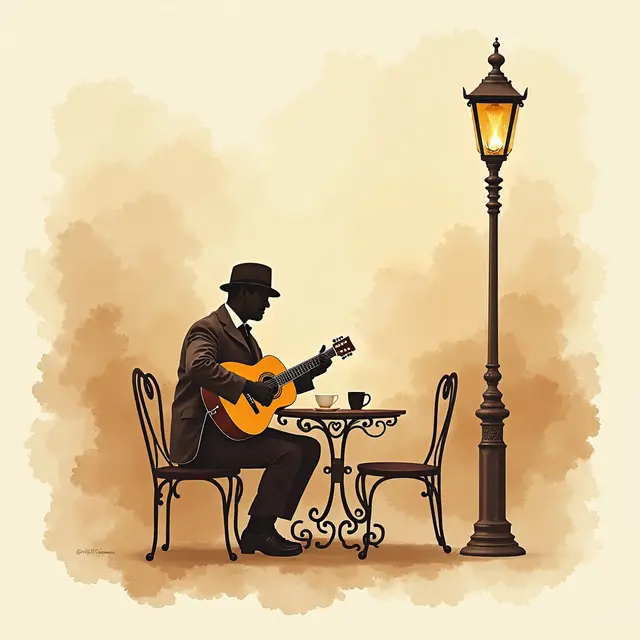
How it sounds
The air smells of bitter coffee, wet wool and dark tobacco burning slowly beneath the yellow glow of canvas awnings. It is three in the morning on a corner of the eighteenth arrondissement, where the cobblestones still hold the dampness of the afternoon rain. You sit on a rush-bottom chair with a sagging seat, your knee brushing the round white marble table that bears a dried circular ring of red wine on its edge. Two meters away, three men in long coats and loose scarves lean their torsos over wooden soundboards.
The oval-hole acoustic guitar drives the pompe with a dry wrist strike, a steady and muffled gallop that never rests, a metronome of wood and gut pushing the floor upward. And suddenly, right over that rhythmic chase, the lead guitar breaks into a solo climbing the fretboard at absurd speed, shredding notes with criminal cleanliness before the violin cuts through the air like breaking glass. No one claps because no one takes a deep breath; the music grazes your ears with the precision of a knife thrown in the dark.
Tuning pegs creak under the tension of silver strings. Someone at the counter finishes the last drop from a low glass while the melody vanishes into a sharp curve, leaving silence pulsing against the walls.
Palette: sepia / gold / burgundy
- BPM
- 180 BPM
- Family
- Smoke and Midnight
- Serial
- HUM-15
- Rarity
- Rare
- Style strength
- 94
- Experimentation
- 30
Typical structure
[Intro] → [Theme] → [Solo] fast guitar → [Solo] violin → [Final Theme]
The data above forms merely the visible frame of the score. What remains hidden is how to resolve the vertigo of the gallop without falling into rhythmic chaos, or how to fit lengthy guitar phrases into the meter without losing bohemian elegance. That mastery of a pace at one hundred eighty beats per minute lives inside an unpublished internal distillate of eight parameters that the motor crosses with your story before drafting every single line. Once finished, an internal judge measures the result against six canonical dimensions and orders a rewrite of anything sounding clumsy. The fast tempo can be copied. The millimeter precision, not.
How a lyric in this style thinks
A gypsy jazz lyric does not pause to reflect — it moves the way the music moves, which is fast, decisive, and without apology. The genre operates on forward momentum, and every line you write has to earn its place by contributing to that velocity. Where most song forms allow a verse to slow down and breathe, gypsy jazz treats hesitation as a structural flaw. The lyric's job is to capture a particular kind of pride: the pride of someone who chose difficulty over safety and came out sharper for it. That emotional core — dexterity, calculated risk, the refusal to lower one's head — has to be present in the syntax itself, not just the subject matter.
The base tone is sepia-lit and self-possessed. Emotion in gypsy jazz arrives through precision, not confession. You do not write about feeling alive; you write about the specific weight of a glass at three in the morning, the dry crack of a wrist striking gut strings, the way a corner table in an unmapped bar becomes the only geography that matters. Concrete, sensory, and slightly cinematic. The genre lives in cobblestones, canvas awnings, bitter coffee, dark wool, and the amber glow of a low-hanging lamp. It does not live in domestic interiors, open fields, or anywhere stillness has authority. If a line could appear in a slow ballad, cut it.
Line length in gypsy jazz lyrics tends to be clipped and rhythmically propulsive — short enough to land on a beat without trailing into the next measure. The pompe rhythm underneath is a muffled, galloping wrist-strike on the off-beats, a relentless wooden pulse, and your syllable counts need to respect that drive. Repetition works here, but not the kind that confesses vulnerability; repetition in this genre is more like a musician returning to the head of a theme after a long solo, confident and inevitable.
The hook should feel like something already known, not something newly admitted. Rhyme can be tight or slant, but loose approximations that soften the line's edge will undercut the genre's essential precision.
Structurally, gypsy jazz follows a logic borrowed directly from its instrumental architecture: a theme stated, then handed off to the solo instruments, then reclaimed at the end. In lyric terms, this means your opening section plants the world and the character's position in it with authority. What follows — whether a bridge or a second thematic pass — should feel like the equivalent of a virtuoso run up the fretboard: elevated, slightly dangerous, moving faster than the listener expects. The return to the final theme is not a recap for the sake of comfort; it is a landing after a long, clean arc, the melody snapping back into place with the confidence of something that was never in doubt.
What separates a genuine gypsy jazz lyric from a generic imitation is the refusal of self-pity and the absence of explanation. The character in this genre does not tell you why they left the drab job or why they risk everything — they simply arrive, already in motion, already dressed well, already three moves ahead. The violin cuts through the air like breaking glass, and nobody in the room flinches because everyone there chose to be in a place where that kind of precision is the norm. Write from inside that world, not from outside looking in with admiration. Admiration is the listener's job. The lyric's job is to be the knife, not to describe the throw.
- LA POMPE
- BOHEMIAN ELEGANCE
- INSTRUMENTAL
Sample excerpt
Copper coins on the zinc bar top My coat smells of rain and stale tobacco The clock strikes three, the shutters drop I trade my shadow for a deck of cards Nobody asks where I spent the morning Only how I move through the closing door.
Tighten the strings until the wood hums gold Running from the dawn on a razor blade edge Never looking back at the debts I hold.
Workshop note — Gypsy jazz relies on syncopated, rhythmic phrasing that mimics the 'la pompe' guitar strum, keeping lines punchy and immediate. The lyrics avoid introspection, focusing instead on physical actions and the momentum of the night, mirroring the high-speed dexterity of the music. Avoid long, flowing sentences; the narrative must gallop to match the 180 BPM tempo.
Sample excerpt written by MUSAI Song. Your lyrics are written from scratch, based on your story.
When to choose this style
Choose this card when your story speaks of an elegance that asks for no permission, of a talent imposed through pure velocity, and of nights where survival dresses up as a bohemian celebration. It works to tell the forward rush of someone who left a drab job behind to risk everything in another city; for a friend who lives on the edge but always wears a well-pressed shirt; for a clandestine reunion in a bar that appears on no maps; or to celebrate a fast, razor-sharp victory that left everyone else speechless. It fits best if your core is dexterity, calculated risk, and the pride of someone who never lowers their head.
Do not choose it if you seek an intimate, confession-heavy or low-intensity tone; gypsy jazz never stops to explain its motives nor tolerates self-pity. Neither does it work for lullabies, prolonged grief, or domestic spaces where stillness matters most. If you want a late-night club atmosphere but with a slower, denser tempo, the card is Jazz Nocturno.
Your story in this style
MUSAI Song writes original lyrics from your story, in the Gypsy Jazz style, and delivers the finished sung song, the ready-to-use style recipe, and an illustrated art plate with its numbered certificate, private by default; public only if its owner publishes it.
- Original lyrics written from your story
- A finished sung song, ready to play and share
- Art plate with a unique seal and a numbered certificate, private by default; public only if its owner publishes it
Frequently asked questions
What BPM is Gypsy Jazz?
Gypsy Jazz usually runs at 180 BPM.
What does Gypsy Jazz sound like?
An acoustic guitar galloping the pompe rhythm and a virtuoso solo that soars. Gypsy jazz is the bohemian elegance of Parisian cafés: fast, joyful, and dazzling.
What song structure does Gypsy Jazz use?
[Intro] → [Theme] → [Solo] fast guitar → [Solo] violin → [Final Theme]
How do I write Gypsy Jazz lyrics?
Tell MUSAI Song your story and pick Gypsy Jazz: it writes original lyrics for this style at 180 BPM, you edit them word by word, and you get the song sung in Gypsy Jazz, with an illustration of the song and its numbered certificate. $19 USD per song, one-time payment.
Explore more styles
- Acid Jazz
- Afro-Cuban Jazz
- Bebop
- Big Band
- Boogie-Woogie
- Bossa Nova
- Cabaret
- Chicago Blues
- Classic Blues
- Cool Jazz (West Coast)
- Delta Blues
- Exotica Lounge
- Hard Bop
- Jazz Funk
- Jazz Fusion
- Jump Blues
- Late-Night Jazz
- Latin Jazz
- Lounge
- Modal Jazz
- New Orleans Jazz
- Nu-Jazz
- Organ Trio
- Piano Jazz Trio
Your idea or story, sung in this style
Card · secure payment via Stripe, charged in USD
If it doesn't move you, we give you your money back · 7 days