Classic Blues
The neon flickers because it's hurting too.
Get your song in Classic Blues
Make yours in this styleHear it before you pay.$19 USD · your first song for $5.50 USDIf it doesn't move you, we give you your money back · 7 days.
Classic Blues is a style from the Smoke and Midnight family. 75 BPM, Experimentation 26, Style strength 95.
What is Classic Blues?
A guitar that cries through twelve bars and a voice weathered by life. Classic blues: pain turned into beauty, the root of an entire century of popular music.
How it sounds
It is half past three in a roadside tavern where the wide oak floorboards groan beneath every shift of weight and the smell of spilled liquor and old floor wax clings straight to your jacket. Outside, a steady sheet of rain beats down on the dirt track, blurring tire tracks no one is coming back to check. In the corner, an amber glass shaded lamp casts a dim circle over a round table holding a low tumbler with two fingers of bourbon and melted ice.
Against the back wall, a vintage tube amplifier hums with a low, constant drone that fights the drip of a leak over the storage room. Someone down by the counter shakes dice inside a leather cup without ever rolling them out. The guitarist sits on a split vinyl stool, left hand gripping a neck worn smooth by friction, fingers pressing strings that cry out with a slow, heavy vibrato designed not to impress the room but to empty it.
Twelve bars starting with a sharp complaint and dropping into a walking bass line that pulls your blood straight down. The voice that follows does not yell; it clears its throat, dragging vowels as if lifting the tongue required actual physical effort, telling a tale about a letter arriving too late and a freight train passing through without slowing down. There is no rush here. Time is measured by how fast the ice turns to water in the glass and how the final note fades out on its own, leaving the room hollower than before.
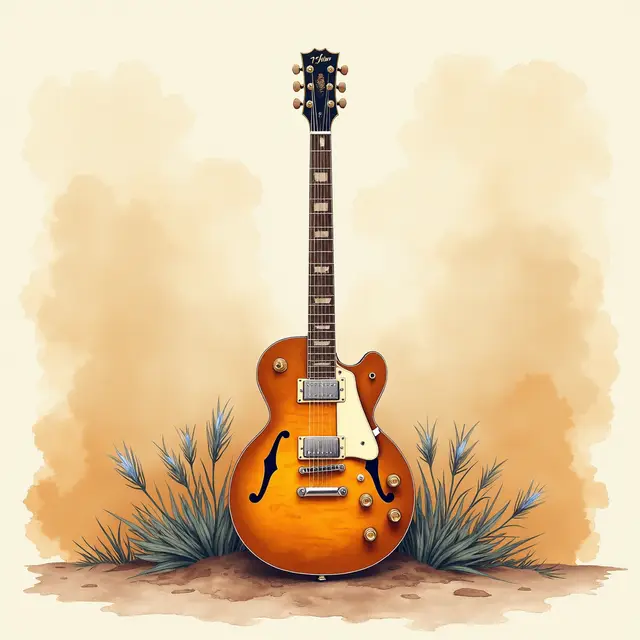
Palette: orange amber / grayish blue / dark brown
- BPM
- 75 BPM
- Family
- Smoke and Midnight
- Serial
- HUM-03
- Rarity
- Epic
- Style strength
- 95
- Experimentation
- 26
Typical structure
[Intro] guitar → [Verse 1] → [Verse 2] → [Solo] guitar → [Final verse]
The data above takes a minute to copy. What does not get copied is the judgment: how to stop pain from sounding like cheap whining and turn it into a physical fact, or where to place the precise silence between a syllable and the guitar's reply so it cuts deeper. All of that lives inside this card's unreleased internal distillate, eight parameters the engine crosses with your story before a single line is written. When it finishes, an internal judge measures the lyric against six canons and sends back anything that misses the mark. The twelve-bar form is played anywhere. The weight is not.
How a lyric in this style thinks
A Classic Blues lyric does not explain grief — it demonstrates it by refusing to move on. The lyric stays in the room with the hurt, turns it over slowly, and lets it breathe at its own pace. This is the foundational discipline of the form: the twelve-bar structure is not a cage but a recurring obligation, a debt the song pays every time through, and the lyric's job is to make that repetition feel inevitable rather than mechanical. Classic blues earns its authority by committing fully to a specific, unresolved wound — the kind that does not slam a door but simply goes quiet, leaving something small and ordinary behind to remind you daily.
The emotional tone lives in the amber and gray-blue range: not the white heat of rage, not the clean ache of nostalgia, but something closer to a low, steady pressure behind the sternum. Emotion in Classic Blues arrives through understatement. The voice does not announce the loss; it circles around a concrete image — a letter that came on the wrong day, a freight train that did not slow, a glass of bourbon melting into water — and lets the image carry the weight. Sensory precision is the craft here.
The genre lives in worn floorboards, the smell of floor wax and spilled liquor, the drone of a tube amplifier, the physical effort of lifting a vowel against gravity. It never reaches for abstraction, never tells you how to feel, never floats into metaphor so elevated it loses contact with the body.
Line length and rhythm behave in a specific way: the first line of a verse states the complaint, the second line repeats or slightly extends it, and the third resolves — not into comfort but into consequence. This AAB structure is the skeleton, and a lyric that abandons it loses the genre's central logic. The repetition is not laziness; it is how the blues insists.
Saying the same thing twice with minor variation is the form's way of demonstrating that the situation has not changed, that the speaker has looked at it from two angles and arrived at the same wall. The third line then lands with the flatness of a fact. Tempo sits around 75 BPM, which means the lyric has to be comfortable with silence — with the guitarist's slow vibrato filling space the words deliberately leave open.
Structurally, Classic Blues is spare by design: an instrumental intro that sets the mood before a single word is spoken, two verses that establish the story, a guitar solo that says what the voice cannot, and a final verse that offers no resolution but instead deepens the record of what happened. The solo is not decoration — it is a structural argument, a place where the instrument voices the emotion the singer has been too controlled to release. Your final verse should land heavier than your first, not because anything new has happened, but because the listener now understands the full weight of what was always there.
What separates a genuine Classic Blues lyric from an imitation is the absence of self-pity and the absence of closure. The singer is not asking for sympathy and is not building toward a lesson. The voice is weathered not because it has suffered more than anyone else, but because it has decided to be an honest witness to what suffering actually feels like at half past three in a roadside tavern with no one coming through the door. The guitar cries so the voice does not have to. The lyric's work is to hold still long enough for the truth to catch up with the room.
- CRYING GUITAR
- PAIN INTO BEAUTY
Sample excerpt
Left a coffee cup sitting in the kitchen sink Took me seven mornings just to fetch a sponge Your coat is gone from behind the door Left a cold draft chilling the floorboards
Old man clock keeps ticking down the heavy hours Nobody coming back to share these empty rooms
Workshop note — This excerpt grounds emotional weight in ordinary domestic objects like a dirty mug and an empty coat hook rather than abstract misery. The lines stay short and heavy, matching the slow seventy-five beats per minute tempo without rushing toward any tidy resolution.
Sample excerpt written by MUSAI Song. Your lyrics are written from scratch, based on your story.
When to choose this style
Choose this card when the story deals with a blow you did not shake off quickly, but instead sat down to wait out. It works when love left without a slam of the door, merely abandoning a dirty coffee mug in the sink that took you a full week to wash. For the day you locked the shop for the very last time and stood staring at the keys in your empty palm. For telling of a debt that money cannot settle or a mistake that served its sentence but still lives in the same house.
Classic blues is the card of resignation with a long memory: use it when you seek no comfort or revenge, but simply a record that it hurt. Do not choose it for a quick victory, a cheerful birthday, or an afternoon temper that vanishes after a nap. It fails for sweet reconciliations or stories where the fix arrived on time. If you seek a tidy ending with a moral and applause, the card is Jazz Nocturno.
Your story in this style
MUSAI Song writes original lyrics from your story, in the Classic Blues style, and delivers the finished sung song, the ready-to-use style recipe, and an illustrated art plate with its numbered certificate, private by default; public only if its owner publishes it.
- Original lyrics written from your story
- A finished sung song, ready to play and share
- Art plate with a unique seal and a numbered certificate, private by default; public only if its owner publishes it
Frequently asked questions
What BPM is Classic Blues?
Classic Blues usually runs at 75 BPM.
What does Classic Blues sound like?
A guitar that cries through twelve bars and a voice weathered by life. Classic blues: pain turned into beauty, the root of an entire century of popular music.
What song structure does Classic Blues use?
[Intro] guitar → [Verse 1] → [Verse 2] → [Solo] guitar → [Final verse]
How do I write Classic Blues lyrics?
Tell MUSAI Song your story and pick Classic Blues: it writes original lyrics for this style at 75 BPM, you edit them word by word, and you get the song sung in Classic Blues, with an illustration of the song and its numbered certificate. $19 USD per song, one-time payment.
Explore more styles
- Acid Jazz
- Afro-Cuban Jazz
- Bebop
- Big Band
- Boogie-Woogie
- Bossa Nova
- Cabaret
- Chicago Blues
- Cool Jazz (West Coast)
- Delta Blues
- Exotica Lounge
- Gypsy Jazz
- Hard Bop
- Jazz Funk
- Jazz Fusion
- Jump Blues
- Late-Night Jazz
- Latin Jazz
- Lounge
- Modal Jazz
- New Orleans Jazz
- Nu-Jazz
- Organ Trio
- Piano Jazz Trio
Your idea or story, sung in this style
Card · secure payment via Stripe, charged in USD
If it doesn't move you, we give you your money back · 7 days