Jump Blues
The saxophone decided that pain can move your feet just as well.
Get your song in Jump Blues
Make yours in this styleHear it before you pay.$19 USD · your first song for $5.50 USDIf it doesn't move you, we give you your money back · 7 days.
Jump Blues is a style from the Smoke and Midnight family. 165 BPM, Experimentation 26, Style strength 92.
What is Jump Blues?
Jumping horns and boogie piano with a voice that shouts for joy. Jump blues: the blues that got up and danced, party-ready, full of energy, and the direct ancestor of rock and roll.
How it sounds
It is eleven past the hour in a low-ceilinged joint where the wooden walls soak up tobacco smoke and condensation drips straight onto the pine floorboards. You are wedged hard against the bar, waiting for a low-ball glass of whiskey that takes forever because the bartender is drowning in tickets. The piano in the corner hammers out an unrelenting boogie-woogie with its left hand, a steady bass thump that rattles your stool and vibrates straight through the soles of your shoes.
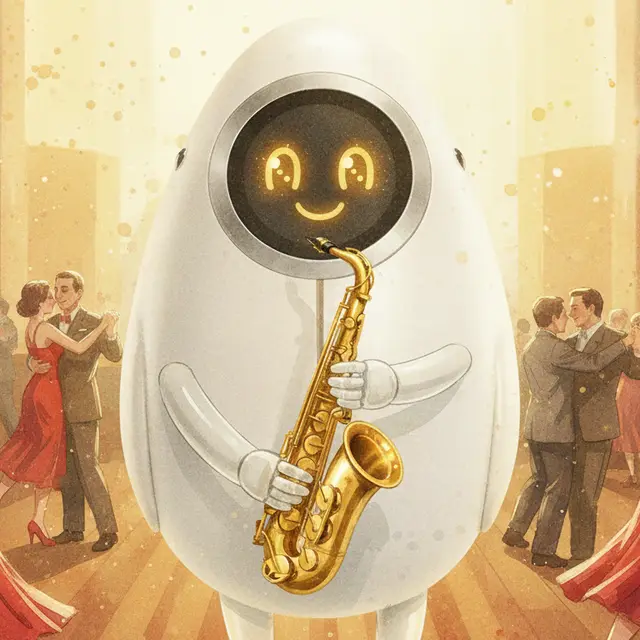
Two paces away, the horn section hits as one: the trumpet barks a high note that slices the air and the tenor sax fires back with a hot, raspy wail so fierce it sounds ready to split the reed. There is no room to stand still; swinging skirts blur into fast circles and the talcum powder scattered across the floorboards to grease the dancers' slides kicks up in a white haze beneath the golden glow of the chandeliers.
You yank off your necktie and tuck it into your pocket, sweat is already soaking the back of your neck and cheap perfume mixes with alcohol and the body heat of fifty people moving as one machine. The frontman is not singing: he is shouting pure, unfiltered joy, cutting through the din with a clean holler that cues the next turnaround. The entire floor seems to drop half an inch with every downbeat and the music shoves you forward, right into the center of the riot.
Palette: bright gold / dresses red / warm cream
- BPM
- 165 BPM
- Family
- Smoke and Midnight
- Serial
- HUM-19
- Rarity
- Common
- Style strength
- 92
- Experimentation
- 26
Typical structure
[Intro] → [Verse] → [Chorus] → [Sax Solo] → [Final verse]
The details above can be copied in a minute. What cannot be copied is the craft: how to keep the chorus from sounding like an ad slogan when the band leans into the gas, or exactly where to place the lyric syncopation so the words leap alongside the boogie piano without tripping over themselves. That lives inside an unpublishable distillate of eight parameters, and the engine crosses it with your story before writing a single line. When it finishes, an internal judge measures the output against six canons and sends back anything that lacks enough kick. The beat can be copied. The unbridled rush, no.
How a lyric in this style thinks
A jump blues lyric does one thing above all others: it commands the body. Not the mind, not the memory — the body. The words exist to drive dancers forward, to cue the next move, to give the shout something to land on. Jump blues earned its name honestly; the lyric is built to make the room jump, and every structural choice bends toward that single physical fact. The emotion arrives not through confession or reflection but through volume, repetition, and the controlled release of pure forward momentum. Joy in this genre is not tender. It is loud, broad, and completely uninterested in nuance.
The base tone is bright and combative in the best sense — the lyric stakes a claim and dares you to sit still. Lines are short, declarative, and punched out in the rhythmic pocket of the boogie-woogie piano's left hand. You feel the walking bass in the syllable count. A typical verse runs three or four bars of statement followed by a repetition that hammers the same phrase with slight variation, then a turnaround line that snaps everything closed and sets up the next eight bars.
That AAB blues architecture is alive here, but jump blues pulls it faster and looser than its slower cousins — the repetition is not mournful, it is insistent. The repeated line is a shout to the floor, not a lament to the ceiling.
The sensory field of jump blues is specific and non-negotiable. Concrete objects belong here: a low-ball glass, a rented hall, a pair of shoes that can't stop moving, a car with just enough gas, a front door slamming behind you on the way out. The vocabulary is physical and immediate — bodies, heat, noise, speed. What this genre refuses is abstraction, interiority, and anything that asks the listener to slow down and consider. There is no dark corner in a jump blues lyric. No quiet midnight. No metaphor that requires two readings to unpack.
If an image can't land in the half-second between horn blasts, cut it. The chandeliers are gold, the floorboards vibrate, the room smells like whiskey and talcum powder and fifty people moving as one machine — that is the register. Stay in it.
Structurally, jump blues keeps its architecture tight because the dancefloor demands signposts. The intro drops the tempo and the horn voicing immediately, so the body knows what contract it has signed before the first word arrives. The verse makes the claim — something happened, something is happening, something is about to happen — and the chorus is less a melodic peak than a release valve, the moment when the whole room answers the frontman's holler.
Then the sax solo does what no lyric can: it says the part that is beyond words, the pure animal joy of a tenor reed pushed to its limit. When the final verse lands, it is not a recap — it is a confirmation. The party was real. The feeling was real. Now do it again.
What separates a real jump blues lyric from a generic imitation is that the imitation tries to be clever. Jump blues does not want clever. It wants conviction delivered at 165 beats per minute with a voice that sounds like it is shouting across a packed room because it is. The vocal delivery is a clean holler — no ornament, no whisper, no falsetto drift. Every word has to cut through brass and piano and the noise of fifty people who are already dancing.
This means your lyric has to earn its place phonetically: open vowels, hard consonants, syllables that land on the downbeat like a fist on a bar top. If you are writing jump blues and your lines feel like poetry to be read quietly, you have left the genre. Go back to the floor, feel the bass through your shoes, and write the line that makes the room drop half an inch.
- JUMPING HORNS
- BLUES THAT DANCES
Sample excerpt
Got a suit made of amber and a pair of polished shoes, I paid my rent in copper, now I’m shaking off the blues. Clock struck five, the office door is swinging open wide, I’m hitting every sidewalk with a heavy, rhythmic stride.
I’m jumping on the corner, I’m dancing through the heat, I got a golden rhythm pounding underneath my feet. Everything is wide open, we’re tearing up the floor, I’m shouting out my joy until the neighbors yell for more!
Workshop note — This genre relies on a relentless, driving cadence where short, punchy lines mimic the syncopated brass stabs. The chorus functions as a call-to-action that demands immediate physical participation rather than reflection. Avoid complex metaphors or slow-paced imagery; every word must move at the speed of the drum kit to keep the energy levels at a constant peak.
Sample excerpt written by MUSAI Song. Your lyrics are written from scratch, based on your story.
When to choose this style
Pick this card when your happiness is so loud it overflows and demands your whole body join in to celebrate. It works for the day a close friend finally claws their way out of a bad stretch and you need to tear the roof off the joint. For an anniversary where quiet dinners are banned in favor of a raucous party that wakes the neighbors. For the morning you quit a miserable job and hit the sidewalk jumping curbs. For telling your grandchildren what your youth looked like when you had an old car and enough gas to cross the state line dancing.
Do not pick this for an intimate reconciliation or a melancholic farewell: jump blues does not know how to whisper or look back with longing. It fails for solemn birthdays or low-key family gratitude; if your historia asks for stillness, a dark corner, or a quiet midnight confession, this packed-dancefloor music will feel as out of place as a car horn inside a church. If you are looking for late-night conversation among close friends, the card is Jazz Nocturno.
Your story in this style
MUSAI Song writes original lyrics from your story, in the Jump Blues style, and delivers the finished sung song, the ready-to-use style recipe, and an illustrated art plate with its numbered certificate, private by default; public only if its owner publishes it.
- Original lyrics written from your story
- A finished sung song, ready to play and share
- Art plate with a unique seal and a numbered certificate, private by default; public only if its owner publishes it
Frequently asked questions
What BPM is Jump Blues?
Jump Blues usually runs at 165 BPM.
What does Jump Blues sound like?
Jumping horns and boogie piano with a voice that shouts for joy. Jump blues: the blues that got up and danced, party-ready, full of energy, and the direct ancestor of rock and roll.
What song structure does Jump Blues use?
[Intro] → [Verse] → [Chorus] → [Sax Solo] → [Final verse]
How do I write Jump Blues lyrics?
Tell MUSAI Song your story and pick Jump Blues: it writes original lyrics for this style at 165 BPM, you edit them word by word, and you get the song sung in Jump Blues, with an illustration of the song and its numbered certificate. $19 USD per song, one-time payment.
Explore more styles
- Acid Jazz
- Afro-Cuban Jazz
- Bebop
- Big Band
- Boogie-Woogie
- Bossa Nova
- Cabaret
- Chicago Blues
- Classic Blues
- Cool Jazz (West Coast)
- Delta Blues
- Exotica Lounge
- Gypsy Jazz
- Hard Bop
- Jazz Funk
- Jazz Fusion
- Late-Night Jazz
- Latin Jazz
- Lounge
- Modal Jazz
- New Orleans Jazz
- Nu-Jazz
- Organ Trio
- Piano Jazz Trio
Your idea or story, sung in this style
Card · secure payment via Stripe, charged in USD
If it doesn't move you, we give you your money back · 7 days