Soul Jazz
The organ warms the soul before the drink has time to cool.
Get your song in Soul Jazz
Make yours in this styleHear it before you pay.$19 USD · your first song for $5.50 USDIf it doesn't move you, we give you your money back · 7 days.
Soul Jazz is a style from the Smoke and Midnight family. 100 BPM, Experimentation 26, Style strength 93.
What is Soul Jazz?
A greasy Hammond organ and horns with a gospel edge. Soul jazz: jazz that went to church and came back with groove, warm, earthy, and irresistibly tasty.
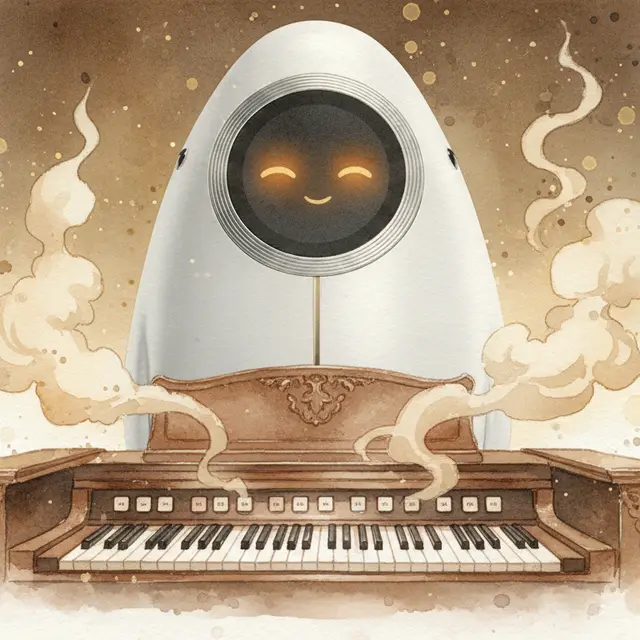
How it sounds
It is three in the morning in a low-ceilinged club where the walls are soaked in history and stale tobacco. The air hangs heavy, hot, thick with the scent of spilled bourbon and wood polished smooth by thousands of elbows. Straddling a worn stool, the organist leans hard over the keys of the Hammond B-3; the casing vibrates against his ribs before the sound even hits the Leslie speakers. The rotor spins inside its wooden cabinet, churning the air with a greasy tremolo that crawls under your skin and settles right at the base of your neck.
There is no room for hesitation here: the drums lay down a heavy, earthly shuffle that forces your right foot to hammer the oak floor with an urgency you never cleared with your brain. Suddenly the horns cut through, a blinding flash of trumpet and tenor sax slicing the smoke like a hot knife through butter. It carries the raw urgency of a Sunday morning sermon, filtered through midnight sweat and the stubborn will to stay alive in a dark corner where nobody asks for forgiveness.
The saxophonist closes his eyes, takes a step forward, and lets the highest note crack for a split second—just long enough for you to feel the flesh behind the brass. Your shoulders drop, your wet glass rests in your hand, and you let the groove shake you until every stray thought falls away.
Palette: gold cream brown warm amber
- BPM
- 100 BPM
- Family
- Smoke and Midnight
- Serial
- HUM-06
- Rarity
- Rare
- Style strength
- 93
- Experimentation
- 26
Typical structure
[Intro] organ → [Head] → [Solo] organ → [Solo] guitar → [Final head]
The details above are just the varnish visible from across the bar. What stays hidden is how to keep the groove from sounding like generic hotel-lounge pastiche, or how to make the horns push hard without tipping into empty shouting. That lives in an unreleased internal distillate of eight parameters that the engine cross-references with the raw facts of your history. Afterward, an internal judge measures the lyrics against six canons and forces a rewrite on anything that doesn't smell like living flesh. The organ is for rent. The groove is not.
How a lyric in this style thinks
A soul jazz lyric does not confess — it testifies. Where a ballad might fold inward and ask for sympathy, soul jazz stands up, plants both feet, and declares something that has already been earned. The emotion arrives not as vulnerability but as proof: proof of survival, of loyalty that outlasted the hard years, of a friendship that never needed the right words because the right words were never the point. This is the genre for the moment after the struggle, not the struggle itself — the moment when you look across a sticky bar table at someone who knew you when you had nothing, and the only thing left to say is that you are both still here, and that is enough to make the whole room shake.
The sensory world of soul jazz is specific and unapologetic. Lyrics belong to low-ceilinged rooms, bourbon rings on wooden tables, the particular heat of a crowd that has stopped caring about looking composed. The Hammond B-3 is not a background detail — it is the emotional architecture, its rotary tremolo doing the work that a string section would do in another genre, pressing warmth into every corner of the mix.
When you write for this sound, you reach for objects that have weight and temperature: a glass that sweats in your hand, a floor that vibrates under your shoes, a handshake that turns into something closer to a collision. You do not reach for the sky, the stars, or any geography above eye level. Soul jazz lives at chest height and below.
Rhythmically, the lyric has to earn its place inside the groove. The shuffle feel at roughly a hundred beats per minute gives lines a natural swagger — phrases that land on the two and four carry more weight than anything that tries to rush the one. Line length tends to be loose, almost conversational, with room to breathe between phrases the way a tenor saxophone leaves space between runs. Repetition is not a weakness here; it is the mechanism.
A hook that says the same thing three times, slightly differently each time, mirrors what the horns are doing: restating the theme until the room has no choice but to feel it. The verse earns the chorus by accumulating detail; the chorus pays it off with a single, physical declaration.
Structurally, soul jazz follows a logic closer to a jazz head arrangement than a conventional pop song. The intro is almost always instrumental — the organ establishes the groove before any word is spoken, which means your first lyric lands into a room that is already warm. The head states the central idea plainly. Solo sections are not breaks in the narrative; they are the narrative continuing without words, which means the lyric you write on either side of a solo needs to be strong enough to survive the comparison.
The final head returns to the opening statement, but the listener has been somewhere in the meantime, so the same words carry more weight the second time around. Write accordingly.
What separates a real soul jazz lyric from a generic imitation is the refusal of sentimentality without the refusal of feeling. A lyric that gets maudlin, that lingers too long on the pain before the celebration, loses the plot entirely — soul jazz has no patience for self-pity dressed up as depth. The emotion has to be warm and broad, the kind that makes a stranger at the next table nod without knowing the story.
Gospel influence shows up not in religious language but in the call-and-response logic of phrasing, in the sense that the room is always answering back even when no one is singing. If you find yourself writing something quiet, something that asks for silence to be understood, you are in the wrong genre. Soul jazz asks you to be loud enough that the Leslie speaker can justify its own existence.
- GREASY ORGAN
- JAZZ WITH GROOVE
- INSTRUMENTAL
Sample excerpt
Sunday morning grease on a greasy spoon plate Coffee grounds settle in the bottom of the grate You walked through that screen door without a knock Dropped a silver quarter on the counter clock We don't need a sermon about where we went wrong Just let the organ preacher roll that rhythm along
Pour another glass of that amber lane Wash away the rust and the highway rain We are still standing when the horns blow wide Nothing left to hide
Workshop note — This verse relies on physical, kitchen-floor details to establish intimacy without sentimentality. The chorus acts as a toast, keeping lines short and percussive so they lock into the organ's heavy swing.
Sample excerpt written by MUSAI Song. Your lyrics are written from scratch, based on your story.
When to choose this style
Choose this card when you need to tell the story of a reconciliation that didn't ask for formal apologies, just a sweaty hug and a shared drink. It works to celebrate a lifelong friend with whom you have walked through fire, leaving only room to laugh over cheap beer. Use it when an old project finally takes off after years of pushing against a brick wall, or to thank someone who handed you your pulse back when you were half-dead inside.
It is built for milestone birthdays where there is no space for quiet nostalgia, only the loud pride of still being here, dancing badly. Do not pick this if you need a shattered ballad for crying alone, or for a whispered confession at three in the morning driven by the fear of rejection; soul jazz has no patience for shyness or silent grief. It fails completely when trying to chronicle quiet mourning or a fresh loss that still hurts to breathe through. If you want a nocturnal mood but colder and more distant, the card is Jazz Nocturno.
Your story in this style
MUSAI Song writes original lyrics from your story, in the Soul Jazz style, and delivers the finished sung song, the ready-to-use style recipe, and an illustrated art plate with its numbered certificate, private by default; public only if its owner publishes it.
- Original lyrics written from your story
- A finished sung song, ready to play and share
- Art plate with a unique seal and a numbered certificate, private by default; public only if its owner publishes it
Frequently asked questions
What BPM is Soul Jazz?
Soul Jazz usually runs at 100 BPM.
What does Soul Jazz sound like?
A greasy Hammond organ and horns with a gospel edge. Soul jazz: jazz that went to church and came back with groove, warm, earthy, and irresistibly tasty.
What song structure does Soul Jazz use?
[Intro] organ → [Head] → [Solo] organ → [Solo] guitar → [Final head]
How do I write Soul Jazz lyrics?
Tell MUSAI Song your story and pick Soul Jazz: it writes original lyrics for this style at 100 BPM, you edit them word by word, and you get the song sung in Soul Jazz, with an illustration of the song and its numbered certificate. $19 USD per song, one-time payment.
Explore more styles
- Acid Jazz
- Afro-Cuban Jazz
- Bebop
- Big Band
- Boogie-Woogie
- Bossa Nova
- Cabaret
- Chicago Blues
- Classic Blues
- Cool Jazz (West Coast)
- Delta Blues
- Exotica Lounge
- Gypsy Jazz
- Hard Bop
- Jazz Funk
- Jazz Fusion
- Jump Blues
- Late-Night Jazz
- Latin Jazz
- Lounge
- Modal Jazz
- New Orleans Jazz
- Nu-Jazz
- Organ Trio
Your idea or story, sung in this style
Card · secure payment via Stripe, charged in USD
If it doesn't move you, we give you your money back · 7 days