Rockabilly
The pompadour takes longer to style than the song does to play.
Get your song in Rockabilly
Make yours in this styleHear it before you pay.$19 USD · your first song for $5.50 USDIf it doesn't move you, we give you your money back · 7 days.
Rockabilly is a style from the Electric Roads family. 160 BPM, Experimentation 24, Style strength 93.
What is Rockabilly?
A slapping upright bass, a twangy guitar, and a playful voice. Rockabilly: the rebellious root of rock and roll, retro, rowdy, and greased-up.
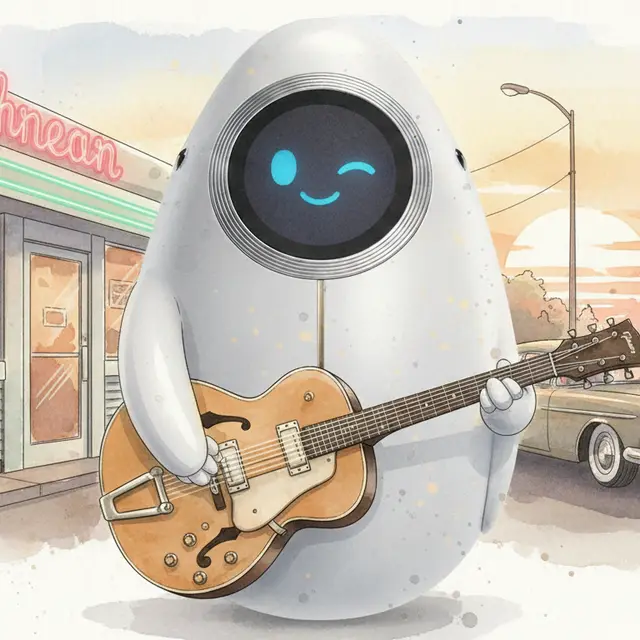
How it sounds
It is three in the afternoon at a dusty highway crossroads where the asphalt bakes thick enough to warp the yellow center line. The bullet-shaped chrome bumpers catch a heavy, blinding sun. You are leaning against the door of a tail-finned heap, smelling high-test gasoline and hot oil dripping onto dry earth. Inside the porcelain-tiled diner, a Wurlitzer jukebox growls with tubes burning red hot.
The first notes drop, and the upright bass does not just keep time: it is a giant slab of wood taking an open-palm slap, a dry thud that travels straight through your boot soles and rattles your back teeth. The hollow-body guitar cuts in sharp, twisting strings with a metallic twang that slices the air like a straight razor. You run a hand through your greased pompadour, snapping the collar of a leather jacket that creaks every time your shoulders roll.
There is no room for hesitation when the vocal starts to hitch on purpose, stuttering between lines like it is swallowing air by force, laughing right in the face of gravity and the guy staring from across the street. The tempo is a freight train off the rails in the best possible way, forcing your feet to move before your brain can issue the command.
Palette: warm orange / turquoise / neon pink / gold cream
- BPM
- 160 BPM
- Family
- Electric Roads
- Serial
- ELC-21
- Rarity
- Rare
- Style strength
- 93
- Experimentation
- 24
Typical structure
[Intro] → [Verse] → [Chorus] → [Guitar Solo] → [Verse 2] → [Final Chorus]
The details above are just fresh paint on a fender. Behind them lie two invisible traps: how to make lyrics race without tripping over the slap bass consonants, and where to drop the retro trope so it feels like a natural extension of bone rather than a costume shop outfit. That lives in an internal distillate crossing vocal tics with your exact anecdote. At the end, an internal judge measures the lines against six canons and sends back anything that reads flat. The beat is easy to copy. The momentum, not.
How a lyric in this style thinks
A rockabilly lyric does one thing above everything else: it moves. Not emotionally, not metaphorically — physically. The words are designed to make a body shift weight before the conscious mind catches up, and every craft decision bends toward that physical urgency. The genre lives at the intersection where country storytelling meets the electric jolt of early rock and roll, and a lyric that doesn't understand that double inheritance will always sound like a costume rather than a skin. Rockabilly is not a mood piece. It is a machine built for acceleration, and the lyrics are the fuel.
The emotional register here runs hot and narrow: cockiness, reckless joy, the specific grin you wear when you know you shouldn't be winning but you are. Sentiment arrives through action, never through confession. A character in a rockabilly song doesn't say he feels alive — he pops the clutch, spins the tires, and the listener feels it in the chest. The tone is warm and blunt, like afternoon sun off chrome. There is no room for ambiguity or irony layered under irony. The danger in the lyric is always real and always a little funny, the way a near-miss at a crossroads is terrifying for three seconds and then becomes a story you tell laughing for the rest of your life.
Line length in rockabilly tends short and punchy, built around strong stressed syllables that lock onto the slapped upright bass and the shuffle of the snare. The hiccup in the vocal — that deliberate stutter or catch between phrases — is not an ornament, it is structural: it creates a micro-suspension that the next beat resolves, and your lyric has to leave space for it. If you write lines that are too smooth, too grammatically complete, the singer has nowhere to breathe and nowhere to grin.
Repetition functions as momentum rather than emphasis; a chorus hook in this genre repeats because it sounds better every time, not because it is probing deeper meaning. The rhyme scheme tends to be direct and unapologetic — AABB or simple ABAB — because the energy comes from forward drive, not from the surprise of a slant rhyme landing sideways.
The sensory world of rockabilly is sharply specific: hot asphalt, high-test gasoline, the creak of a leather jacket, grease on a comb, a jukebox warming up its tubes, a diner counter, a tail-finned car with chrome catching hard light. These objects are not decorative. They are load-bearing. The hollow-body guitar's metallic twang and the dry thud of the slapped bass define a sonic texture that the lyric should echo in its own language — hard consonants, short vowels, words that stop fast rather than trail off.
What this genre never uses: soft textures, indoor light, abstract emotional states, weather as metaphor for grief. Rain in a rockabilly song is just rain, and it probably means the road is more fun to drive on.
Structurally, the form is lean and purposeful. An intro drops you into the groove before any story begins — the bass and guitar establish the physical contract with the listener. The verses carry the narrative, usually a scene or a boast told in tight couplets, and they move fast enough that you can't linger. The chorus is the payoff, the line everyone will shout, and in rockabilly it tends to arrive early because patience is not a virtue this genre respects.
The guitar solo is not optional decoration — it is a full emotional statement delivered in the language of the hollow-body, and after it the second verse has to earn its place by raising the stakes slightly or adding a new detail that recontextualizes the first. The final chorus hits harder because of everything that came before it, and it ends without apology or resolution. The song doesn't conclude — it peels out.
What separates a real rockabilly lyric from a generic imitation is specificity of attitude rather than specificity of detail. Any writer can drop in a reference to a jukebox or a two-lane highway, but the voice has to carry a quality that's harder to fake: the absolute certainty that this moment, right now, is the best thing that has ever happened, and the slight suspicion that tomorrow it might all go sideways, and the complete indifference to that suspicion.
That combination — full-throttle confidence edged with just enough recklessness to feel dangerous — is what the slapping bass and the twangy guitar are already doing instrumentally. The lyric's job is to be the human voice of the same feeling.
- SLAPPING UPRIGHT BASS
- RETRO ROCK AND ROLL
Sample excerpt
Got a ’59 Chevy with a busted tail Brought it on down from the county jail Keys in the ignition and a tank full of gas Leaving old trouble in a cloud of thick ash Greased-up hair and a pack in my sleeve Got a one-way ticket and a town to leave
Well, shake it down, baby, let the tires spin We are riding fast where the rough roads begin Slapping that bass while the motor screams loud We are kicking up dust just to shock the crowd
Workshop note — This sample keeps lines fast, rhyming hard to match the slapping upright bass and relentless tempo. It uses concrete motor city imagery—busted tails, keys, and gas tanks—while strictly avoiding any gray nostalgia or quiet sorrow. The chorus deploys high-energy commands that demand an aggressive, smiling vocal delivery.
Sample excerpt written by MUSAI Song. Your lyrics are written from scratch, based on your story.
When to choose this style
Choose this card when your story demands speed and a grin pointed straight at danger. It works when you won an argument against all odds and walked away with your boots hitting hard. For the day you bought that loud, clunker of a car and refused to care what anyone thought. To celebrate a hard-fought win carried off with pure swagger. To recount a roadside diner scuffle that ended in broken laughter and torn sleeves. Rockabilly has no room for quiet sorrow, whispered confessions, or gray nostalgia.
It is the wrong vehicle for asking forgiveness, unpacking baggage, or nursing a loss. If the story calls for tears, distance, or careful reflection, this option will fail because this engine only knows how to burn rubber. If you seek an intimate, vulnerable confession, the card is Bedroom Indie.
Your story in this style
MUSAI Song writes original lyrics from your story, in the Rockabilly style, and delivers the finished sung song, the ready-to-use style recipe, and an illustrated art plate with its numbered certificate, private by default; public only if its owner publishes it.
- Original lyrics written from your story
- A finished sung song, ready to play and share
- Art plate with a unique seal and a numbered certificate, private by default; public only if its owner publishes it
Frequently asked questions
What BPM is Rockabilly?
Rockabilly usually runs at 160 BPM.
What does Rockabilly sound like?
A slapping upright bass, a twangy guitar, and a playful voice. Rockabilly: the rebellious root of rock and roll, retro, rowdy, and greased-up.
What song structure does Rockabilly use?
[Intro] → [Verse] → [Chorus] → [Guitar Solo] → [Verse 2] → [Final Chorus]
How do I write Rockabilly lyrics?
Tell MUSAI Song your story and pick Rockabilly: it writes original lyrics for this style at 160 BPM, you edit them word by word, and you get the song sung in Rockabilly, with an illustration of the song and its numbered certificate. $19 USD per song, one-time payment.
Explore more styles
- Alt-Rock 90s
- Bedroom Indie
- Blues Rock
- Britpop
- Campfire Indie Folk
- Classic Rock
- Dance-Punk
- Emo Midwest
- Folk Rock
- Garage Punk
- Garage Revival
- Garage Rock
- Grunge
- Hard Rock
- Heartland Rock
- Indie Pop
- Indie Rock
- Jangle Pop
- Math Rock
- New Wave
- Noise Rock
- Pop Punk
- Post-Punk
- Power Pop
Your idea or story, sung in this style
Card · secure payment via Stripe, charged in USD
If it doesn't move you, we give you your money back · 7 days