Math Rock
The time signature bends; the guitar doesn't apologize.
Get your song in Math Rock
Make yours in this styleHear it before you pay.$19 USD · your first song for $5.50 USDIf it doesn't move you, we give you your money back · 7 days.
Math Rock is a style from the Electric Roads family. 140 BPM, Experimentation 36, Style strength 90.
What is Math Rock?
Intricate tapping guitars locked into impossible time signatures. Math rock: geometric rebellion, technical and luminous, a beautiful puzzle to play.
How it sounds
It is four in the afternoon in a room where the only furniture is a Fender amplifier and a pedalboard tangled with colored electrical tape. Sunlight cuts through the uncurtained window, illuminating dust motes suspended in exact lines. Your guitar rests on your left thigh, your right hand stretched over the fretboard, index and middle fingers hovering over the nineteenth fret for the tapping sequence. The metronome on your phone screen dictates a rigid one hundred forty beats per minute, a digital pulse that tolerates no deviation.
You count in silence: one, two, three, four, five, six, seven. The time signature is not a circle; it is a staircase of uneven steps where every movement demands millimeter-level precision. You strike the wound string with the edge of your nail—clean, metallic, piercing. The second guitar enters off-beat, weaving a geometric figure that seems to contradict your pattern, until the third bar where both lines intersect at a sharp, flawless vertex. The tendons in your left forearm begin to tighten, standing out beneath your skin like tension cables.
There is no heavy distortion to mask a mistake; every single note remains exposed, stark and cold as cut crystal. You repeat the pattern for the fourth time because this time the seven-eighths measure landed exactly where it had to, closing the figure like a heavy door clicking into a steel frame. The air smells of warm solder and old metal. Outside, the street keeps moving, but inside this room time has turned into a clockwork mechanism that your fingertips are forced to keep running.
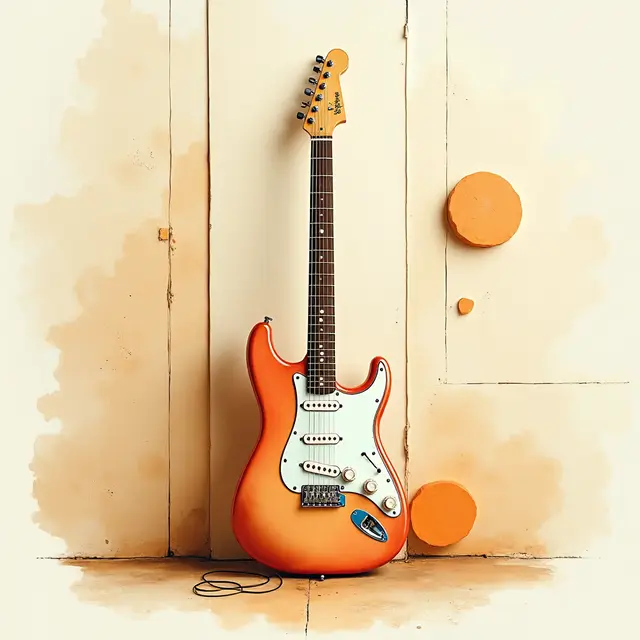
Palette: intense orange / white / cyan blue / brown
- BPM
- 140 BPM
- Family
- Electric Roads
- Serial
- ELC-19
- Rarity
- Common
- Style strength
- 90
- Experimentation
- 36
Typical structure
[Theme A] complex → [Theme B] → [Section C] time signature shift → [Final theme A]
The four specs above can be copied in a minute. What cannot be copied is the precise tension between calculation and breath: knowing exactly which time signature to fracture so the structure avoids sterile clinical coldness, and translating a rigid geometric guitar figure into an actual human pulse. All of that lives inside an unpublished internal distillate of eight parameters, which the engine cross-references with your story before writing a single line. When it finishes, an internal judge measures the output against six canon dimensions and forces a rewrite of anything breaking the geometry. The metronome is bought. The precision is not.
How a lyric in this style thinks
A math rock lyric does not confess — it constructs. Where most songwriting reaches for the gut, math rock reaches for the blueprint, building an architecture of language that mirrors the interlocking time signatures beneath it. The words are not there to be felt immediately; they are there to be solved, to reward the listener who stays patient long enough to watch two apparently contradictory lines resolve into a single, precise vertex. If what you need to say can be delivered in a direct emotional statement, math rock will resist you.
This genre is for the mental processes that resist simple naming: the obsessive mapping of a year of burnout, the cold satisfaction of a final gear locking into place, the end of a relationship understood not as grief but as geometric incompatibility.
The emotional register in math rock sits at a specific temperature — not cold exactly, but controlled. The orange of intense concentration, the cyan blue of a screen at four in the afternoon, the white of overexposed clarity. Emotion arrives obliquely, embedded in precision rather than stated outright. A lyric might describe the exact angle of sunlight through an uncurtained window rather than the loneliness of the room, and the loneliness arrives anyway, harder for having been withheld.
Line lengths in math rock lyrics tend to be asymmetrical and deliberate, resisting the comfortable pull of even syllable counts. You are writing in seven-eighths, not four-four. The line breaks land where the phrase actually ends, not where a rhyme scheme demands, and repetition when it appears is structural, not emotional — a motif returning at the close of a section the way Theme A returns after the time signature shift, transformed by everything that happened in between.
The sensory field of math rock is specific and industrial in its intimacy: wound strings, the smell of warm solder, colored electrical tape on a pedalboard, the digital pulse of a metronome that tolerates no deviation. These are not decorative details. They are the load-bearing walls of the lyric. Math rock never reaches for the pastoral or the abstract sublime — no wide open skies, no ocean metaphors, no weather used as emotional shorthand.
It lives in closed rooms, in the millimeter-level space between a fingertip and a fret, in the tightening tendons of a forearm holding a position. The concrete object is always preferred over the feeling the object produces, because the object is verifiable and the genre prizes verifiability.
Structurally, math rock operates on the logic of its own canon: Theme A stated in its full complexity, Theme B introducing a contrasting geometric figure, a section where the time signature shifts and the ground moves beneath both patterns, and then the return of Theme A — but now the listener has been through the shift and hears the original theme differently. A lyric written for this structure should honor that logic. The opening section establishes the system.
The middle section breaks it in a way that feels almost wrong, that productive wrongness of two guitar lines seeming to contradict each other until bar three where they intersect. The final return of the theme is not a comfort; it is a confirmation. The door clicks into the steel frame.
What separates a real math rock lyric from a generic imitation is the refusal of melodrama and the refusal of resolution as release. The genre does not build toward catharsis in the conventional sense. It builds toward exactness. A lyric that ends with an emotional outpouring has broken the contract. A lyric that ends with the system finally, quietly, correctly completing its own equation — that is math rock.
The instrumental nature of much of the genre is not incidental; when vocals do appear, they function as another textural layer, another line in the geometric figure, not as the dominant emotional carrier. Write the words the way the tapping sequence is written: every note exposed, stark, nothing hidden behind distortion, the mistake impossible to mask and therefore the precision worth everything.
- INTRICATE TAPPING
- SONIC GEOMETRY
- INSTRUMENTAL
Sample excerpt
Three coffee rings on the oak grain, Aligning north by the window frame. I count the flickers of the amber bulb, Two seconds on, one second dim, A rhythm synced to the radiator’s hiss.
The geometry of the drift, Calculating the exact distance Between where we started and the silence.
Workshop note — Math rock relies on percussive, clipped phrasing that mirrors the erratic time signatures of the guitar work. By focusing on mundane, measurable objects like coffee rings and light bulbs, you create a sense of detached precision that replaces messy emotional outbursts. Keep your imagery strictly physical and avoid adjectives that suggest sentimentality to ensure the architecture of the song remains rigid and structural.
Sample excerpt written by MUSAI Song. Your lyrics are written from scratch, based on your story.
When to choose this style
Choose this card when your story requires an architecture to organize what felt impossible to grasp, rather than a raw confession or a cry. It works to map out a complex mental process, like navigating a year of burnout by calculating every single day as if it were a strict equation. For a professional or academic milestone built on years of solitary discipline, where victory demands the cold satisfaction of seeing a final gear lock into place.
For a relationship that ended not out of hatred, but because the pieces simply stopped fitting together mathematically, requiring the patience of a clockmaker to accept. For detailing an obsessive mind that finds genuine peace in patterns, rules, and rigorous design. Math rock does not work for visceral confessions, messy heartbreaks, or blurry nostalgia; it rejects sloppy emotionality and melodrama. If what you need to say fits neatly inside a hug or a tear, this template will feel stiff and foreign.
If you are looking for a warm, direct confession, the letter is Midwest Emo.
Your story in this style
MUSAI Song writes original lyrics from your story, in the Math Rock style, and delivers the finished sung song, the ready-to-use style recipe, and an illustrated art plate with its numbered certificate, private by default; public only if its owner publishes it.
- Original lyrics written from your story
- A finished sung song, ready to play and share
- Art plate with a unique seal and a numbered certificate, private by default; public only if its owner publishes it
Frequently asked questions
What BPM is Math Rock?
Math Rock usually runs at 140 BPM.
What does Math Rock sound like?
Intricate tapping guitars locked into impossible time signatures. Math rock: geometric rebellion, technical and luminous, a beautiful puzzle to play.
What song structure does Math Rock use?
[Theme A] complex → [Theme B] → [Section C] time signature shift → [Final theme A]
How do I write Math Rock lyrics?
Tell MUSAI Song your story and pick Math Rock: it writes original lyrics for this style at 140 BPM, you edit them word by word, and you get the song sung in Math Rock, with an illustration of the song and its numbered certificate. $19 USD per song, one-time payment.
Explore more styles
- Alt-Rock 90s
- Bedroom Indie
- Blues Rock
- Britpop
- Campfire Indie Folk
- Classic Rock
- Dance-Punk
- Emo Midwest
- Folk Rock
- Garage Punk
- Garage Revival
- Garage Rock
- Grunge
- Hard Rock
- Heartland Rock
- Indie Pop
- Indie Rock
- Jangle Pop
- New Wave
- Noise Rock
- Pop Punk
- Post-Punk
- Power Pop
- Psychedelic Rock
Your idea or story, sung in this style
Card · secure payment via Stripe, charged in USD
If it doesn't move you, we give you your money back · 7 days