Dance-Punk
The body sweats, the bass calls the shots, nobody asks why.
Get your song in Dance-Punk
Make yours in this styleHear it before you pay.$19 USD · your first song for $5.50 USDIf it doesn't move you, we give you your money back · 7 days.
Dance-Punk is a style from the Electric Roads family. 128 BPM, Experimentation 30, Style strength 90.
What is Dance-Punk?
An unstoppable funky bass and angular guitars that make you move. Dance-punk: rebellion that stepped onto the dance floor — electric, danceable, and sharp.
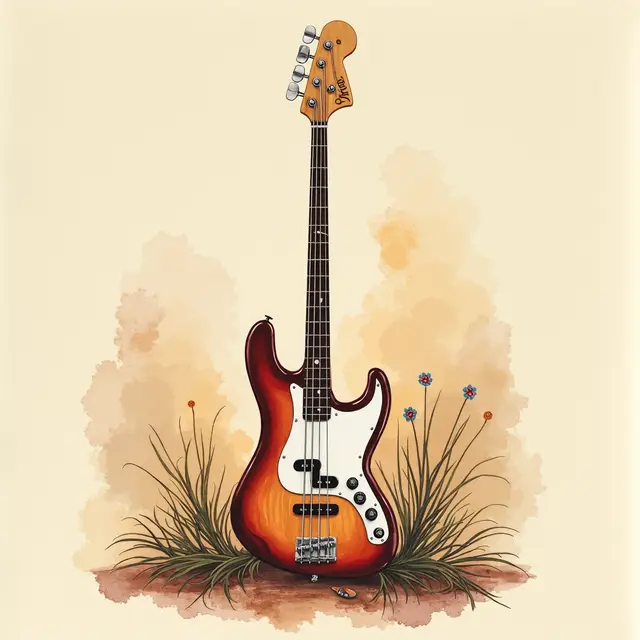
How it sounds
The concrete floor is tacky, smelling of stale lager evaporating under discharge lamps pulsing in cyan and magenta. It is three in the morning and you are wedged between the decks and a fifteen-inch cabinet shoving air straight against your ribs. There is no quarter in the four-by-four drum machine kick; it marks a physical urgency while the four-string bass—a battered Music Man with pickups wide open—slices the room with a mechanical groove that forces your feet to move before your brain registers the beat.
Beside you, someone barks chopped lyrics like a drill sergeant turned club chant, while guitars slash in with dissonant, angular chords, scraping the air like razor blades. Sweat runs down your neck, mixing with dust kicked up by dozens of canvas sneakers slamming the floor in unison. Pedal cables snake across the stage like exposed guts.
There is no room for melancholy or looking backward; the music demands no permission, shoving you relentlessly forward into a closed circuit of adrenaline and clean distortion where physical exhaustion feels, strangely, like the only truth left.
Palette: small blue green brown orange sunburst red
- BPM
- 128 BPM
- Family
- Electric Roads
- Serial
- ELC-29
- Rarity
- Common
- Style strength
- 90
- Experimentation
- 30
Typical structure
[Intro] bass → [Verse] → [Chorus] → [Verse 2] → [Break] → [Final chorus]
What you see above is just the club floor scenery. Two specific writing problems in this genre refuse to fit into any table: sustaining the relentless low-end tension without flatlining, and keeping the lyrical irony sharp enough to bite without sounding like a joke. That lives in an unpublished internal distillate of eight parameters, which the engine cross-references with your real history to build the verses. When finished, an internal judge measures the lyrics against six dimensions of the canon and forces a rewrite on anything that sounds soft. The beat takes five minutes to program. The electric jolt, not.
How a lyric in this style thinks
A dance-punk lyric does not confess — it commands. The words land like instructions barked over a PA system, short declarative punches that tell the body what to do before the mind has time to object. This is a genre built on the premise that frustration is a physical substance, something you sweat out under discharge lamps rather than whisper into a journal. The emotional logic runs on compression: whatever accumulated resentment, exhaustion, or hard-won defiance you bring to the page gets stripped of its nuance and hammered into a groove that hits at 128 beats per minute. Dance-punk has no patience for subordinate clauses. If a line needs explaining, it does not belong here.
The base tone is controlled aggression with a locked-in pulse underneath. Emotion does not arrive through confession or metaphor — it arrives through velocity and repetition. The chorus in dance-punk is less a melodic peak and more a chant that the room absorbs collectively, a phrase short enough to shout and hard enough to mean something physical. Think two to four words maximum at the centre of that section, then build the verse around the specific, concrete grievance that earned them.
The verse carries the narrative weight — the dead-end shift, the fluorescent office, the moment you stopped asking permission — while the chorus reduces all of it to a kinetic slogan. That structural logic, intro bass lock to verse to chorus back to verse to a break that strips everything down before the final chorus hits harder, works because it mirrors the arc of a body reaching exhaustion and then finding a second burst.
Line length in the verse runs short and percussive, landing on the downbeat with enough consonants to feel like impact. You are writing for a vocal delivery that sits somewhere between a shout and a bark — cool rather than raw, controlled rather than unhinged. Avoid melisma, avoid held vowels, avoid anything that signals vulnerability or asks for sympathy.
The sensory field is concrete and industrial: sticky floors, cable runs, the physical pressure of a fifteen-inch bass cabinet displacing air against your sternum, canvas sneakers on poured concrete, the smell of stale lager and hot amplifier. These are the textures dance-punk lives inside. What it never uses: candlelight, rain on windows, soft regret, the colour of anyone's eyes. If an image could appear in a breakup ballad, cut it.
The break — that stripped-down section before the final chorus — is where a generic imitation falls apart. Most writers treat it as a rest. In dance-punk it is a pressure chamber. The bass holds the groove alone, or the drums drop to a single rim shot pattern, and the vocal shifts from chant to something closer to a spoken accusation. One or two lines, delivered flat, with the full weight of the lyric behind them. Then the final chorus returns not as relief but as release, louder and more physical than anything before it.
The four-on-the-floor kick, the angular guitar slashes, the funky bass locked in its mechanical groove — all of it returns because the lyric has earned it. A real dance-punk song feels inevitable by the time it ends. A generic one just stops.
What separates craft from imitation in this genre is the specificity of the grievance matched to the physicality of the language. The rebellion has to dance, which means the anger cannot be abstract. You need a real image from the world — a time clock, a fluorescent strip light blinking out, a concrete floor, the exact moment the routine became unbearable — and then you need to move that image at tempo. The angular guitars and driving bass are already doing the emotional work that strings and piano do in other genres. Your job as a lyricist is to be as precise and as merciless as the rhythm section underneath you.
- FUNKY BASS
- REBELLION THAT DANCES
Sample excerpt
Clocked out at five with a static hum in my head Left the name tag on the desk, left the spreadsheet dead The security guard didn't even turn his chair Just a flick of a switch and a cold amber glare My sneakers are scuffed on the industrial tile I’m trading the cubicle for a jagged mile.
Sever the wire, cut the feed This kinetic rhythm is all I need Watch the ink black shadow start to slide Nowhere left for the ghosts to hide.
Workshop note — Dance-punk relies on clipped, rhythmic phrasing and sharp consonants to mirror the angular guitar stabs typical of the genre. Keep your lines short and punchy, prioritizing physical movement and sensory tension over complex narrative explanations. Avoid any sentimental longing, as the music demands a sense of immediate, visceral defiance.
Sample excerpt written by MUSAI Song. Your lyrics are written from scratch, based on your story.
When to choose this style
Choose this track when your story demands a violent jolt of energy rather than a quiet confession. It works when you walk away from a suffocating job or a dead-end routine and need to sweat it out under the strobe lights. For a hard-won victory that cost you weeks of raw nerve. For turning accumulated frustration into an unstoppable bassline. Do not use this for romantic declarations or quiet grief; dance-punk has zero patience for soft nostalgia or middle registers. If you need to explain subtle emotions or seek a tender reconciliation, this format will tear the message apart. If you seek an acoustic refuge for quiet introspection, the card is Bedroom Indie.
Your story in this style
MUSAI Song writes original lyrics from your story, in the Dance-Punk style, and delivers the finished sung song, the ready-to-use style recipe, and an illustrated art plate with its numbered certificate, private by default; public only if its owner publishes it.
- Original lyrics written from your story
- A finished sung song, ready to play and share
- Art plate with a unique seal and a numbered certificate, private by default; public only if its owner publishes it
Frequently asked questions
What BPM is Dance-Punk?
Dance-Punk usually runs at 128 BPM.
What does Dance-Punk sound like?
An unstoppable funky bass and angular guitars that make you move. Dance-punk: rebellion that stepped onto the dance floor — electric, danceable, and sharp.
What song structure does Dance-Punk use?
[Intro] bass → [Verse] → [Chorus] → [Verse 2] → [Break] → [Final chorus]
How do I write Dance-Punk lyrics?
Tell MUSAI Song your story and pick Dance-Punk: it writes original lyrics for this style at 128 BPM, you edit them word by word, and you get the song sung in Dance-Punk, with an illustration of the song and its numbered certificate. $19 USD per song, one-time payment.
Explore more styles
- Alt-Rock 90s
- Bedroom Indie
- Blues Rock
- Britpop
- Campfire Indie Folk
- Classic Rock
- Emo Midwest
- Folk Rock
- Garage Punk
- Garage Revival
- Garage Rock
- Grunge
- Hard Rock
- Heartland Rock
- Indie Pop
- Indie Rock
- Jangle Pop
- Math Rock
- New Wave
- Noise Rock
- Pop Punk
- Post-Punk
- Power Pop
- Psychedelic Rock
Your idea or story, sung in this style
Card · secure payment via Stripe, charged in USD
If it doesn't move you, we give you your money back · 7 days