Grunge
The rain doesn't kill the amp — it feeds it.
Get your song in Grunge
Make yours in this styleHear it before you pay.$19 USD · your first song for $5.50 USDIf it doesn't move you, we give you your money back · 7 days.
Grunge is a style from the Electric Roads family. 115 BPM, Experimentation 30, Style strength 93.
What is Grunge?
Dirty guitars that shift from a whisper to a roar, and a voice heavy with anguish. Grunge is Seattle's wounded rebellion: raw, honest, and gut-wrenching.
How it sounds
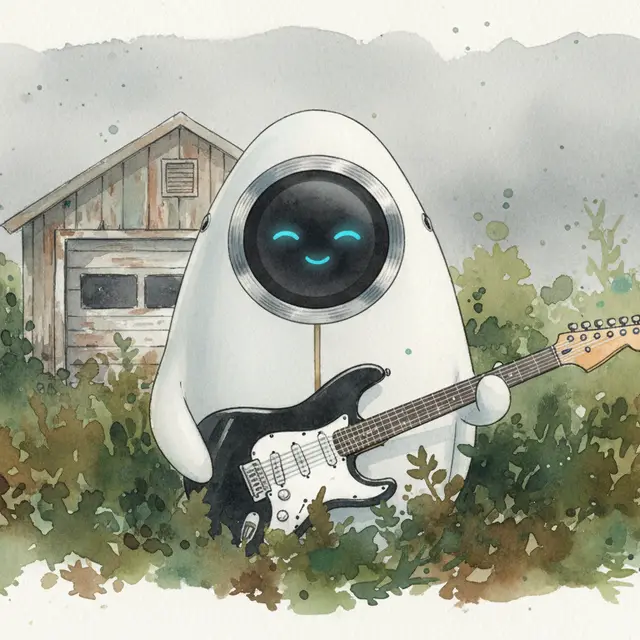
The garage roof is sheet metal, and every drop of rain sounds like lead shot hitting tin. It is freezing, but nobody takes off their flannel because the raw concrete floor sweats a dampness that crawls straight up into your bones. The air smells thick of rotting timber, cold coffee forgotten in a dented tin mug, and the sharp metallic tang of a frayed cable spitting tiny sparks every time it shifts. You are sitting on the edge of a canvas cot, guitar slung over your shoulder but not being played yet.
The amplifier is a beat-up box with a torn speaker cone that hums on its own, a low-end drone vibrating straight through the soles of your sneakers. Outside, the wall of fir trees blurs into a sky with no grey or black left in it, just a dirty smear flattening the afternoon. You wrap your fingers around the neck and they catch on oxidized steel; the tuning is a quarter-step flat because the cold has warped the wood past straight.
You start to drag a minor chord out, barely breathing on the strings, your fretting hand squeezing hard enough to turn the knuckles chalk-white. There is no audience, no soundproofing, just the wall of moisture and the solid certainty that nobody is coming to pull you out of what you are about to say. The noise builds slowly, like an old engine coughing before it catches, and you know that in another second you will tear your throat open because there is simply no room left inside.
Palette: light gray / moss green / black / cyan
- BPM
- 115 BPM
- Family
- Electric Roads
- Serial
- ELC-06
- Rarity
- Epic
- Style strength
- 93
- Experimentation
- 30
Typical structure
[Intro] clean → [Verse] soft → [Chorus] explosive distorted → [Verse 2] → [Final Chorus]
What you see on the public sheet is just the amp volume knob. What stays hidden is how to keep the pain from sounding like a retail costume, or how to make the drop from a whisper to a scream feel like an emergency instead of a trick. That lives inside an unpublished set of eight internal metrics, and the engine grinds them against your raw history before a single line gets written. When it finishes, an internal judge measures the lyrics against six dimensions of the canon and orders a complete tear-down of anything that sounds too neat. Distortion is sold in music shops. The wreck, not.
How a lyric in this style thinks
A grunge lyric does not explain its pain — it pressurizes it. The words sit in the body before they reach the mouth, and when they finally come out, they arrive half-swallowed, bitten off, or torn loose in a way that makes the listener feel the sound more than parse the meaning. Grunge operates on the principle that inarticulate fury is more honest than eloquent grief. The lyric's job is not to describe the wound but to be the wound: unresolved, slightly infected, not asking for your sympathy.
The emotional architecture of grunge is built on suppression followed by rupture. Verses tend to be low and close, almost mumbled, the syllables landing soft against a clean or barely-cracked guitar tone. The language in these sections is concrete and unglamorous — rotting wood, fluorescent flicker, a shirt that smells like someone else's bad decision. The sensory field is Pacific Northwest damp: cold metal, mildew, overcast sky pressing down on flat suburban rooftops. Grunge never reaches for the sublime.
It does not use cathedrals or open highways or dawn breaking gold over anything. Its geography is the dead end, the basement, the parking lot behind a strip mall where nothing happens and everything festers. When the chorus arrives, the distortion floods in and the vocal rips upward, but the lyric does not suddenly become clear or cathartic. The roar is still confused. That confusion is the point.
Line length in grunge is irregular on purpose. A verse might hold a long, dragging clause that feels like it cannot find its end, followed by a two-word fragment that lands like a door slamming. This asymmetry mirrors the dynamic of the music itself — the quiet-loud shift that defines the genre structurally. Repetition works not as a hook mechanism but as obsession: the same phrase comes back not because it is a chorus but because the speaker cannot stop circling it, the way you cannot stop pressing a bruise. The rhyme scheme, if there is one, is often loose or slant, because grunge distrusts anything that sounds too finished.
The structural logic of the canon — clean intro moving into a soft verse, then the explosive distorted chorus, a second verse that reopens the wound, and a final chorus that does not resolve it — reflects a very specific emotional truth: things do not get better, but you get louder about them. The final chorus does not deliver relief. It delivers volume. The vocal delivery through the whole arc should carry that quality of someone who has been holding their jaw tight for years and is only now letting it unlock.
Production-wise, the sludgy low-end bass sits under everything like a foundation that has been sinking slowly, and the torn-speaker distortion is not a flaw to fix but a texture to preserve.
What separates a real grunge lyric from a generic imitation is restraint in the verses and genuine incoherence in the chorus. Imitators tend to write articulate anger — well-structured complaint, clear metaphor, satisfying resolution. Grunge resists all three. The verses should feel like someone talking to the floor. The chorus should feel like the floor giving way. If your lyric makes complete sense when read quietly on a page, it probably needs to be broken. Cut a clause mid-thought. Let a line end somewhere that feels wrong. Trust that the amp hum and the flat tuning will carry what the words refuse to say.
- WHISPER TO ROAR
- SEATTLE ANGUISH
Sample excerpt
The linoleum floor is peeling at the seams. My coffee cup holds a film of grey oil. There is a letter under the radiator, covered in a decade of dust and ink black. I don't reach for it, I just watch the steam, while the rain tries to force the window open.
The house is holding its breath again. I’m swallowing the glass, I’m wearing the grit. Nothing is moving, nothing is changing.
Workshop note — Grunge succeeds by contrasting a mumble-heavy, intimate verse with a jagged, explosive chorus that prioritizes raw vocal texture over polished melody. Keep your imagery grounded in decaying, tactile domestic settings to create a sense of stagnant tension that refuses to resolve. Avoid rhyming couplets that sound too neat; the goal is to sound like a confession dragged out of a throat full of sand.
Sample excerpt written by MUSAI Song. Your lyrics are written from scratch, based on your story.
When to choose this style
Choose this track when your history carries a dull, heavy grudge that refuses to explain itself or ask for closure. It fits the precise moment you realized the town you grew up in only offered dead ends, and you somehow learned to love the suffocation. Use it for a silent family feud where nobody raised their voice, yet everything shattered underneath. For the exact hour you stopped pretending old fractures would heal and decided that carrying the weight is the only way left to move.
Do not pick this for tidy sorrows or neat reconciliations where everyone hugs it out at the end; grunge does not comfort, it scrapes. If your story demands an optimistic life lesson or a glowing resolution, look elsewhere. If you want a hook that shines clean and radio-ready, the card is Alt-Rock 90s.
Your story in this style
MUSAI Song writes original lyrics from your story, in the Grunge style, and delivers the finished sung song, the ready-to-use style recipe, and an illustrated art plate with its numbered certificate, private by default; public only if its owner publishes it.
- Original lyrics written from your story
- A finished sung song, ready to play and share
- Art plate with a unique seal and a numbered certificate, private by default; public only if its owner publishes it
Frequently asked questions
What BPM is Grunge?
Grunge usually runs at 115 BPM.
What does Grunge sound like?
Dirty guitars that shift from a whisper to a roar, and a voice heavy with anguish. Grunge is Seattle's wounded rebellion: raw, honest, and gut-wrenching.
What song structure does Grunge use?
[Intro] clean → [Verse] soft → [Chorus] explosive distorted → [Verse 2] → [Final Chorus]
How do I write Grunge lyrics?
Tell MUSAI Song your story and pick Grunge: it writes original lyrics for this style at 115 BPM, you edit them word by word, and you get the song sung in Grunge, with an illustration of the song and its numbered certificate. $19 USD per song, one-time payment.
Explore more styles
- Alt-Rock 90s
- Bedroom Indie
- Blues Rock
- Britpop
- Campfire Indie Folk
- Classic Rock
- Dance-Punk
- Emo Midwest
- Folk Rock
- Garage Punk
- Garage Revival
- Garage Rock
- Hard Rock
- Heartland Rock
- Indie Pop
- Indie Rock
- Jangle Pop
- Math Rock
- New Wave
- Noise Rock
- Pop Punk
- Post-Punk
- Power Pop
- Psychedelic Rock
Your idea or story, sung in this style
Card · secure payment via Stripe, charged in USD
If it doesn't move you, we give you your money back · 7 days