New Wave
The future already happened, and it sounded pretty good.
Get your song in New Wave
Make yours in this styleHear it before you pay.$19 USD · your first song for $5.50 USDIf it doesn't move you, we give you your money back · 7 days.
New Wave is a style from the Electric Roads family. 128 BPM, Experimentation 28, Style strength 92.
What is New Wave?
Bright synths and danceable guitars with a quirky, catchy vocal. New wave: the rock that learned to dance, colorful, eighties, and utterly irresistible.
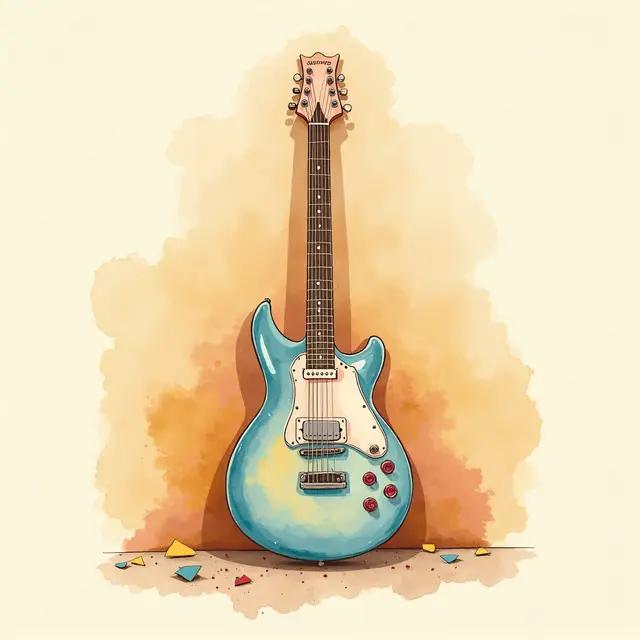
How it sounds
It is three in the morning and the asphalt outside the phone booth shines with a magenta glare because the bulb above buzzes with stubborn insistence. You lean against the cold glass, collar popped on your leather jacket, wearing sunglasses you refuse to take off even though the only light comes from a television screen glowing through a storefront window, hissing gray static. Outside it drizzles, but the water does not stain: it merely etches bright streaks across the cobblestones.
Inside the club, the Roland Juno synthesizer fires off an arpeggio that climbs like a fire escape painted in fluorescent green. The TR-808 drum machine hits dry, clinical, unpitying, locking in a hundred and twenty-eight beats per minute that force your foot to tap even while you stand still. The guitar cuts clean, laced with a metallic chorus pedal slicing the air like a razor blade.
A girl dances alone by the speakers, wearing a geometric dress and lips painted a red so deep it looks nearly black; she moves her arms with mechanical precision, as if every gesture were a mathematical proof no one else grasps. She glances at you through the static for a second, a crooked smile that never reaches her eyes, then spins away again. The bass bounces off the black vinyl walls, an elastic line shoving your chest forward while the melody feigns joy behind a chilly smirk.
Palette: magenta / cyan / yellow
- BPM
- 128 BPM
- Family
- Electric Roads
- Serial
- ELC-11
- Rarity
- Rare
- Style strength
- 92
- Experimentation
- 28
Typical structure
[Intro] synth → [Verse] → [Chorus] → [Verse 2] → [Bridge] → [Final Chorus]
What you see above is merely the paint job on the frame. Writing here requires solving two invisible traps: stopping the irony from sounding like cheap cynicism and making the dance floor and private tragedy occupy the same room without tripping over each other. That lives inside a secret eight-parameter distillate that the motor crosses with your story before drafting a single line. When it finishes, an internal judge measures the lyrics against six canons and repairs anything that feels too soft. The drum machine can be copied. The cold elegance, not.
How a lyric in this style thinks
A new wave lyric does not confess — it performs confession while pretending it has somewhere better to be. The emotional move is always double: something real happened, probably something that would wreck another genre entirely, but the lyric holds it at arm's length with irony, angular phrasing, and a studied cool that makes the hurt feel like a design choice.
New wave is the genre where you write about longing by describing the architecture of an empty room, where heartbreak arrives disguised as a wry observation about the weather or the cut of someone's coat. The mask is not dishonesty; it is the whole aesthetic argument. Anguish sharpens into style, and style becomes a survival mechanism.
Rhythmically, new wave lyrics are clipped and forward-moving, built to sit inside a drum machine groove running at a tempo that will not let the body rest. Lines tend to be short and declarative — subject, verb, image — and they land on the beat with a kind of deliberate thud that mimics the dry snap of a TR-808 snare.
Repetition is structural rather than emotional: a phrase comes back not because feeling demands it but because the architecture requires it, the way an arpeggio cycles through the same four notes regardless of what you feel about them. The chorus in this genre often says less than the verse, not more. It condenses the lyric's argument into something close to a slogan, a phrase that sounds almost too simple until you notice it has been running through your head for three days.
The sensory field is specific and non-negotiable. New wave lives in artificial light — neon, fluorescent, the blue-gray glow of a television through plate glass. Its textures are hard and reflective: chrome, vinyl, wet cobblestone, the metallic shimmer of a chorus pedal cutting through a clean guitar line. The bass is elastic, physical, almost argumentative. Synthesizer arpeggios climb like fire escapes. Nothing in a new wave lyric smells of earth or wood smoke; nothing is soft-focus or pastoral.
The genre does not do rural, does not do acoustic warmth, does not do the kitchen table. If a concrete object appears in your lyric, it should be something you could photograph for a magazine spread rather than something you could hold in your palm. Specificity is mandatory — a Roland Juno, a geometric dress, a phone booth at three in the morning — but the specificity always reads as stylized rather than sentimental.
Structurally, the intro earns its length because the synth establishes the emotional key before a word is sung — the listener should already feel the temperature of the lyric before the verse opens. The verse carries most of the narrative weight, delivering images in quick declarative strokes without editorializing. The chorus pivots to something more abstract, often a refrain that sounds like a statement of position rather than a cry for help.
The bridge is where new wave allows its one moment of genuine exposure, usually a slight rhythmic break or a stripped texture that lets the lyric say what it has been avoiding — but even here, the delivery stays controlled, the word choice stays oblique. The final chorus lands harder because of that brief honesty, not despite it.
What separates a real new wave lyric from a generic imitation is the discipline of the smirk. Imitations pile on the eighties references — the sunglasses, the synths, the dancefloor — without understanding that the genre's emotional logic is built on restraint masquerading as attitude. The lyric should never explain its own irony. It should never tell the listener it is being cool; it should simply be cool, which in practice means choosing the unexpected angle on a familiar feeling and then refusing to apologize for it. Write the breakup as an aesthetic event. Write the longing as a problem of geometry. Let the 128-BPM pulse do the emotional work the words are too proud to do outright.
- DANCEABLE SYNTHS
- ROCK THAT DANCES
Sample excerpt
I left your house key on the wet pavement, Beside the taxi stand at half-past three. The neon sign is buzzing like a hornet, And you are just a pixel on a screen. I’m wearing indigo leather in the rain, Checking my watch to see if I’m still bored.
So keep the static, keep the cold, I’m trading silver for the gold. We’re just two wires in the dark, Waiting for a sudden spark.
Workshop note — New Wave thrives on rhythmic precision and a sense of detached cool, so keep your line lengths tight and your rhyme schemes snappy. Focus on cold, modern imagery like electronics or city infrastructure to maintain that signature ironic distance. Avoid heavy emotional confessionals; the goal is to make the listener want to move, not to cry.
Sample excerpt written by MUSAI Song. Your lyrics are written from scratch, based on your story.
When to choose this style
Choose this card when you need to narrate a breakup that stung but left you with your hair fixed and your shades on. It works for the story where anguish hides behind an ironized smirk, when pride outweighs the tear and you would rather dance under strobe lights than admit you miss someone. It fits a midnight drive down an industrial avenue, windows down, stereo cranked to drown out thought. For when disillusionment does not drag you under, but sharpens you into something sleek, distant, and untouchable.
Do not choose this for quiet grief, tearful family reconciliations around a dinner table, or tender gratitude; new wave does not know how to hug without choreography. If you are looking for raw confession without a mask or stylistic distance, the card is Alt-Rock 90s.
Your story in this style
MUSAI Song writes original lyrics from your story, in the New Wave style, and delivers the finished sung song, the ready-to-use style recipe, and an illustrated art plate with its numbered certificate, private by default; public only if its owner publishes it.
- Original lyrics written from your story
- A finished sung song, ready to play and share
- Art plate with a unique seal and a numbered certificate, private by default; public only if its owner publishes it
Frequently asked questions
What BPM is New Wave?
New Wave usually runs at 128 BPM.
What does New Wave sound like?
Bright synths and danceable guitars with a quirky, catchy vocal. New wave: the rock that learned to dance, colorful, eighties, and utterly irresistible.
What song structure does New Wave use?
[Intro] synth → [Verse] → [Chorus] → [Verse 2] → [Bridge] → [Final Chorus]
How do I write New Wave lyrics?
Tell MUSAI Song your story and pick New Wave: it writes original lyrics for this style at 128 BPM, you edit them word by word, and you get the song sung in New Wave, with an illustration of the song and its numbered certificate. $19 USD per song, one-time payment.
Explore more styles
- Alt-Rock 90s
- Bedroom Indie
- Blues Rock
- Britpop
- Campfire Indie Folk
- Classic Rock
- Dance-Punk
- Emo Midwest
- Folk Rock
- Garage Punk
- Garage Revival
- Garage Rock
- Grunge
- Hard Rock
- Heartland Rock
- Indie Pop
- Indie Rock
- Jangle Pop
- Math Rock
- Noise Rock
- Pop Punk
- Post-Punk
- Power Pop
- Psychedelic Rock
Your idea or story, sung in this style
Card · secure payment via Stripe, charged in USD
If it doesn't move you, we give you your money back · 7 days