Garage Punk
No budget, but more than enough volume.
Get your song in Garage Punk
Make yours in this styleHear it before you pay.$19 USD · your first song for $5.50 USDIf it doesn't move you, we give you your money back · 7 days.
Garage Punk is a style from the Electric Roads family. 165 BPM, Experimentation 30, Style strength 91.
What is Garage Punk?
Fuzz-blown guitars and a defiant voice cranked to the max. Garage punk: punk born in a grimy garage, chaotic, fast, and gloriously raw.
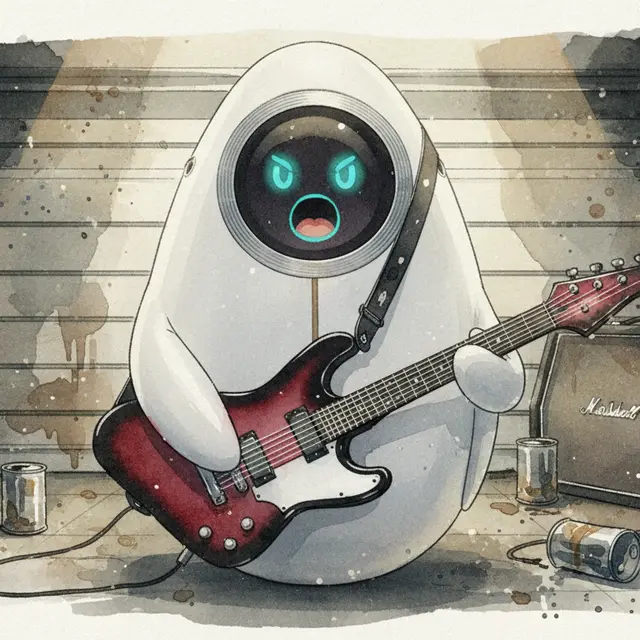
How it sounds
The cold concrete floor smells of dampness and stale gasoline. You are standing inside a two-car garage where a single bare bulb hangs from a frayed cord, swinging every time the bass blows out the speaker cones. On a workbench covered in grease and crushed cans sits a fuzz pedal held together by gray duct tape; the metal chassis is dented from a drop nobody remembers happening. The amp hums with a metallic frequency that vibrates right behind your teeth.
Someone plugs in a guitar and the first open chord rips through the air before you can close your mouth. The drums sound like a stack of metal trash cans tumbling down a flight of stairs—dry, bone-dry, beaten to death at one hundred and sixty-five beats per minute. The heat is thick, smelling of fresh sweat and burning plastic because the cables are screaming for mercy.
There is no room to think about clean tuning or theory; the vocals come in early, barked with total disdain, sandpapered by cigarettes and the raw fury of someone with nothing left to lose. The back of your neck aches from headbanging, the amp spits static every time a fret-hand slide scrapes the winding, and the overhead bulb flickers to the kick drum like it is about to shatter.
Palette: dark red / black / cyan / beige gray
- BPM
- 165 BPM
- Family
- Electric Roads
- Serial
- ELC-15
- Rarity
- Common
- Style strength
- 91
- Experimentation
- 30
Typical structure
[Intro] → [Verse] → [Chorus] → [Verse 2] → [Outro] chaotic
The specs above can be copied in a minute. What cannot be copied is the hidden criteria: how to keep melodic tension when vocals ride the edge of a scream without turning into flat noise, and where to chop a line short so the breath sounds like a dare instead of exhaustion. That lives inside an unpublished eight-parameter distillate that the engine cross-references with your story before writing a single syllable. When finished, an internal judge measures the lyrics against six dimensions of the canon and forces a rewrite on anything that sounds too polite or predictable. Distorted guitars can be bought anywhere. The sneer, no.
How a lyric in this style thinks
A garage punk lyric does one thing above everything else: it delivers the accusation before the listener has time to brace. There is no preamble, no scene-setting throat-clear. The first line names the offense or the offender — not metaphorically, not with lyrical distance, but with the blunt force of someone who has been holding it in for months and just stopped caring about consequences. Garage punk operates on the principle that restraint is its own form of dishonesty. The emotion arrives at full volume in bar one and stays there, which means the craft challenge is not how to build toward something but how to sustain rage without it curdling into self-pity.
The tonal register is dark and confrontational — think ink-black fury cut with a streak of bitter, almost sardonic amusement at how absurd the situation has become. The palette runs from seething resentment to outright contempt, and the best lyrics in this genre hold both at once. Repetition is structural and deliberate: a chorus phrase gets hammered not to develop it but to drive it through the wall.
Line length tends toward short and punchy in the verse — five to eight syllables, clipped consonants, hard stops — because the vocal delivery is a bark, not a melody. Syllables that overhang the beat get swallowed by the drums, and at 165 BPM with a kit that sounds like trash cans hitting concrete, anything that doesn't land on the downbeat simply disappears.
The sensory field of garage punk is hyper-specific and resolutely unglamorous. The objects that belong here are duct tape, blown speaker cones, grease-stained concrete, a fuzz pedal held together by luck and spite, fluorescent light, cheap beer, and the smell of burning cable insulation. These are not decorative details — they are the emotional proof of the lyric. When a verse places the listener in a physical space this precisely, the anger becomes credible.
What garage punk never touches: candlelight, soft fabrics, rain on a window, anything that implies comfort or retrospection. The moment a lyric reaches for tenderness or nostalgia, the genre's entire architecture collapses. This is not a format for looking back warmly.
Structurally, garage punk is compressed to the point of aggression. The intro exists only long enough to establish the sonic assault — one open chord ripping through before the vocals come in early, almost interrupting the music. The verse carries the specific accusation: the boss who extracted three years of your life and handed you a box, the family dinner where you finally said what you meant, the exact afternoon a decision got made. The chorus strips it to the bone — a phrase short enough to shout, repeated until it becomes a chant.
There is rarely a bridge in the traditional sense; the outro is chaotic, often a structural collapse where the lyric dissolves into the noise. That dissolution is not a failure of craft — it is the point. The song ends because it runs out of controlled fury, not because it resolved anything.
What separates a genuine garage punk lyric from a generic imitation is specificity at the verse level and restraint in the metaphor. Generic imitations reach for big abstract statements about freedom or rebellion; the real thing names the grease stain on the workbench, the exact phrase someone said that broke the last wire. The blown-out guitars and the snotty shouted vocal delivery will handle the emotional scale — your job as the lyricist is to give the listener something concrete to grab onto before the fuzz pedal buries everything. Write the accusation first. Write it short. Then let the amp do the rest.
- BLOWN-OUT GUITARS
- GARAGE CHAOS
Sample excerpt
Third cup of burnt coffee at four in the morn Sitting in a basement where the drywall is torn You want a quiet answer while I chew on my teeth Swallowing the static coming up from beneath
I am done biting down on the rust Turning all your polite little rules into dust Keep your steady hands and your clean floor I am walking right out through the broken back door
Workshop note — Garage punk lyrics rely on abrasive, tactile imagery like burnt coffee and torn drywall to mirror the fuzz-blown guitars. Keep the lines short and punchy, avoiding any polished metaphors so the raw frustration hits without a filter.
Sample excerpt written by MUSAI Song. Your lyrics are written from scratch, based on your story.
When to choose this style
Choose this track when you need to throw up a frustration that has been rotting in your chest for months, without asking for permission or apologizing. It works when you tell off a boss who squeezed you dry, when a relationship ends in screaming matches and slammed doors with zero room for nostalgia, or when you are sick of biting your tongue in front of a family that judges your every move.
It is the exact tool to narrate a sudden firing, a forced move into a cramped dive, or that precise afternoon you decided to shred everyone else's expectations. Do not pick this for quiet love, sweet reconciliations, or tender memories of someone who passed away; garage punk reeks of sweat and defiance, and forcing it to sound cozy feels like a cheap costume. It is also useless for silent grief or late-night reflections over a cup of tea. If you are looking for nostalgic fuzz to stare out a rainy window, the card is Alt-Rock 90s.
Your story in this style
MUSAI Song writes original lyrics from your story, in the Garage Punk style, and delivers the finished sung song, the ready-to-use style recipe, and an illustrated art plate with its numbered certificate, private by default; public only if its owner publishes it.
- Original lyrics written from your story
- A finished sung song, ready to play and share
- Art plate with a unique seal and a numbered certificate, private by default; public only if its owner publishes it
Frequently asked questions
What BPM is Garage Punk?
Garage Punk usually runs at 165 BPM.
What does Garage Punk sound like?
Fuzz-blown guitars and a defiant voice cranked to the max. Garage punk: punk born in a grimy garage, chaotic, fast, and gloriously raw.
What song structure does Garage Punk use?
[Intro] → [Verse] → [Chorus] → [Verse 2] → [Outro] chaotic
How do I write Garage Punk lyrics?
Tell MUSAI Song your story and pick Garage Punk: it writes original lyrics for this style at 165 BPM, you edit them word by word, and you get the song sung in Garage Punk, with an illustration of the song and its numbered certificate. $19 USD per song, one-time payment.
Explore more styles
- Alt-Rock 90s
- Bedroom Indie
- Blues Rock
- Britpop
- Campfire Indie Folk
- Classic Rock
- Dance-Punk
- Emo Midwest
- Folk Rock
- Garage Revival
- Garage Rock
- Grunge
- Hard Rock
- Heartland Rock
- Indie Pop
- Indie Rock
- Jangle Pop
- Math Rock
- New Wave
- Noise Rock
- Pop Punk
- Post-Punk
- Power Pop
- Psychedelic Rock
Your idea or story, sung in this style
Card · secure payment via Stripe, charged in USD
If it doesn't move you, we give you your money back · 7 days