Campfire Indie Folk
Someone always knows the chorus before it ends.
Get your song in Campfire Indie Folk
Make yours in this styleHear it before you pay.$19 USD · your first song for $5.50 USDIf it doesn't move you, we give you your money back · 7 days.
Campfire Indie Folk is a style from the Electric Roads family. 100 BPM, Experimentation 48, Style strength 85.
What is Campfire Indie Folk?
Fingerpicked guitar, banjo, and warm harmonies gathered around the fire. Campfire indie folk: the sweet rebellion of going back to basics, all earth and community.
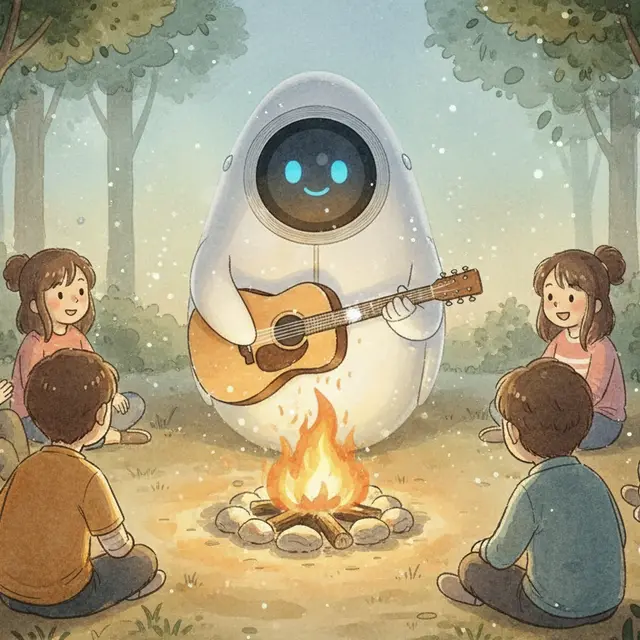
How it sounds
It is half past ten and the dark woods have swallowed the dirt road completely. Nobody has phone service and nobody cares. Someone shoves a heavy oak log toward the center and sparks fly straight up, chasing the stars through the pine needles. Dried mud flakes off heavy boots against the frozen ground. A dented metal mug passes around, filled with dark coffee that burns the lip. The acoustic guitar has a visible scar right below the soundhole where the varnish chipped away from years of rubbing against belt buckles.
The arpeggio starts slow, finger by finger over worn nylon strings, hunting for the exact pulse everyone recognizes without knowing why. Then the banjo cuts through the cold air, sharp and rattling. Someone starts to hum off-key just to test if their voice works in the freezing night. Three bars in, two more voices crash into the harmony, rough around the edges, imperfect, pulling the melody upward until the mountain chill stops stinging the face.
Someone stomps their boot heel directly onto the packed earth, a dull thud that hits the chest of everyone sitting on the logs. No one looks past the amber circle of light. There is only burning wood, smoke stinging the eyes, and hands reaching for the neck of the guitar again because the night is still young.
Palette: warm amber / forest green / bluish gray
- BPM
- 100 BPM
- Family
- Electric Roads
- Serial
- ELC-07
- Rarity
- Rare
- Style strength
- 85
- Experimentation
- 48
Typical structure
[Guitar Intro] → [Verse] → [Chorus with harmonies] → [Stomp build] → [Final chorus]
What you see above is just the exposed wood and the smoke. Underneath lie tricky craft problems: how to keep rustic simplicity from sounding like a greeting card, and how to weave English and Spanish naturally into the same stanza without forcing a bilingual gimmick. That lives inside an unpublished internal distillate of eight parameters that the motor crosses with your story before drafting a single line. When it finishes, an internal judge measures the lyrics against six canons and sends back anything that sounds too polished. The guitar chords are anywhere. The dirt in the voice is not.
How a lyric in this style thinks
A lyric in campfire indie folk does not announce its emotion — it builds a fire and lets you stand close enough to feel the heat. The words work through accumulation: a chipped mug, a scar on the guitar body, mud drying off a boot heel. By the time the chorus arrives, the listener has already been placed inside a specific night, a specific circle of people, and the feeling hits because the scene earned it. This is a genre about return and recognition, about the particular warmth of people who stopped needing to explain themselves to each other. The lyric's job is to make that recognition feel inevitable.
The base tone is amber-warm but honest — there is no false comfort here, no pretending the years away were easy or that the silences didn't cost something. Emotion arrives sideways, carried by a concrete detail rather than a declared feeling. You do not write 'I missed you.' You write about the way the same arpeggio starts and everyone's shoulders drop at the same moment.
Line length in campfire indie folk tends toward the medium and conversational, close to the rhythm of someone speaking carefully around a fire, choosing words because the cold makes you precise. Repetition is structural and earned: a phrase returns at the chorus not because the writer ran out of ideas but because the circle has come back around, because that is what a chorus around a fire actually does.
The sensory field is narrow and specific: packed earth, pine smoke, nylon strings worn soft, the amber radius where the firelight stops. Instruments that belong here include the fingerpicked acoustic guitar with its organic resonance, the banjo cutting sharp and percussive through the low end, and the human voice in its roughest, most unguarded state — slightly off-pitch at the entry, finding the note by the second bar.
What this genre never uses: glass surfaces, fluorescent light, the texture of polyester, the vocabulary of performance metrics or personal brands. If a word belongs in a quarterly report, it does not belong in this lyric. The production anchors are foot stomps on packed ground, hand claps slightly behind the beat, and room ambience that sounds like cold open air rather than a treated studio.
The structure follows the fire's own logic. The guitar intro sets the pulse before a single word is spoken — it is the moment everyone leans in. The verse builds the scene with restraint, one image at a time, never rushing toward the payoff. The chorus with harmonies is where the individual voice opens into the group: rough entries, imperfect unisons, voices that pull slightly against each other before locking.
The stomp build is not a breakdown in the pop sense — it is the moment the body takes over from the mind, when the boot heel hits the earth and the chest cavity responds. The final chorus lands differently from the first because by then the lyric has done its work and the return feels like something that was always going to happen.
What separates a real campfire indie folk lyric from a generic imitation is the specificity of its debts. A generic version gives you a vague night and vague friends and a vague feeling of belonging. The real version gives you the exact weight of the oak log, the exact sound of the banjo cutting through cold air, the exact quality of silence between people who have owed each other something for years and chosen not to collect.
Around 100 BPM, the rhythm breathes rather than drives — there is room for a syllable to land late, for a harmony to enter a beat behind, for the stomp to feel like a decision rather than a click track. Write toward that looseness. The imperfection is not a flaw to correct; it is the genre's signature proof that the people in this song are real.
- AROUND THE FIRE
- BACK TO BASICS
Sample excerpt
The dust on your boots is the same red clay, From the creek bed where we lost the day. I left my tie on the passenger seat, And watched the highway turn into wheat. Your kettle is humming a rusted tune, Under the rise of a jagged moon.
Keep the wood burning until the indigo fades, We are trading the static for the quiet of glades. No heavy ledger, no debt to be paid, Just embers and kin in the amber shade.
Workshop note — This style thrives on tactile, grounded imagery that contrasts the weight of modern routines with the simplicity of the land. The lyrics use a steady, conversational rhythm and rely on the chorus to provide a collective, harmonic release rather than a complex narrative shift. Avoid overly poetic metaphors; instead, focus on specific objects and sensory details that ground the listener in a tangible place.
Sample excerpt written by MUSAI Song. Your lyrics are written from scratch, based on your story.
When to choose this style
Choose this card when the story is about coming back home after years of not belonging anywhere. It works to celebrate a friendship that survived distance, debt, and long silences without asking for explanations. For the exact day you walked away from a corporate desk to stand on real soil again. For thanking a sibling who stayed in the hometown while you went looking for something else. For a group that gathers once a year around a long wooden table and needs to remember they are still the same.
Campfire indie folk does not fit fast city stories, solo ambition, or glass-tower triumphs. It is not the genre for a formal love letter, a cold breakup, or an office reconciliation. And if you are looking for high-voltage amplifiers and dirty distortion, the card is Garage Revival.
Your story in this style
MUSAI Song writes original lyrics from your story, in the Campfire Indie Folk style, and delivers the finished sung song, the ready-to-use style recipe, and an illustrated art plate with its numbered certificate, private by default; public only if its owner publishes it.
- Original lyrics written from your story
- A finished sung song, ready to play and share
- Art plate with a unique seal and a numbered certificate, private by default; public only if its owner publishes it
Frequently asked questions
What BPM is Campfire Indie Folk?
Campfire Indie Folk usually runs at 100 BPM.
What does Campfire Indie Folk sound like?
Fingerpicked guitar, banjo, and warm harmonies gathered around the fire. Campfire indie folk: the sweet rebellion of going back to basics, all earth and community.
What song structure does Campfire Indie Folk use?
[Guitar Intro] → [Verse] → [Chorus with harmonies] → [Stomp build] → [Final chorus]
How do I write Campfire Indie Folk lyrics?
Tell MUSAI Song your story and pick Campfire Indie Folk: it writes original lyrics for this style at 100 BPM, you edit them word by word, and you get the song sung in Campfire Indie Folk, with an illustration of the song and its numbered certificate. $19 USD per song, one-time payment.
Explore more styles
- Alt-Rock 90s
- Bedroom Indie
- Blues Rock
- Britpop
- Classic Rock
- Dance-Punk
- Emo Midwest
- Folk Rock
- Garage Punk
- Garage Revival
- Garage Rock
- Grunge
- Hard Rock
- Heartland Rock
- Indie Pop
- Indie Rock
- Jangle Pop
- Math Rock
- New Wave
- Noise Rock
- Pop Punk
- Post-Punk
- Power Pop
- Psychedelic Rock
Your idea or story, sung in this style
Card · secure payment via Stripe, charged in USD
If it doesn't move you, we give you your money back · 7 days