Urban Rock
The antenna picks up what the neighborhood already knew.
Get your song in Urban Rock
Make yours in this styleHear it before you pay.$19 USD · your first song for $5.50 USDIf it doesn't move you, we give you your money back · 7 days.
Urban Rock is a style from the Electric Roads family. 125 BPM, Experimentation 28, Style strength 93.
What is Urban Rock?
Gritty guitars and a street voice singing real life. Rock urbano, the sound of Hispanic working-class rebellion, honest, hardworking, and big-hearted.
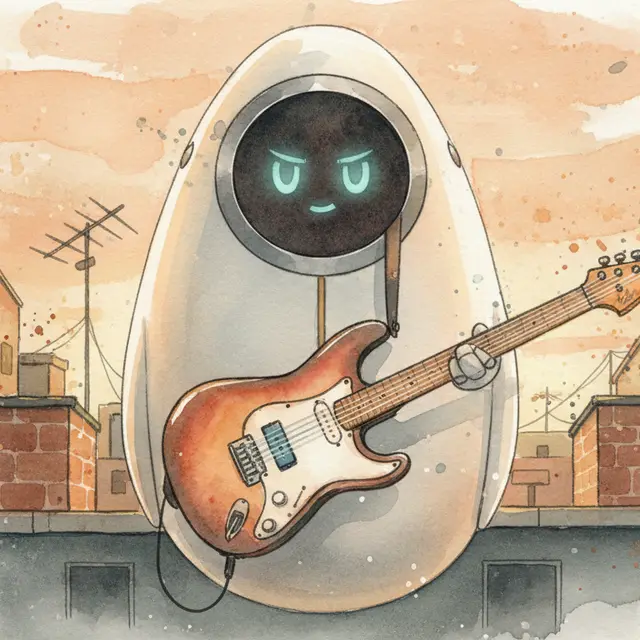
How it sounds
It is eight in the evening and the shift on the construction site just ended, though dust still hangs suspended in the thick amber light pooling across the avenue. You are leaning against the closed metal shutter of a corner bodega, feeling the chill of the iron through your canvas overalls. Two blocks away, a utility transformer hums with a steady, low drone like an engine refusing to quit.
The guitar starts before anyone speaks: a raw, abrasive chord struck hard against the frets, pushing straight through an amplifier that has swallowed too much basement dampness over the years. There is no polish in that sound, only friction—sandpaper against raw timber. The vocals cut in without asking permission, using a throat that has seen no warm water all day, scraping hard against every consonant as if each word has to force its way through exhaust fumes and street noise.
Someone walks past carrying a plastic grocery bag that crinkles right on the kick drum's beat. There are no delicate metaphors here, only exact nouns: the stripped wire dangling from the utility pole, the oil slick outside the mechanic's shop, the heavy boots caked in dry mud. The music does not ask you to imagine somewhere else or offer a clean escape; it drops you right back onto the warm asphalt with dirty knuckles and the stubborn certainty that your story, exactly as it happened, deserves to be shouted against the brick.
Palette: warm orange / gray / muted cyan
- BPM
- 125 BPM
- Family
- Electric Roads
- Serial
- ELC-08
- Rarity
- Rare
- Style strength
- 93
- Experimentation
- 28
Typical structure
[Intro] riff → [Verse] → [Chorus] → [Verse 2] → [Solo] → [Final Chorus]
The four points above are just the surface layout, but what actually holds the track together happens out of sight. Figuring out how to name hardship without falling into pity clichés and knowing precisely which syllable needs vocal grit so the line sounds like the pavement instead of a theater stage are problems that never fit into a spreadsheet. Beneath this card lies an unreleased internal distillate of eight parameters that the engine cross-references with your specific history. Once done, an internal judge measures the lyrics against six canonical dimensions and sends back anything that smells like posturing to be rewritten. The amplifier is bought. The grit, not.
How a lyric in this style thinks
A lyric in rock urbano does not describe hardship from a distance — it stands inside it, shoulders squared, and refuses to flinch. The form exists to convert daily friction into collective dignity: the cracked knuckle, the overdue bill, the handshake between two men who have nothing left to offer each other except loyalty. Rock urbano is the sound of the Ibero-American street corner translated into electric guitar and a voice that has earned its roughness. If the lyric is doing its job, the listener does not feel sympathy — they feel recognition.
The emotional register here runs hot but never melodramatic. Anger arrives as statement, not complaint. Grief arrives as fact, not confession. The base tone is something close to amber-lit defiance: warm enough to carry solidarity, heavy enough to carry loss. Emotion in this genre is delivered through concrete accumulation rather than explicit declaration — you stack exact nouns until the weight of them becomes undeniable. The stripped wire on the utility pole. The oil stain that has been there since before you were born.
The plastic bag crumpling on the pavement. You do not write "life is hard" in rock urbano; you write the specific object that proves it, and you trust the listener to feel the rest.
Rhythm and line length behave like the music itself: driven, slightly uneven, resistant to decoration. Verses tend to run in longer, declarative lines that mirror the forward grind of a 125 BPM rhythm section — not frantic, but relentless. The chorus shortens everything down. It punches. It repeats. It is the phrase you shout rather than sing, built to survive a loud room and a crowd that does not know all the words yet.
Repetition in the chorus is structural, not lazy — the repeated line should feel like a fist coming back to the same wall, each time a little harder. The [Intro] riff sets the emotional contract before a word is spoken, so the opening guitar chord is not decoration; it is the first sentence of the story. The [Solo] section, arriving after the second verse, functions as the moment the body speaks when the words run out — write toward it, not past it.
The sensory field of rock urbano is narrow and precise, which is exactly its power. It lives in industrial amber light, in the drone of machinery that never fully stops, in the texture of damp concrete and canvas and iron. It does not use nature imagery unless nature is also working — a dog on a leash, a pigeon on a ledge, rain on asphalt. It never reaches for the pastoral, the celestial, or the abstract. The vocabulary should feel like something you could say to someone's face on a construction site without embarrassment. If a line requires a dictionary or a mood board, cut it.
What separates a genuine rock urbano lyric from a generic hard-rock imitation is the specific gravity of its working-class perspective — and the absence of self-pity. The genre has no patience for victimhood. The narrator of a rock urbano song has been dealt a difficult hand and is still playing it, loudly, without asking for applause. The final chorus does not resolve into hope or despair; it resolves into insistence. The story happened, it cost something real, and it deserves to be said at full volume. That is the contract the form makes with the listener, and every lyrical choice you make should honor it.
- GRITTY GUITARS
- STREET VOICE
Sample excerpt
Grease under the fingernails won't wash away at five Clock puncher at the corner gate, barely keeping alive My old man left his boots right by the kitchen door They don't tread the cement factory floor no more
We built this concrete town with calloused hands Nothing to our name across these broken lands No silver spoons, just sweat and heavy noise Still standing tall, we're the asphalt boys
Workshop note — This sample grounds the emotion in tactile, working-class details like unwashed grease and heavy boots rather than vague misery. The lines stay punchy and rhythm-driven to match the gritty guitar drive, avoiding any soft poetic ornaments that would betray the raw street voice.
Sample excerpt written by MUSAI Song. Your lyrics are written from scratch, based on your story.
When to choose this style
Choose this track when you need to tell a working-class story without ornaments or self-pity. It works when your father left his hands on an assembly line for thirty years and you want that legacy to sound like a victory instead of a defeat. For a friendship forged on street corners, sharing a cheap drink on cracked pavement when there was nothing else to go around. For returning to the neighborhood years later and seeing the same battered walls take the same beating from the wind.
For when a breakup feels less like a tragedy and more like a termination notice: cold, final, and leaving unpaid debts behind. Do not pick this for sugary love declarations, weddings, or soft tourist-postcard nostalgia; urban rock does not know how to whisper, and forced gentleness here sounds like a lie. If you are looking for an intimate, fragile confession by a rainy window, the card is Bedroom Indie.
Your story in this style
MUSAI Song writes original lyrics from your story, in the Urban Rock style, and delivers the finished sung song, the ready-to-use style recipe, and an illustrated art plate with its numbered certificate, private by default; public only if its owner publishes it.
- Original lyrics written from your story
- A finished sung song, ready to play and share
- Art plate with a unique seal and a numbered certificate, private by default; public only if its owner publishes it
Frequently asked questions
What BPM is Urban Rock?
Urban Rock usually runs at 125 BPM.
What does Urban Rock sound like?
Gritty guitars and a street voice singing real life. Rock urbano, the sound of Hispanic working-class rebellion, honest, hardworking, and big-hearted.
What song structure does Urban Rock use?
[Intro] riff → [Verse] → [Chorus] → [Verse 2] → [Solo] → [Final Chorus]
How do I write Urban Rock lyrics?
Tell MUSAI Song your story and pick Urban Rock: it writes original lyrics for this style at 125 BPM, you edit them word by word, and you get the song sung in Urban Rock, with an illustration of the song and its numbered certificate. $19 USD per song, one-time payment.
Explore more styles
- Alt-Rock 90s
- Bedroom Indie
- Blues Rock
- Britpop
- Campfire Indie Folk
- Classic Rock
- Dance-Punk
- Emo Midwest
- Folk Rock
- Garage Punk
- Garage Revival
- Garage Rock
- Grunge
- Hard Rock
- Heartland Rock
- Indie Pop
- Indie Rock
- Jangle Pop
- Math Rock
- New Wave
- Noise Rock
- Pop Punk
- Post-Punk
- Power Pop
Your idea or story, sung in this style
Card · secure payment via Stripe, charged in USD
If it doesn't move you, we give you your money back · 7 days