Acid Experimental
The line between experiment and warning is razor-thin here.
Get your song in Acid Experimental
Make yours in this styleHear it before you pay.$19 USD · your first song for $5.50 USDIf it doesn't move you, we give you your money back · 7 days.
Acid Experimental is a style from The Edge of the Map family. 130 BPM, Experimentation 58, Style strength 90.
What is Acid Experimental?
A 303 writhing through endless filter mutations and resonance. Acid experimental: the bass line that breathes and morphs without end, hypnotic, acidic, and deeply psychedelic.
How it sounds
It's four in the morning and you're standing in front of a table full of cables. The room smells like warm plastic and sweat. The only light that works is a fluorescent tube blinking green on the back wall, and every time it blinks something shifts in the mix, something too small to name but too real to ignore.
The Roland TB-303 has been running the same pattern for forty minutes and still doesn't sound like it did forty minutes ago: the filter has opened a fraction, the resonance crept up two notches, the bassline that started almost inaudible now presses against the center of your chest like a thumb that squeezes and releases, squeezes and releases. Your fingers turn the cutoff without thinking, out of instinct or exhaustion, and the sound answers with something close to the groan of living metal. There's no melody. You don't need one.
There's a pulse that keeps changing and a body that can no longer tell whether it's pushing the frequency or the frequency is pushing it. Outside, the city continues. In here, time is a different substance, something liquid that the oscillator deforms in real time, and you are inside it, with no exit and no desire to find one.
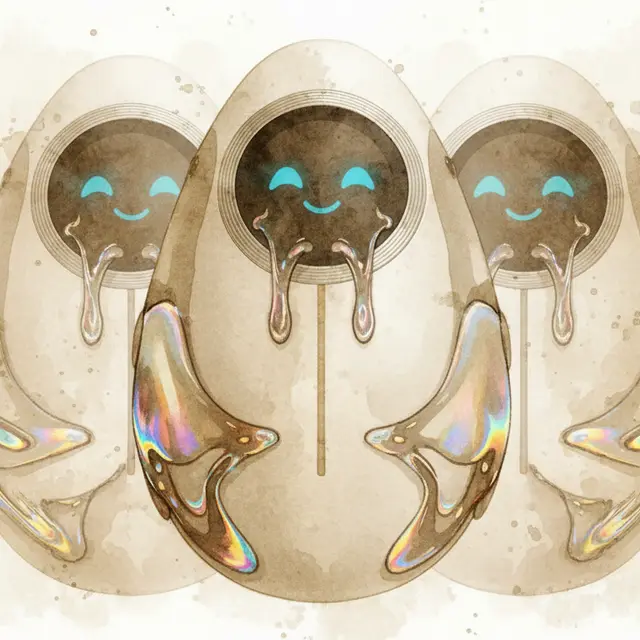
Palette: cyan / multicolor iridescent / dark brown / beige
- BPM
- 130 BPM
- Family
- The Edge of the Map
- Serial
- BRD-26
- Rarity
- Common
- Style strength
- 90
- Experimentation
- 58
Typical structure
[Emerging 303] → [Filter mutation] → [Modular chaos] → [Resonant climax] → [Acid decay]
How a lyric in this style thinks
A lyric in Acid Experimental doesn't tell a story: it processes one. That distinction is both technical and philosophical. In most genres, lyrics describe an emotional state from the outside or confess it from the inside. Here, the lyric is part of the mechanism that produces that state in the listener. Every phrase functions as one more parameter in the signal chain: if the 303 mutates the filter, the word mutates the image. If the resonance rises, the syntax compresses. The listener doesn't read a poem. They move through a process.
The sensory field of this genre belongs equally to the laboratory and the dancefloor. What you see: iridescent liquid that never quite solidifies, cyan bleeding into acid green, geometric shapes dissolving before they can define themselves, wet surfaces under cold light. What you touch: vibration in the sternum, temperature that shifts between metallic cold and circuit-board heat, textures that go from smooth to rough without warning. What you smell: ozone, warm plastic, something chemical without an exact name.
Three signature moves are worth knowing before you write a single line. The first is progressive image mutation: the same phrase comes back in the verse and the chorus, but something has shifted, one word swapped, an order reversed, a syllable added or dropped, and that minimal change is the most powerful expressive gesture the genre has. The second is physico-chemical synesthesia: a frequency has temperature, a filter has texture, resonance has specific weight.
The third is the liquid image: whatever is being described never fully solidifies, never acquires a definitive outline, and that instability is not a flaw but the entire point.
The surface tone is cold, almost clinical. But underneath the filter something hurts, something that's never stated directly and therefore presses harder because of it. The angles that work best are IMMERSED, which places the self inside the process without critical distance, and ABSENT, which depersonalizes until the images float on their own without a subject to anchor them. Both avoid direct confession because this genre doesn't confess: it induces.
- MUTATING 303
- HYPNOTIC ACID
- INSTRUMENTAL
Sample excerpt
The amber pilot light flickers twice. Four in the morning on the linoleum floor. I rewind the tape to the mark on the plastic. You said the exact same thing last Sunday. The copper wire stays bent in a loop. It doesn't break, it just turns warm.
Keep turning the dial. It moves, but it stays inside the frame. Keep turning the dial. Same hum, different name.
Workshop note — Acid experimental demands minimal, rhythmic text fragments that act as sonic textures rather than linear narrative lines. The chorus uses mechanical repetition to mirror the rising resonance and filter sweeps of a synth pattern. Clean resolution and direct emotional exposition are avoided to keep the focus on hypnotic, circular movement.
Sample excerpt written by MUSAI Song. Your lyrics are written from scratch, based on your story.
When to choose this style
This card works when the experience you want to turn into a song has no clean narrative arc and no emotion that can be summarized in a single line. It works for the feeling of circling the same thought for weeks without resolution: a grief that won't move forward, an obsession that won't close, a decision that keeps repeating without ever being made.
It works for someone who senses that something inside them is shifting without being able to name it yet: an identity in the middle of changing, a relationship that's no longer what it was but hasn't ended either. A father who has the same argument with his son every Sunday and nothing changes but everything is slowly changing. A musician in the longest creative block of their life who still shows up to the studio. It does not work for a clean breakup with a date and a name.
It does not work for a celebratory achievement with a clear recipient, or for a loss that needs to be mourned with direct, legible lyrics. It does not work when the story needs to be understood. It works when it needs to be felt until it tips into vertigo.
Your story in this style
MUSAI Song writes original lyrics from your story, in the Acid Experimental style, and delivers the finished sung song, the ready-to-use style recipe, and an illustrated art plate with its numbered certificate, private by default; public only if its owner publishes it.
- Original lyrics written from your story
- A finished sung song, ready to play and share
- Art plate with a unique seal and a numbered certificate, private by default; public only if its owner publishes it
Frequently asked questions
What BPM is Acid Experimental?
Acid Experimental usually runs at 130 BPM.
What does Acid Experimental sound like?
A 303 writhing through endless filter mutations and resonance. Acid experimental: the bass line that breathes and morphs without end, hypnotic, acidic, and deeply psychedelic.
What song structure does Acid Experimental use?
[Emerging 303] → [Filter mutation] → [Modular chaos] → [Resonant climax] → [Acid decay]
How do I write Acid Experimental lyrics?
Tell MUSAI Song your story and pick Acid Experimental: it writes original lyrics for this style at 130 BPM, you edit them word by word, and you get the song sung in Acid Experimental, with an illustration of the song and its numbered certificate. $19 USD per song, one-time payment.
Explore more styles
- Aleatoric Music
- Atonal / Serialism
- Avant-Prog
- Breakcore
- Chiptune Experimental
- Dark Ambient / Sound Art
- Deconstructed Club
- Digicore
- Drone Experimental
- Electroacoustic
- Footwork / Juke
- Fourth World
- Free Jazz
- Glitch
- Glitch-Hop / Wonky
- Hauntology
- Hyperpop
- IDM
- Jersey Club
- Microsound
- Musique Concrète
- Nameless Signal
- Nightcore
- Noise
Your idea or story, sung in this style
Card · secure payment via Stripe, charged in USD
If it doesn't move you, we give you your money back · 7 days