Samba Batucada
The surdo doesn't keep the beat — the beat asks the surdo for permission.
Get your song in Samba Batucada
Make yours in this styleHear it before you pay.$19 USD · your first song for $5.50 USDIf it doesn't move you, we give you your money back · 7 days.

Example in a sibling style: Cumbia Sonidera
“Esta Cumbia Va por Karla”
- Karla hoy cumples treinta
- y el barrio prende bocinas,
- la que armaba los karaokes
- nos recorre las esquinas.
Example made with MUSAI Song · sample story · See its certificate MUS-E3C4BD
Samba Batucada is a style from The Party That Never Ends family. 130 BPM, Experimentation 16, Style strength 96.
What is Samba Batucada?
An entire drum section beating like one giant heart. Batucada, the percussion tradition of Rio Carnival: pure collective euphoria, sun, and feathers.
How it sounds
It is four in the afternoon on Presidente Vargas Avenue, and the asphalt holds the midday heat like a hot skillet. There is no shade beneath the towering float structures lining up to enter the sambadrome. The air smells of warm sunscreen, spilled pilsner on the pavement, and the salt of five thousand bodies packed shoulder-to-shoulder since dawn. A twenty-two-inch surdo hits your chest cavity before your ears register the sound; every mallet strike sends a shockwave through the humid February air.
Tamborims slice through that heavy rumble with a dry, metallic crack whipped out by wrists that have rehearsed the exact same angle for months. Someone beside you wears a towering green plume that whips against your cheek with every jump, but the sting vanishes the moment the cuíca starts grinding its bamboo stick, letting out that raspy, mocking groan that sounds like an old alley cat. You are not walking; the current carries you.
A sequined costume flashes blindingly as the low sun hits it square, and confetti turns to soggy pulp beneath bare feet on the warm concrete. You are pressed against strangers, yet the exact second the chamada breaks the chaos and the entire percussion line drops as one single explosion, your arms fly upward and your mouth opens to shout a Portuguese phrase you learned five minutes ago but somehow knew by heart.
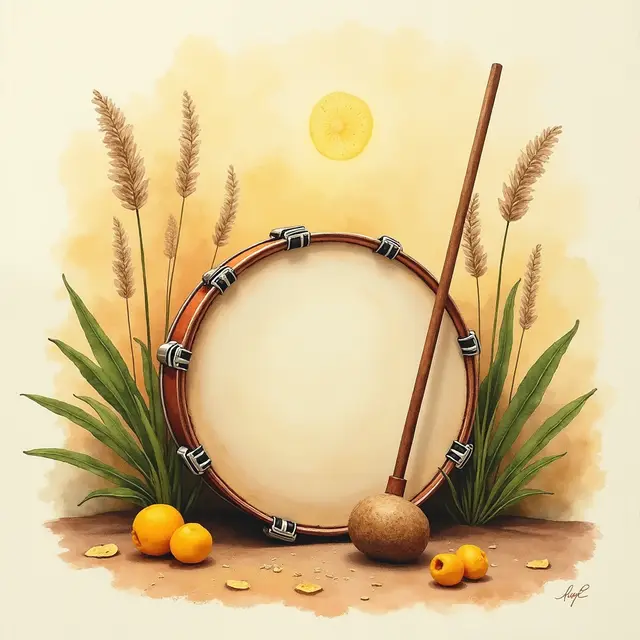
Palette: reddish brown / ochre yellow / green / beige
- BPM
- 130 BPM
- Family
- The Party That Never Ends
- Serial
- FST-18
- Rarity
- Epic
- Style strength
- 96
- Experimentation
- 16
Typical structure
[Intro] surdo → [Chamada] → [Drum Groove] → [Break] → [Euphoric Final Groove]
The details above are just the percussion notes anyone can jot down on a napkin. What remains hidden is how to keep relentless high-tempo joy from flattening out into noise, or how to make Portuguese slang ring true without sounding like a vacation postcard. That pulse lives inside an unreleased distillation of eight parameters, which the motor cross-references with your specific history before writing a single line. When it finishes, an internal judge measures the output against six canons of the genre and sends back anything that lacks the weight of a moving crowd. The beat can be copied. The heat of Rio, cannot.
How a lyric in this style thinks
A Samba Batucada lyric does not describe a celebration — it becomes the mechanism that makes one happen. The words exist to be shouted collectively, not read privately, and every line is engineered to disappear into the percussion battery and reappear as pure physical sensation. This is the lyric form of Rio Carnival's percussion tradition, where the text functions less as narrative and more as rhythmic fuel: syllables are chosen for how they land against a surdo hit, not for their poetic elegance. The emotional logic is entirely forward-facing.
There is no looking back, no accounting, no tenderness. The feeling arrives as pressure — chest-level, involuntary — the same way a twenty-two-inch drum arrives before your ears process it.
The base tone of Samba Batucada sits somewhere between proclamation and command. Emotion does not build slowly here; it detonates at the first downbeat and sustains through repetition rather than development. Repetition is not a lazy shortcut — it is the central structural tool. A chant phrase will cycle four, six, eight times because the body needs that many passes to lock into the groove and surrender to it.
Line length stays short and percussive: three to six syllables land cleanest against the tamborim's dry metallic snap, and anything longer risks losing the rhythmic pocket. Stress patterns follow the samba clave instinctively, with accented syllables falling where the agogô bell marks the pulse. If a line sounds natural spoken slowly, it probably won't survive at 130 BPM surrounded by an entire bateria — you have to write it at tempo in your head from the first draft.
The sensory field of this genre is hyper-specific and non-negotiable. Concrete belongs here: warm asphalt, the salt of packed bodies, sequined fabric catching low afternoon sun, confetti turning to pulp underfoot, the raspy groan of a cuíca cutting through the low-end rumble. These are not decorative images — they are the genre's evidence of authenticity. What Samba Batucada never uses: interior monologue, conditional tenses, metaphors that require stillness to unpack, anything that asks the listener to pause.
The cuíca's mocking, animal-like wail tells you the emotional register: irreverent, physical, almost feral in its joy. Lyrics that reach for refinement will sound wrong the moment the surdo hits.
Structurally, the form follows the percussion logic of the chamada — the collective signal that drops the entire drum section at once and reassembles it into the main groove. The intro plants the surdo pattern and nothing else, giving the listener time to feel the pulse before language arrives. The chamada section is where the lyric makes its core declaration, the one phrase the whole crowd will carry.
The drum groove section underneath is where call-and-response can live, with a lead voice throwing a short line and the group answering with a syllabic percussion phrase. The break is the moment of held breath — a sudden silence or near-silence — and the lyric here, if any, is stripped to its bones: one word, a name, a place. The euphoric final groove then brings everything back louder, and the chamada phrase returns in full force.
That architecture is not flexible; the emotional payoff of the finale only works because the break created the vacuum.
What separates a real Samba Batucada lyric from a generic party song is precisely this structural submission to the percussion. Generic imitations treat the drums as background and the lyric as foreground. In Batucada, the relationship inverts: the lyric is a rhythmic instrument that happens to carry semantic meaning, and when meaning conflicts with rhythm, rhythm wins every time. The collective triumph this genre celebrates — the whole block that pushed the cart uphill, not any single person — must be encoded in plural grammar and shared imagery. First-person singular is suspect here. The lyric speaks as a crowd or it speaks falsely.
- THUNDERING DRUMS
- RIO EUPHORIA
Sample excerpt
Step off the curb into the ochre dust, We pull the heavy iron gate off the rust, Coffee and sweat and the smell of the rain, Nobody remembers the weight or the strain, Move your shoulders, let the hips find the key, The pavement is humming beneath you and me.
Drumming the street until the sun goes down, We own every inch of this feverish town, Gold in our veins and the rhythm stays tight, Dancing our victory into the night.
Workshop note — Samba Batucada thrives on rhythmic propulsion, so keep your phrasing punchy with short, syncopated lines that mirror the beat of the surdo drums. Use high-energy, active verbs and group-focused imagery to capture a sense of collective movement. Avoid internal reflection or slow-paced metaphors, as this style demands constant forward momentum and outward-facing celebration.
Sample excerpt written by MUSAI Song. Your lyrics are written from scratch, based on your story.
When to choose this style
Choose this card when a family triumph has outgrown a quiet dinner and demands to spill out into the street. It works to celebrate a storefront surviving the hardest years and finally throwing its doors wide open with the volume turned all the way up. For the return of someone who spent years abroad and comes back with arms full of groceries and a laugh louder than ever. For an anniversary where nobody wants to look backward, only forward to the next dance.
This is the card of collective victory: when the achievement belongs not to a single person, but to the entire block that helped push the cart uphill. Do not choose it for a late-night confession, a quiet apology, or a nostalgic memory that asks for silence. Nor for an intimate wedding where guests prefer to talk softly in corners. If you are looking for a contained, elegant celebration, the card is Salsa Romántica.
Your story in this style
MUSAI Song writes original lyrics from your story, in the Samba Batucada style, and delivers the finished sung song, the ready-to-use style recipe, and an illustrated art plate with its numbered certificate, private by default; public only if its owner publishes it.
- Original lyrics written from your story
- A finished sung song, ready to play and share
- Art plate with a unique seal and a numbered certificate, private by default; public only if its owner publishes it
Frequently asked questions
What BPM is Samba Batucada?
Samba Batucada usually runs at 130 BPM.
What does Samba Batucada sound like?
An entire drum section beating like one giant heart. Batucada, the percussion tradition of Rio Carnival: pure collective euphoria, sun, and feathers.
What song structure does Samba Batucada use?
[Intro] surdo → [Chamada] → [Drum Groove] → [Break] → [Euphoric Final Groove]
How do I write Samba Batucada lyrics?
Tell MUSAI Song your story and pick Samba Batucada: it writes original lyrics for this style at 130 BPM, you edit them word by word, and you get the song sung in Samba Batucada, with an illustration of the song and its numbered certificate. $19 USD per song, one-time payment.
Explore more styles
- Afro House
- Afrobeats
- Amapiano
- Axé Bahia
- Bomba & Plena
- Calypso
- Cha-Cha-Chá
- Champeta
- Cuarteto Cordobés
- Cuban Son
- Cuban Timba
- Cumbia Norteña
- Cumbia Sonidera
- Cumbia Villera
- Dancehall
- Dominican Dembow
- Electronic Guaracha
- Funk Carioca
- Highlife
- Kuduro
- Mambo
- Merengue
- Pagode
- Peruvian Cumbia (Chicha)
Your idea or story, sung in this style
Card · secure payment via Stripe, charged in USD
If it doesn't move you, we give you your money back · 7 days