Cuban Son
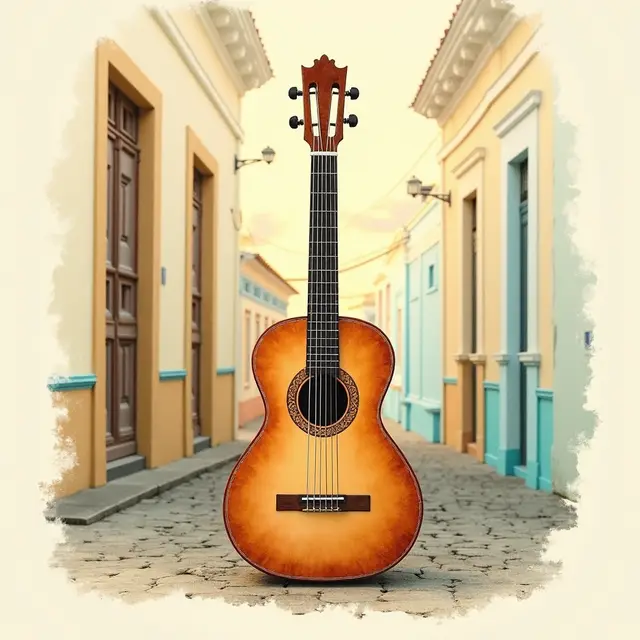
The cobblestone street already knows the next chord by heart.
Get your song in Cuban Son
Make yours in this styleHear it before you pay.$19 USD · your first song for $5.50 USDIf it doesn't move you, we give you your money back · 7 days.

Example in a sibling style: Cumbia Sonidera
“Esta Cumbia Va por Karla”
- Karla hoy cumples treinta
- y el barrio prende bocinas,
- la que armaba los karaokes
- nos recorre las esquinas.
Example made with MUSAI Song · sample story · See its certificate MUS-E3C4BD
Cuban Son is a style from The Party That Never Ends family. 95 BPM, Experimentation 14, Style strength 97.
What is Cuban Son?
A Cuban tres guitar ringing out and a bongó in full conversation. Son cubano, the root of all Caribbean music, is warm, elegant, and as timeless as Havana itself.
How it sounds
It is five in the afternoon on a corner in old Havana where a mango-and-turquoise facade peels away with the grace of well-worn years. The cobblestone still holds the midday heat, and the breeze from the Malecón slips through the shaded doorway carrying the scent of cured tobacco and sea salt. You are sitting in a wicker rocking chair that creaks in time, watching the sun slice through wooden shutters into exact beams of light.
Three houses down, someone tunes a tres guitar: the steel strings sound dry at first, a crisp ripple cutting the air before locking into pitch. Next to it, the bongo answers with a tight skin vibrating beneath fingertips, setting a pulse so natural it feels like the street itself is breathing. A neighbor's skirt sweeps past the corner as she walks, and the wooden double bass drops underneath like a slow pulse beating beneath the pavement. There is no rush anywhere. Clear rum sits in a glass without ice, sweating slowly against the rim.
The music builds on its own, not by command, but because the air itself no longer knows how to stay quiet. The tres strikes again, the dialogue between the skins grows denser, and suddenly the whole afternoon arranges itself around a rhythm that asks for no permission to move into your chest.
Palette: gold amber / turquoise / warm brown
- BPM
- 95 BPM
- Family
- The Party That Never Ends
- Serial
- FST-24
- Rarity
- Rare
- Style strength
- 97
- Experimentation
- 14
Typical structure
[Intro] tres → [Largo/Verse] → [Montuno] chorus → [Soneo] → [Final Chorus]
The four data points above are only the surface of the recipe that fits in a table. What remains unseen is how to maintain the tension between the tres and the bongo without the party collapsing into empty noise, or how to make improvised sonero verses sound like porch conversation rather than forced rhymes. Behind that lies an unlisted internal distillate of eight parameters that the engine crosses with your personal story. When finished, an internal judge measures the lyric against six dimensions of the canon and sends back anything lacking the exact weight of the street for repair. The beat is tuned. The root, not.
How a lyric in this style thinks
A son cubano lyric does not confess — it declares. The words arrive the way the tres guitar does: clear, ringing, already in motion before you fully register them. This is a genre built on the assumption that joy is not fragile and does not need to be protected with irony or understatement. Son cubano carries a personal story the way a good rocking chair carries a body: with warmth, with a slow rhythmic give, with the sense that this particular piece of furniture has held many people and will hold many more.
The emotion does not escalate dramatically; it deepens. Every verse lays down another layer of amber light on the same scene, and by the time the montuno arrives, the listener is not surprised by the feeling — they are already inside it.
The structural logic of son cubano divides cleanly into two different kinds of speech. The largo, or verse, is where the story lives in full sentences — specific names, specific places, the smell of cured tobacco on a shirt, the sound a wooden door makes when it swings open in the afternoon heat. These lines tend to be longer, more narrative, almost conversational in cadence, sitting loosely over the upright bass pulse that moves beneath them like a slow tide under pavement. Then the montuno section arrives and everything contracts.
The coro — the repeated chorus phrase — becomes a short, declarative unit, often no more than six or eight syllables, sung by multiple voices and answered by a lead voice improvising in the soneo. This call-and-response is not decoration; it is the architecture. The lyric literally splits into two roles: the crowd that knows the truth and the voice that keeps finding new ways to say it.
Repetition in son cubano is intentional and load-bearing. The coro phrase will be sung many times, and the craft is in choosing a line that does not wear out — something concrete enough to feel real, short enough to lock into the body's rhythm, and open enough to absorb the soneo improvisations layered against it. Lines that work tend to name a specific object or gesture: a glass of rum sweating on a windowsill, cobblestones holding midday heat, a skirt moving past a corner.
Lines that fail reach for abstraction — love as a concept, time as a metaphor, happiness as a general condition. The sensory field of this genre is narrow and precise: wooden interiors, sea-salt air, dry steel strings, warm skin, afternoon light through shutters. It does not do cold climates, neon, concrete towers, or the interior of a car at night.
Vocal delivery in son cubano sits relaxed and authoritative at the same time, rarely pushing into the upper register for emotional emphasis the way pop or salsa romántica would. The voice trusts the rhythm to carry the weight. At around 95 BPM, the tempo gives the syllables room to breathe, and a lyricist should write with that space in mind — do not crowd the lines. The bongó sets a pulse so conversational that over-written lyrics will fight it rather than ride it.
The tres guitar, with its dry crisp ripple and its habit of locking into a rolling montuno pattern, suggests a lyric that also has that quality: something that chimes clearly and then settles into a groove without demanding attention.
What separates a real son cubano lyric from a generic imitation is the absence of nostalgia as pain. This genre celebrates heritage without mourning it. A grandparent who built a home with empty hands is not a figure of tragedy here — they are evidence of something that worked, something that held. A couple who has spent decades dancing on the same floor is not a symbol of time passing; they are the proof that some things do not need to change. The writing should feel like the afternoon it describes: unhurried, warm, slightly worn at the edges in a way that only makes it more beautiful, with no desire to be anywhere else.
- RINGING TRES
- TIMELESS ROOT
Sample excerpt
Old man Mateo holds the wooden box, his calloused fingers waking up the strings. On the porch, the afternoon clock forgets to tick while the sweet music sings. We poured the rum into the clay pot, brown as the earth where our mothers were born. Nobody leaves this corner of town until the shadow meets the golden morn.
Keep the tres ringing loud and clear, bring the bongó close to the fire. We dance through the hours right here, as the rhythm takes us higher.
Workshop note — This verse anchors the story in tangible objects like the wooden tres and the clay pot, avoiding vague abstractions to build an authentic setting. The montuno chorus relies on call-and-response momentum and tight internal rhythm, keeping the celebration warm and unbroken.
Sample excerpt written by MUSAI Song. Your lyrics are written from scratch, based on your story.
When to choose this style
Choose this card when a personal story calls to celebrate heritage without disguises or bitter nostalgia. It works to thank grandparents who built a home with empty hands and a wide grin. For the anniversary of two people who have spent half a lifetime dancing on the same floor while the world changes around them. To tell of a return to a hometown where everyone knows your name and the air smells just like childhood. For the pride of belonging to a loud, warm, stubborn family that refuses to break.
To celebrate that real love is not a wildfire but a steady hearth that lasts decades. Do not choose this card to tell of a recent loss, a bitter breakup, or a grief that still needs silence: son cubano does not know how to cry inward, and forcing it would sound like a farce. Neither is it for solitary introspection or dark urban grit. If you look for an elegant celebration where joy is an open door, the card is Salsa Romántica.
Your story in this style
MUSAI Song writes original lyrics from your story, in the Cuban Son style, and delivers the finished sung song, the ready-to-use style recipe, and an illustrated art plate with its numbered certificate, private by default; public only if its owner publishes it.
- Original lyrics written from your story
- A finished sung song, ready to play and share
- Art plate with a unique seal and a numbered certificate, private by default; public only if its owner publishes it
Frequently asked questions
What BPM is Cuban Son?
Cuban Son usually runs at 95 BPM.
What does Cuban Son sound like?
A Cuban tres guitar ringing out and a bongó in full conversation. Son cubano, the root of all Caribbean music, is warm, elegant, and as timeless as Havana itself.
What song structure does Cuban Son use?
[Intro] tres → [Largo/Verse] → [Montuno] chorus → [Soneo] → [Final Chorus]
How do I write Cuban Son lyrics?
Tell MUSAI Song your story and pick Cuban Son: it writes original lyrics for this style at 95 BPM, you edit them word by word, and you get the song sung in Cuban Son, with an illustration of the song and its numbered certificate. $19 USD per song, one-time payment.
Explore more styles
- Afro House
- Afrobeats
- Amapiano
- Axé Bahia
- Bomba & Plena
- Calypso
- Cha-Cha-Chá
- Champeta
- Cuarteto Cordobés
- Cuban Timba
- Cumbia Norteña
- Cumbia Sonidera
- Cumbia Villera
- Dancehall
- Dominican Dembow
- Electronic Guaracha
- Funk Carioca
- Highlife
- Kuduro
- Mambo
- Merengue
- Pagode
- Peruvian Cumbia (Chicha)
- Peruvian Festejo
Your idea or story, sung in this style
Card · secure payment via Stripe, charged in USD
If it doesn't move you, we give you your money back · 7 days