Cuarteto Cordobés
The accordion opens the night and the crowd makes sure it never closes.
Get your song in Cuarteto Cordobés
Make yours in this styleHear it before you pay.$19 USD · your first song for $5.50 USDIf it doesn't move you, we give you your money back · 7 days.

Example in a sibling style: Cumbia Sonidera
“Esta Cumbia Va por Karla”
- Karla hoy cumples treinta
- y el barrio prende bocinas,
- la que armaba los karaokes
- nos recorre las esquinas.
Example made with MUSAI Song · sample story · See its certificate MUS-E3C4BD
Cuarteto Cordobés is a style from The Party That Never Ends family. 130 BPM, Experimentation 16, Style strength 92.
What is Cuarteto Cordobés?
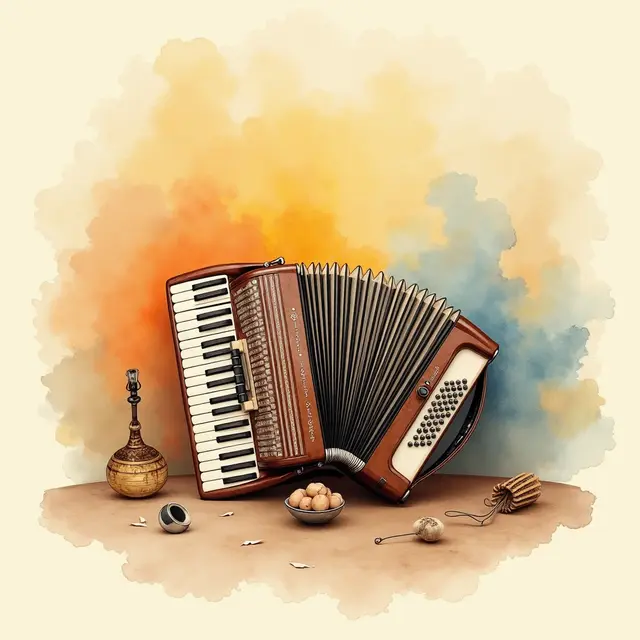
A bouncing tunga-tunga piano and a joyful accordion. Cuarteto cordobés, the beloved popular dance music of Argentina: bouncy, big-hearted, and built for a crowd.
How it sounds
It is three in the morning inside a packed social club in Córdoba where the asphalt still holds the dry heat of yesterday afternoon. The corrugated tin roof groans from the thick humidity, and a rusted industrial fan churns warm air without cooling anyone down. You are leaning against the sticky wooden bar with a half-empty glass, watching dust motes spin inside the beam of a borrowed spotlight flashing dull red.
On stage, the piano drives the tunga-tunga with mechanical insistence, a dry, chopped chord hitting the soles of your feet before climbing straight up your calves. The accordion cuts through, stretching a note that smells like cheap cologne and crowded buses, opening wide like a lung breathing for the entire room. Nobody is looking down. A guy next to you with his shirt unbuttoned to the sternum is drumming his knuckles on the counter to the exact pulse, and a girl three steps away spins with her eyes closed, holding a plastic cup of melted ice.
The bass pushes from underneath, a thick thud that rattles your ribs and erases any thought longer than three words. There is no pause to dwell on yesterday or worry about tomorrow; there is only this chord starting over, the collective jump kicking up a thin cloud of dust from the tile floor, and the stubborn, beautiful certainty that nobody wants to be anywhere else.
Palette: orange / blue / yellow
- BPM
- 130 BPM
- Family
- The Party That Never Ends
- Serial
- FST-29
- Rarity
- Common
- Style strength
- 92
- Experimentation
- 16
Typical structure
[Intro] tunga-tunga piano → [Verse] → [Chorus] → [Verse 2] → [Final chorus]
The data above can be copied in a minute with any keyboard. What cannot be copied is the precise distance between the piano's dry hit and the accordion's breath without turning the party into a mess. You have to know where the syllable lands so the jump feels like a visceral need rather than a gym instruction. All of that lives in an unpublished internal distillate, and the engine crosses that pulse with your history before writing the first line. When it finishes, an internal judge measures the lyrics against six dimensions of the canon and sends back anything that trips up. The tunga-tunga can be played by anyone. The chest-tearing joy that makes you leap, cannot.
How a lyric in this style thinks
A lyric in Cuarteto Cordobés does one thing above everything else: it gives the body permission to stop thinking. The words arrive not to be studied but to be shouted back at the stage by people who already know them, whose mouths move before the line is finished.
This is the beloved popular dance music of Argentina's interior, rooted in Córdoba, and a lyric written for it must carry the same mechanical certainty as the tunga-tunga itself — that chopped, insistent piano chord landing on beats one and three with the precision of a heartbeat that refuses to be talked out of anything. The emotion is not complicated. It is orange and gold and loud: the euphoria of a body that has earned the right to be here, in this room, at this hour, with these people.
The base tone is communal relief dressed as celebration. Whatever weight the week carried, the lyric does not name it carefully — it names the release. Verses in Cuarteto Cordobés tend to be short and declarative, sketching a scene rather than excavating a feeling. Three or four lines that locate you in a specific, sensory moment: the heat, the crowd, the glass in your hand, the bass rattling your sternum. Line length stays tight. Long subordinate clauses belong to a different genre entirely.
The rhythm demands syllables that land cleanly on the beat, and the melody will not wait for a thought to finish. Rhyme is expected and should arrive without apology — slant rhyme reads as laziness here, not sophistication.
The chorus is where the lyric earns its keep. It must be short enough to yell, open enough in its vowels to survive a packed room with bad acoustics, and specific enough that it does not dissolve into generic celebration. The hook is not a metaphor — it is a declaration. It says what is true right now, at three in the morning, with the accordion stretched wide and the bass pushing from underneath.
The structure follows the logic of the dance floor: intro to establish the tunga-tunga pulse, a verse to set the scene, a chorus that lifts the room, a second verse that deepens the story just enough, then a final chorus that the crowd already owns. There is no bridge to slow things down, no key change to signal introspection. The song does not step outside itself.
The sensory field is very specific. Cuarteto Cordobés lives in corrugated tin roofs and tile floors, in cheap cologne and melted ice in plastic cups, in borrowed spotlights and the physical thud of a bass cabinet. The accordion is not decorative — it is the lung of the song, the thing that breathes for everyone in the room. The piano's chopped chord is not background texture; it is the skeleton. Lyrics should reflect this material world. Concrete nouns outperform abstractions every time.
A rusted fan, a sticky bar, a shirt unbuttoned in the heat — these images carry more emotional weight than any word meaning happiness. What the genre never uses: indoor melancholy, winter imagery, silence as a value, or the kind of introspective second-guessing that requires a listener to sit down.
What separates a real Cuarteto Cordobés lyric from a generic party song is the specificity of the joy. Generic celebration is universal and therefore weightless. Real Cuarteto is Córdoba on a summer night, working-class and proud, communal in a way that does not perform itself. The lyric should feel as though it was written by someone inside the room, not observing it. Vocals are delivered with forward placement, chest-driven, sometimes conversational in the verses and fully committed in the chorus — not polished, not breathy.
If you are producing this for Suno or a similar platform, the style prompt should anchor the tunga-tunga rhythm explicitly, keep the BPM at or near 130, and ask for accordion and piano as primary voices. The bounce lives in the gap between the chopped chord and the bass thud. Keep your lyrics short-lined, rhyme-forward, and grounded in a room you can smell.
- TUNGA-TUNGA
- POPULAR JOY
Sample excerpt
Cut the tall plastic bottle and fill it with ice, Roll the old metal fan to the middle of the yard. After seven long months of counting every single price, The front shutter stays open and we don't work hard! Leo brings the soda crates, yelling through the door, Kick your dusty boots off right across the kitchen floor!
Pass the pitcher around, let the whole alley hear! Put your hands on my shoulders and bounce on the beat! Every bad week is finished, the table is clear, And we jump till the morning brings gold to the street!
Workshop note — Cuarteto relies on short, punchy lines that lock into the galloping tunga-tunga piano rhythm rather than drifting into poetic abstraction. The chorus succeeds by using direct physical instructions—jumping, passing drinks, shouting across the patio—to transform a working-class relief into an irresistible crowd anthem. The genre forbids whispery confessions and slow-building melancholia; every lyric must be loud enough to compete with a brass section.
Sample excerpt written by MUSAI Song. Your lyrics are written from scratch, based on your story.
When to choose this style
Choose this card when you need to tell of a hard-won joy, a small victory that demands to be shouted out loud with friends until your voice gives out. It works to celebrate a family business finally paying off after years of tight corners, a long-awaited reunion with a sibling coming home with heavy bags, or that sweltering summer night when you decide the week's troubles stay outside the door. This style is not for neat sorrows or quiet confessions; it is for when euphoria is the only way left for the body to say thank you.
Do not use it for solemn farewells, long griefs, or quiet reconciliations that need stillness and low volume. If your story asks for a still embrace and a late-night talk, this rhythm will make too much noise. If you want a warm celebration with a different bounce and less jumping, the card is Cumbia Norteña.
Your story in this style
MUSAI Song writes original lyrics from your story, in the Cuarteto Cordobés style, and delivers the finished sung song, the ready-to-use style recipe, and an illustrated art plate with its numbered certificate, private by default; public only if its owner publishes it.
- Original lyrics written from your story
- A finished sung song, ready to play and share
- Art plate with a unique seal and a numbered certificate, private by default; public only if its owner publishes it
Frequently asked questions
What BPM is Cuarteto Cordobés?
Cuarteto Cordobés usually runs at 130 BPM.
What does Cuarteto Cordobés sound like?
A bouncing tunga-tunga piano and a joyful accordion. Cuarteto cordobés, the beloved popular dance music of Argentina: bouncy, big-hearted, and built for a crowd.
What song structure does Cuarteto Cordobés use?
[Intro] tunga-tunga piano → [Verse] → [Chorus] → [Verse 2] → [Final chorus]
How do I write Cuarteto Cordobés lyrics?
Tell MUSAI Song your story and pick Cuarteto Cordobés: it writes original lyrics for this style at 130 BPM, you edit them word by word, and you get the song sung in Cuarteto Cordobés, with an illustration of the song and its numbered certificate. $19 USD per song, one-time payment.
Explore more styles
- Afro House
- Afrobeats
- Amapiano
- Axé Bahia
- Bomba & Plena
- Calypso
- Cha-Cha-Chá
- Champeta
- Cuban Son
- Cuban Timba
- Cumbia Norteña
- Cumbia Sonidera
- Cumbia Villera
- Dancehall
- Dominican Dembow
- Electronic Guaracha
- Funk Carioca
- Highlife
- Kuduro
- Mambo
- Merengue
- Pagode
- Peruvian Cumbia (Chicha)
- Peruvian Festejo
Your idea or story, sung in this style
Card · secure payment via Stripe, charged in USD
If it doesn't move you, we give you your money back · 7 days