Salsa Dura
The clave does not forgive a missed step.
Get your song in Salsa Dura
Make yours in this styleHear it before you pay.$19 USD · your first song for $5.50 USDIf it doesn't move you, we give you your money back · 7 days.

Example in a sibling style: Cumbia Sonidera
“Esta Cumbia Va por Karla”
- Karla hoy cumples treinta
- y el barrio prende bocinas,
- la que armaba los karaokes
- nos recorre las esquinas.
Example made with MUSAI Song · sample story · See its certificate MUS-E3C4BD
Salsa Dura is a style from The Party That Never Ends family. 98 BPM, Experimentation 18, Style strength 98.
What is Salsa Dura?
A piano that rings, brass that bites, and a sonero improvising fire. New York's hard salsa: pure street, pure pride, pure flavor.
How it sounds
It is three in the morning in a Bronx social club where the air turns thick with the smell of spilled rum and leather soles scraping against linoleum. The heat offers no quarter; it clings to the back of the neck, turning open shirts into damp rags. In the back, perched on a makeshift stage built from empty fruit crates, the montuno piano has been hammering out that obsessive, chopping phrase for ten minutes straight, forcing hips to answer before the brain can catch the clave.
The congas crack dry, animal hide stretched to its breaking point over an open flame just minutes before hitting the stand. No one is standing still. A woman plants her hands on her hips and beats the two-three on the heel of her shoe, driving a wedge of pure force into the floorboards with every step.
Then, without warning, the brass bites into the air: the trumpet spits out a high note that slices through the room like shattered glass while the trombone answers from underneath, dragging a dark tone that tastes of hot asphalt and dead-end streets. The lead singer steps up to a battered Shure mic with a dented grill and launches a pregón that asks for zero permission. He drops names, dates, neighborhood inside jokes meant only for those who have spent years paying rent in this exact currency.
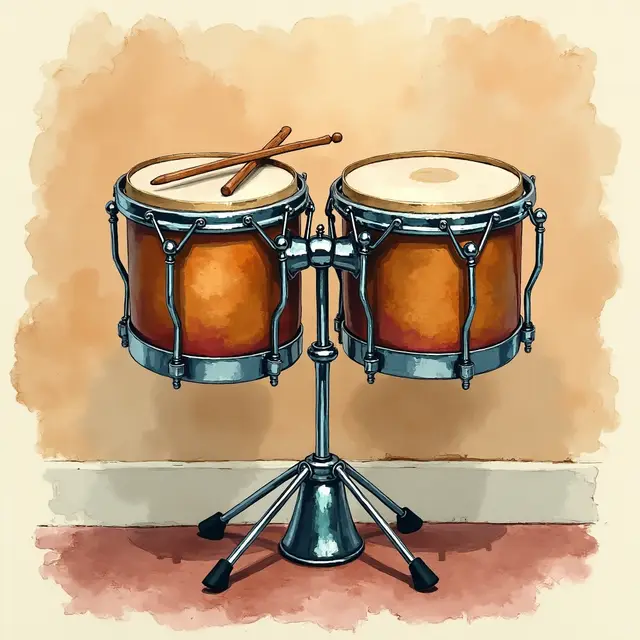
The crowd roars the coro right back, doubling the volume, turning the entire room into a single throat spitting out unyielding pride. The timbales snap a furious fill, wood striking rim with a metallic click that hammers right against the temple, and the groove refuses to break: it gets denser, heavier, until the floor itself feels like it is hovering above the brass.
Palette: toasted orange / dark red / metallic bluish gray / gold
- BPM
- 98 BPM
- Family
- The Party That Never Ends
- Serial
- FST-01
- Rarity
- Master
- Style strength
- 98
- Experimentation
- 18
Typical structure
[Intro] montuno piano → [Verse] → [Chorus/Pregón] → [Mambo] brass → [Montuno] improvised soneo → [Final Chorus]
The data above can be copied in a minute. What cannot be copied is the judgment: how to calculate the exact distance between the pregón and the coro response so the tension never drops, or where to drop the brass so the piano sounds dirtier and truer. That lives in an unreleased internal distillate of eight parameters that the engine crosses with the buyer's story. Upon completion, an internal judge measures the lyric against six canons and repairs anything that sounds artificial or forced. The rhythm gets copied. Street fire, no.
How a lyric in this style thinks
A salsa dura lyric does not describe an emotion — it performs a verdict. The singer walks up to the mic and declares something that the room already knows to be true, and the room roars back because hearing it said out loud, at this volume, is the whole point. This is the genre for stories that have already been won, already been survived, and now need to be announced. The hard salsa tradition, rooted in the dense urban heat of New York's Latin neighborhoods from the late 1960s onward, builds its lyrical logic around confrontation with witnesses: you were there, you know what happened, now let's say it together until the walls shake.
The structure divides into two distinct emotional gears. The verse, the pregón, carries the narrative weight — specific names, specific corners, specific debts paid and scores settled. Line lengths here tend to be long and declarative, built for a voice that projects rather than confides. The sonero does not murmur. Each line lands with the weight of testimony, not confession. Then the coro arrives and everything compresses: four to eight syllables, maximum, repeated with increasing ferocity as the crowd doubles the volume back at the stage.
The coro is not a hook in the pop sense — it is a collective statement, a thing the room owns, not the singer. The best coro lines in salsa dura sound obvious the moment you hear them, as if they were always waiting to be said. That simplicity is the craft.
When the montuno section opens and the soneo begins — the improvised, semi-spoken commentary the sonero layers over the churning piano — the lyric loosens into something closer to street speech, dropping inside references, neighborhood shorthand, the kind of detail that excludes outsiders deliberately. That exclusion is not a flaw; it is the proof of authenticity.
The sensory field in salsa dura is brutally physical and urban. Linoleum floors, damp shirts, cracked leather, the smell of rum and cigarette smoke, the metallic crack of timbale rims, hot asphalt outside a venue that has no air conditioning. These are not poetic flourishes — they are the genre's address. The piano montuno is the rhythmic engine, a two-bar chopping phrase that repeats with obsessive precision, and your lyric needs to have the same quality: a core phrase that can sustain repetition without losing force.
The brass section — trumpet cutting high, trombone dragging dark and low — functions as punctuation. When you write a salsa dura lyric, you are writing for a band that will interrupt you with brass at the end of every phrase, so leave space for the bite. Short, declarative endings to lines work far better than lines that trail off into softness.
What separates a genuine salsa dura lyric from a generic imitation is specificity of pride. Generic versions celebrate vaguely — survival, strength, community. Real salsa dura names the thing that almost broke you and then dismisses it with almost contemptuous confidence. The emotion is not gratitude; it is vindication. The tone sits in that register of dark gold and metallic resolve — warm enough to feel like celebration, hard enough to feel like evidence. There is no room for ambiguity, no space for the quiet second-guess.
If a line could work in a ballad, cut it. If a line sounds like it belongs on a motivational poster, cut it. The lyric should sound like someone who has been through something real and has zero patience for anyone who wasn't there. Tempo sits around 98 BPM, which feels deceptively moderate until the full percussion grid locks in — then it becomes a machine, and your words need to be built like bricks, not silk.
For Suno or any other platform rendering this style, the prompt anchors you want are the piano montuno, the aggressive brass section with trumpet and trombone, dry timbales and congas, and a vocalist with the projection of a pregonero rather than a pop singer. The production should feel dense and slightly compressed, the brass sitting right against the voice rather than behind it. Salsa dura does not breathe — it presses forward, and your lyric should carry the same refusal to pause.
- BOLD BRASS
- STREET SONEO
Sample excerpt
The radiator rattles like a snare drum in the hall, I scrub the grease off the counter till it shines like gold. Twenty years of rent checks paid on the eleventh day, My brother pulls the shutters up to block the humid spray. We carry crates of plantains up the stairs to meet the light, Keeping pace with the heavy traffic humming through the night.
Shake the dust off the floor, keep the rhythm steady and tight, We built this empire brick by brick beneath the streetlamp bright, No handouts here, just the sweat and the heat of the fight.
Workshop note — Salsa dura thrives on rhythmic precision and percussive phrasing, so keep your syllable counts consistent to match the driving piano montuno. The chorus should function as a call-and-response hook that emphasizes communal strength or local pride rather than personal fragility. Avoid overly poetic metaphors; the lyrics must stay anchored in the physical reality of the street, the job, or the struggle to maintain one's ground.
Sample excerpt written by MUSAI Song. Your lyrics are written from scratch, based on your story.
When to choose this style
Choose this card when a personal story is a hard-won triumph that demands to sound like a community victory. It works to celebrate a family business surviving twenty years of hard times without losing its dignity. For the birthday party of someone who wears their neighborhood in their posture and has zero tolerance for false modesty. For recounting a reconciliation that was loud rather than sweet, an embrace after a shouting match on the pavement.
It serves the pride of making it through without asking for favors, head held high and shoes worn down from walking toward a break. Salsa dura does not work for quiet, whispered confessions or silent griefs. This is not the genre for a sad farewell, a melancholic reflection on the past, or a subtle thank-you note. If the emotion asks for pause, distance, or held-back tears, this card will feel too loud and too wide. If you are looking for a slow-burn intimate confession of love, the card is Salsa Romántica.
Your story in this style
MUSAI Song writes original lyrics from your story, in the Salsa Dura style, and delivers the finished sung song, the ready-to-use style recipe, and an illustrated art plate with its numbered certificate, private by default; public only if its owner publishes it.
- Original lyrics written from your story
- A finished sung song, ready to play and share
- Art plate with a unique seal and a numbered certificate, private by default; public only if its owner publishes it
Frequently asked questions
What BPM is Salsa Dura?
Salsa Dura usually runs at 98 BPM.
What does Salsa Dura sound like?
A piano that rings, brass that bites, and a sonero improvising fire. New York's hard salsa: pure street, pure pride, pure flavor.
What song structure does Salsa Dura use?
[Intro] montuno piano → [Verse] → [Chorus/Pregón] → [Mambo] brass → [Montuno] improvised soneo → [Final Chorus]
How do I write Salsa Dura lyrics?
Tell MUSAI Song your story and pick Salsa Dura: it writes original lyrics for this style at 98 BPM, you edit them word by word, and you get the song sung in Salsa Dura, with an illustration of the song and its numbered certificate. $19 USD per song, one-time payment.
Explore more styles
- Afro House
- Afrobeats
- Amapiano
- Axé Bahia
- Bomba & Plena
- Calypso
- Cha-Cha-Chá
- Champeta
- Cuarteto Cordobés
- Cuban Son
- Cuban Timba
- Cumbia Norteña
- Cumbia Sonidera
- Cumbia Villera
- Dancehall
- Dominican Dembow
- Electronic Guaracha
- Funk Carioca
- Highlife
- Kuduro
- Mambo
- Merengue
- Pagode
- Peruvian Cumbia (Chicha)
Your idea or story, sung in this style
Card · secure payment via Stripe, charged in USD
If it doesn't move you, we give you your money back · 7 days