Tone Poem
The orchestra paints what the brush can't reach.
Get your song in Tone Poem
Make yours in this styleHear it before you pay.$19 USD · your first song for $5.50 USDIf it doesn't move you, we give you your money back · 7 days.

Example in a sibling style: Viennese Waltz
“Bailamos el Error”
- Ximena giraba en el patio,
- tu vestido color lavanda,
- ensayaste contra la madera
- los pasos que el violín te anda.
Example made with MUSAI Song · sample story · See its certificate MUS-9QMRYG
Tone Poem is a style from the Hall of Centuries family. 76 BPM, Experimentation 22, Style strength 95.
What is Tone Poem?
An orchestra that tells an entire legend without saying a word. The symphonic poem: music that draws heroes, landscapes, and storms out of pure sound.
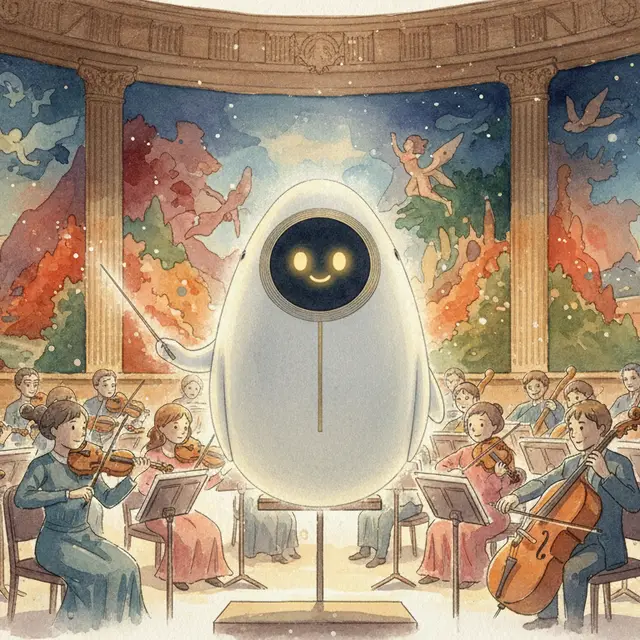
How it sounds
Five in the afternoon inside an auditorium where the burgundy velvet of the seats smells of aged dust and cured spruce. Outside, the storm pushes against the tall windows with a dull insistence, shaking the trees until their spines bend. On stage, beneath the golden cone of a single spotlight, the string section attacks a unison that asks for no permission; bows strike the gut strings with the exact friction of a knife on whetstone. There are no words, but the room saturates with the urgency of a march advancing toward a blind canyon.
The oboe introduces the main theme, a fragile, melancholic line floating above the muffled rumble of the timpani, like a bird crossing a leaden sky. You feel the double bass in the soles of your feet, a low vibration climbing your ankles to settle in your sternum like a cold weight. The brass enters abruptly, trumpets and horns fused into a chord that expands the space, forcing you to shrug your shoulders against the sheer mass of sound. Notes are not merely heard; they unfurl like torn banners across a field where no one is left standing.
The conductor's baton cuts the air in a dry gesture, and the entire orchestra yields—not into silence, but into a tense suspension where every instrument continues ringing in the still air.
Palette: deep blue / burgundy / warm gold
- BPM
- 76 BPM
- Family
- Hall of Centuries
- Serial
- SAL-14
- Rarity
- Common
- Style strength
- 95
- Experimentation
- 22
Typical structure
[Character theme] → [Transformation] → [Conflict] → [Climax] → [Narrative resolution]
The details above are merely the score anyone can read from a music stand. What remains unseen is how to prevent grandiosity from turning pompous, or how to translate a domestic memory into a conflict of brass and strings without losing its truth. That lives in an unpublihed internal distillate of eight parameters that the engine crosses with your story before writing a single note. Upon completion, an internal judge measures the lyric against six dimensions of the canon and repairs whatever sounds like a school exercise. Notes can be written on any staff. The architecture of destiny, cannot.
How a lyric in this style thinks
A lyric written for the symphonic poem does not describe emotion — it becomes the architecture through which emotion moves. This genre, rooted in the programmatic tradition of the concert hall, asks words to behave like orchestral themes: they must introduce a character or a landscape with enough weight that the reader feels the double bass in their sternum before the brass even enters. The symphonic poem as a lyrical form is not interested in confession at a human scale.
It deals in myth-sized grief, in the silence that outlasted a family, in the name someone buried at a border crossing because the new country could not pronounce it. If the subject does not carry that density, the form will expose the thinness immediately.
The base tone is deep blue shading toward warm gold — not the gold of celebration, but the gold of late light on a field where something irreversible has already happened. Emotion in this genre does not arrive through direct statement. It arrives through accumulation, the way a timpani roll builds under a melody until the vibration is felt in the chest rather than heard with the ears.
Repetition functions structurally here: a phrase introduced in the opening character theme must return, transformed, in the conflict and again at the climax, each time carrying more harmonic weight, more scar tissue. Line length tends toward the long and unbroken, mirroring the sweep of a bow across gut string, then contracts sharply at moments of rupture — a single short syllable landing like a conductor's dry cut through the air.
The sensory field of the symphonic poem is specific and non-negotiable. You are inside burgundy velvet, aged dust, cured spruce, tall windows under storm pressure. The textures are physical and resistant — knife on whetstone, cold weight settling in the sternum, spines bending in wind. What this genre never uses: the casual domestic, the ironic aside, the throwaway cultural reference. No office, no dinner table, no device notifications. The imagery must be large enough to sustain a full orchestra without shrinking.
An oboe line floating above muffled timpani is the right register; a text message is not. Concrete objects are allowed and necessary, but they must carry mythic load — a cardboard suitcase crossing an ocean, a yellowed map surviving in an attic, a silence that lasted decades.
The structural logic follows the canon of the form: character theme, transformation, conflict, climax, narrative resolution. This is not verse-chorus-verse pop architecture. Sections do not repeat for comfort; they develop, the way a melodic theme develops through orchestral development — each return is a different creature wearing the same face. The climax is not the loudest moment for its own sake; it is the moment when all the transformed themes collide into a chord that expands the room.
After that, the resolution does not resolve into happiness. It resolves into weight acknowledged, into the tense suspension where every instrument continues ringing in still air long after the baton has fallen.
What separates a genuine symphonic poem lyric from a generic imitation is restraint at exactly the wrong moment. The temptation is to over-explain the tragedy, to name the wound and then name it again. The form demands the opposite: trust the thematic structure to carry meaning across the full arc, and let the climax land without annotation. A lyric that announces its own grandeur has already lost it. The real mark is when the narrative resolution arrives and the reader feels the grief not as something described but as something that has been building in their chest since the first theme was introduced — quiet, cold, and entirely unavoidable.
- ORCHESTRA THAT PAINTS
- LEGEND WITHOUT WORDS
- INSTRUMENTAL
Sample excerpt
The salt-crusted trunk stays locked beneath the floorboards, where indigo ink bleeds into the manifest of a ship long forgotten. You wore your father’s heavy coat to shield against the Atlantic wind, forgetting how the shore looked before the gray horizon swallowed the pier. Every porcelain cup in the kitchen hums a hollow, vibrating note, as the maps yellow and curl into brittle scrolls of lost geography.
The mountain rises from the silence of your chest, casting a shadow of warm gold over the abandoned village square.
Workshop note — This genre demands a vocabulary of landscape and physical burden, favoring grand nouns over abstract feelings to ground the mythic scale. Use long, expansive lines to mimic the swell of an orchestra, ensuring each image carries the weight of a monumental history rather than a fleeting thought. Avoid internal dialogue, focusing instead on how objects and geography bear the scars of your narrative.
Sample excerpt written by MUSAI Song. Your lyrics are written from scratch, based on your story.
When to choose this style
Choose this card when your story requires the scale of an ancient tragedy to be told without embarrassment. It works to narrate the moment a family fractured not through shouting, but through a silence that lasted decades. For the journey of someone who crossed the ocean with a cardboard suitcase and had to reinvent their name in a language that did not bite. For the grief over a city you lost, now surviving only on the yellowed maps of an attic. For a love so heavy it demanded the sacrifice of both sides.
Do not choose it for daily anecdotes, minor office tangles, or lightweight joys that fit into a casual dinner chat; the symphonic poem will crush any content lacking the thickness of a myth. If you seek an intimate confession whispered in the ear, the card is Nocturne for Piano.
Your story in this style
MUSAI Song writes original lyrics from your story, in the Tone Poem style, and delivers the finished sung song, the ready-to-use style recipe, and an illustrated art plate with its numbered certificate, private by default; public only if its owner publishes it.
- Original lyrics written from your story
- A finished sung song, ready to play and share
- Art plate with a unique seal and a numbered certificate, private by default; public only if its owner publishes it
Frequently asked questions
What BPM is Tone Poem?
Tone Poem usually runs at 76 BPM.
What does Tone Poem sound like?
An orchestra that tells an entire legend without saying a word. The symphonic poem: music that draws heroes, landscapes, and storms out of pure sound.
What song structure does Tone Poem use?
[Character theme] → [Transformation] → [Conflict] → [Climax] → [Narrative resolution]
How do I write Tone Poem lyrics?
Tell MUSAI Song your story and pick Tone Poem: it writes original lyrics for this style at 76 BPM, you edit them word by word, and you get the song sung in Tone Poem, with an illustration of the song and its numbered certificate. $19 USD per song, one-time payment.
Explore more styles
- Adagio for Strings
- Baroque Cantata
- Baroque Harpsichord
- Bel Canto Opera
- Chamber Music
- Choral Mass
- Classic Choral Hymn
- Classic Film Score
- Classical Ballet
- Classical Minimalism
- Classical Sonata
- Dramatic Overture
- Festive Overture
- Impressionism
- Neoclassicism
- Operatic Aria
- Oratorio
- Orchestral Suite
- Piano Concerto
- Piano Nocturne
- Renaissance Sacred Music
- Requiem
- Romantic Lied
- Romantic Symphony
Your idea or story, sung in this style
Card · secure payment via Stripe, charged in USD
If it doesn't move you, we give you your money back · 7 days