Classical Sonata
A three-movement argument with no room for rebuttal.
Get your song in Classical Sonata
Make yours in this styleHear it before you pay.$19 USD · your first song for $5.50 USDIf it doesn't move you, we give you your money back · 7 days.

Example in a sibling style: Viennese Waltz
“Bailamos el Error”
- Ximena giraba en el patio,
- tu vestido color lavanda,
- ensayaste contra la madera
- los pasos que el violín te anda.
Example made with MUSAI Song · sample story · See its certificate MUS-9QMRYG
Classical Sonata is a style from the Hall of Centuries family. 88 BPM, Experimentation 16, Style strength 96.
What is Classical Sonata?
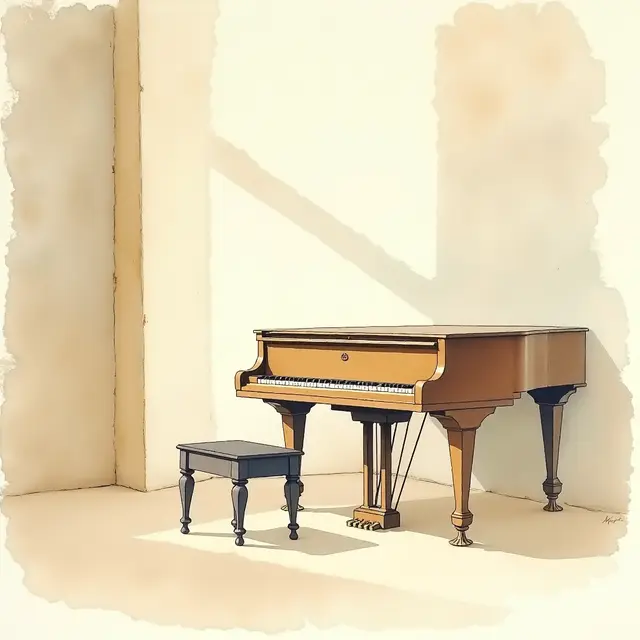
A classical piano carrying the precise elegance of perfect balance. The sonata: clarity and grace given form — serene, luminous, and timeless.
How it sounds
It is four in the afternoon in a tall drawing room with dark oak wainscoting that smells of beeswax and aged paper. October light pours through high windows, cutting through suspended dust like threads of gold that land directly on the grand piano, an instrument of worn ivory where the middle keys bear the exact indentation of thousands of practice hours. You sit on the bench, spine straight but free of tension, feeling the precise chill of the ivory beneath your fingertips.
Outside, the city is only a distant rumor that fails to cross the thick glass. You attack the first theme with clarity, a motif rising clean, luminous, without a single superfluous note. The left hand answers with a precise bass, marking the measure with the serenity of an antique clock. On the open score on the music stand, the pages are yellowed by years, filled with pencil markings made by someone who is gone, yet whose discipline still inhabits the stroke.
The harmony moves toward the development: the themes cross, debate with elegance, a dialogue of contrapuntal logic where tension does not shout but organizes itself, measures itself, is contained within each musical phrase. The resonance of the instrument fills the high room, bouncing against Byzantine mirrors and leather-bound books. There is no overflow, no noise to muddy the form. Everything sits in its exact place, sustained by the grace of an invisible architecture that needs no force to prevail.
Palette: ivory / gold / porcelana blue
- BPM
- 88 BPM
- Family
- Hall of Centuries
- Serial
- SAL-13
- Rarity
- Common
- Style strength
- 96
- Experimentation
- 16
Typical structure
[Exposition] theme A and B → [Development] → [Recapitulation] → [Coda]
What you see above is merely the surface of the parlor. Behind it lies a complex technical problem: how to maintain the dramatic tension of sonata development without falling into empty grandiosity, and how to make sung lyrics respect the symmetrical architecture of two themes without sounding rigid. That lives in an internal distillate of eight parameters that are not published, and the engine crosses it with the story you brought. In the end, an internal judge measures the lyric against six canons and orders repairs on any excess emotion. The piano is tuned. The restraint is not.
How a lyric in this style thinks
A lyric written for Sonata Clásica does not emote — it states. Where other genres reach toward feeling, this one organizes it, gives it architecture, and trusts that containment is its own form of power. The classical sonata tradition demands that every phrase earn its place, that nothing arrives without preparation and nothing departs without resolution. When you write words for this form, you are not confessing; you are composing a record. The emotion is real and large — vast gratitude, irreplaceable loss, the weight of a life fully lived — but it arrives the way October light arrives through tall glass: precise, angled, illuminating without flooding.
The base tone of Sonata Clásica is measured dignity. Sentiment is present but never spilled. A line does not beg the listener to weep; it places an image so exact that weeping becomes the listener's own private discovery. Rhythm in this genre mirrors the left hand of a solo piano at 88 BPM — steady, unhurried, marking time the way an antique clock marks it, not urgently but with absolute authority. Line lengths tend toward symmetry: if your first phrase runs eight syllables, the answering phrase wants eight back.
Repetition is structural rather than emotional; a motif returns because the form requires it, not because the singer needs to hammer the point. Restraint is the technique, not the mood.
The sensory field of this genre is specific and non-negotiable. It lives in dark oak, beeswax, aged paper, worn ivory keys, pencil annotations in the margins of a yellowed score. It lives in the smell of a room that has held decades of practice, in the chill of the bench, in dust suspended in afternoon light. These are not decorations — they are the load-bearing walls of the lyric. What this genre never uses: street noise, raw physical urgency, the vocabulary of rupture or release. There are no shouts here, no unraveling. The city outside is only a distant rumor that fails to cross the thick glass. Keep your images inside that room.
Structurally, the Sonata Clásica lyric follows the classical exposition-development-recapitulation-coda logic, and a writer who understands this has a genuine advantage. The exposition introduces two contrasting but related ideas — call them Theme A and Theme B — which might be two faces of the same person, two moments from the same life, two ways of holding the same grief. The development section is where those ideas are turned, examined from unexpected angles, allowed to create gentle friction without breaking form.
The recapitulation brings them home, transformed by the journey but recognizably themselves. The coda does not summarize — it releases, quietly, the way a final chord resonates in a high room until it becomes silence.
What separates a genuine Sonata Clásica lyric from a generic imitation is the quality of its precision. An imitation reaches for grandeur through adjectives. The real thing reaches for grandeur through selection — the single detail that carries the whole inheritance, the one gesture that stands for a lifetime of discipline. Think of the pencil markings on the score made by someone who is gone: that image does more work than a paragraph of direct statement.
If you find yourself writing about how important someone was, stop and find instead the object that proves it without argument. The solo piano in this form is already carrying the emotional weight; your words need only place the image and trust the instrument.
- PERFECT BALANCE
- CLASSICAL GRACE
- INSTRUMENTAL
Sample excerpt
You kept the ink black pens aligned, a geometry of silver on the oak desk. At five past four, you wound the heavy spring, the rhythmic pulse of brass and polished gear. You never spoke of what the quiet meant, but ordered all the scattered days in rows.
A measure held in amber light, the dignity of hands that never shook. Within this stillness, logic finds its grace, a legacy inscribed in perfect time.
Workshop note — The sonata demands a restrained, objective narrative that favors physical detail over subjective confession. By focusing on the precision of daily habits rather than emotional outbursts, the structure achieves a sense of timeless elegance. Avoid colloquialisms and maintain a consistent, elevated meter to honor the formal balance inherent in this classical tradition.
Sample excerpt written by MUSAI Song. Your lyrics are written from scratch, based on your story.
When to choose this style
Choose this card when you want to honor a family memory with classical dignity, avoiding easy tears or cheap drama. It works to recount the life of an orderly person, a grandfather who measured time with precision or a mother who kept a household running with the elegance of silence. It serves for a solemn anniversary, a legacy inherited with respect, or to close a chapter of chaos with absolute, serene clarity.
It is perfect when gratitude is so vast it demands containment, when you do not wish to scream what you feel but state it with the exact beauty of form. Do not choose it for a violent breakup, a grief seeking physical release, or stories that ask for street-level rawness: the sonata has no shouts, and forcing it would break its equilibrium. If you seek passionate catharsis or a raw confession, the card is Nocturno para Piano.
Your story in this style
MUSAI Song writes original lyrics from your story, in the Classical Sonata style, and delivers the finished sung song, the ready-to-use style recipe, and an illustrated art plate with its numbered certificate, private by default; public only if its owner publishes it.
- Original lyrics written from your story
- A finished sung song, ready to play and share
- Art plate with a unique seal and a numbered certificate, private by default; public only if its owner publishes it
Frequently asked questions
What BPM is Classical Sonata?
Classical Sonata usually runs at 88 BPM.
What does Classical Sonata sound like?
A classical piano carrying the precise elegance of perfect balance. The sonata: clarity and grace given form — serene, luminous, and timeless.
What song structure does Classical Sonata use?
[Exposition] theme A and B → [Development] → [Recapitulation] → [Coda]
How do I write Classical Sonata lyrics?
Tell MUSAI Song your story and pick Classical Sonata: it writes original lyrics for this style at 88 BPM, you edit them word by word, and you get the song sung in Classical Sonata, with an illustration of the song and its numbered certificate. $19 USD per song, one-time payment.
Explore more styles
- Adagio for Strings
- Baroque Cantata
- Baroque Harpsichord
- Bel Canto Opera
- Chamber Music
- Choral Mass
- Classic Choral Hymn
- Classic Film Score
- Classical Ballet
- Classical Minimalism
- Dramatic Overture
- Festive Overture
- Impressionism
- Neoclassicism
- Operatic Aria
- Oratorio
- Orchestral Suite
- Piano Concerto
- Piano Nocturne
- Renaissance Sacred Music
- Requiem
- Romantic Lied
- Romantic Symphony
- String Quartet
Your idea or story, sung in this style
Card · secure payment via Stripe, charged in USD
If it doesn't move you, we give you your money back · 7 days