Romantic Lied
Autumn has a tempo, and it prefers intimate rooms.
Get your song in Romantic Lied
Make yours in this styleHear it before you pay.$19 USD · your first song for $5.50 USDIf it doesn't move you, we give you your money back · 7 days.

Example in a sibling style: Viennese Waltz
“Bailamos el Error”
- Ximena giraba en el patio,
- tu vestido color lavanda,
- ensayaste contra la madera
- los pasos que el violín te anda.
Example made with MUSAI Song · sample story · See its certificate MUS-9QMRYG
Romantic Lied is a style from the Hall of Centuries family. 72 BPM, Experimentation 18, Style strength 95.
What is Romantic Lied?
A voice and a piano setting a poem to music. The lied: the intimacy of poetry sung close to the ear, tender, deep, and quietly beautiful.
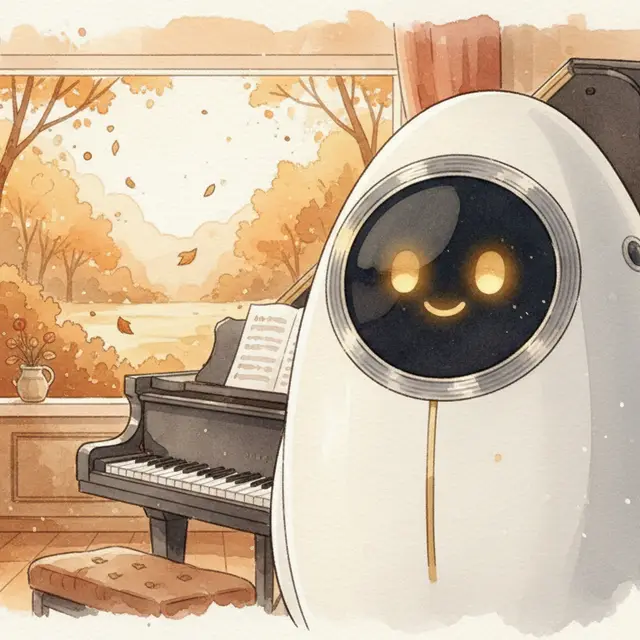
How it sounds
It is past eleven in a parlor where the wallpaper is beginning to peel at the edges from the damp air drifting in from the garden. The hearth fire has collapsed into gray ash and embers that crack with a dry sound. A single candle burns on the mahogany music desk, casting a low light that barely reaches the ivory keys worn yellow by decades of fingers and the dog-eared pages of a handwritten score. Outside, river fog presses against the glass of the loose-fitting window, leaving moisture on the wood.
You sit on the bench, hands still warm from the keys, breathing shallowly so as not to disturb the room. The voice enters on the first line from the quietest corner of the space, carrying no theatrical weight, sounding precisely like a secret kept too long beneath the tongue. Each syllable drops with the heavy, unhurried measure of a dry leaf falling onto wet grass. There is no chorus, no studio polish, no safety net.
Just a vocal line walking step for step beside the left hand of the piano, which seems to think through every chord before striking it. The chill of the night waits right outside thepane, holding its breath to hear a poem turn into music without raising its voice. The silence between one note and the next carries more mass than the sound itself, and when the final vowel fades into the room, the walls feel closer, older, and painfully still.
Palette: autumn gold / dark brown / terracotta
- BPM
- 72 BPM
- Family
- Hall of Centuries
- Serial
- SAL-23
- Rarity
- Common
- Style strength
- 95
- Experimentation
- 18
Typical structure
[Piano Intro] → [Stanza] → [Stanza] → [Poetic climax] → [Piano coda]
The parameters above can be copied in a minute. What cannot be copied is the invisible architecture: how to align the natural stress of spoken language with the exact pulse of the measure without breaking the verse, and how to voice the piano so the melody never has to force itself. That lives inside an internal distillation of eight unpublished parameters, which the engine cross-references with your story before a single line is written. When it finishes, an internal judge measures the text against six dimensions of the canon and orders a rewrite if anything sounds false. The ivory wears down. The lyrical restraint does not.
How a lyric in this style thinks
A lyric written for Lied Romántico does not narrate events so much as it holds a single feeling still long enough to examine it. The form descends from the German art song tradition — intimate, literary, designed for one voice and one piano in a room small enough that a whisper carries — and its central demand is that every word earns its place beside the note it rides. Where most popular forms build toward a release, the Lied Romántico moves inward. Emotion does not arrive in a chorus or a climactic shout; it seeps through the accumulated weight of images, the way cold seeps through glass. The listener should feel something settle in the chest before they can name what it is.
The base tone is one of composed resignation, which is not the same as sadness and not at all the same as defeat. It is the emotional register of a person who has already passed through the worst of it and is now, in the quiet afterward, trying to understand what remains. The lyric earns its gravity by staying concrete. The correct image is the worn yellow of ivory keys, not the abstract idea of age. It is the dog-eared corner of a handwritten page, not the general concept of memory.
The sensory field belongs to enclosed, slightly decayed domestic spaces — damp wallpaper, collapsed hearth fire, river fog on loose window glass — and to objects that carry the fingerprints of repetition over years. What the genre never uses: outdoor grandeur, bright open skies, crowd noise, or any image that requires space and velocity to land. The Lied Romántico lives in rooms, in late hours, in the silences between sentences that were never finished.
Line length and rhythm follow the logic of spoken poetry slowed to the pace of breath. Lines tend to be short enough that the piano can respond to each one, not merely accompany the whole. There is no bounce, no syncopation pressing forward. The tempo sits around 72 beats per minute, and even that number understates the felt pace, because the phrasing breathes against the pulse rather than with it.
Repetition, when it appears, is not the hook repetition of a chorus but the kind found in elegies — a phrase returned to because the speaker cannot yet leave it, because it still has something to yield. The vocal delivery asks for restraint bordering on severity: no melisma, no chest-voice power notes, no audible performance. The voice should sound like it is thinking aloud in a room it believes is empty.
Structurally, the Lied Romántico follows a logic closer to poetry than to song architecture. A piano introduction establishes the harmonic world before the voice enters — this is not a preamble, it is a statement of the emotional key in which everything else will be read. Two stanzas carry the lyric's argument, each one a step deeper into the central image rather than a variation on a theme.
What the form calls a poetic climax is not a dynamic explosion but a moment of sudden clarity, often the quietest line in the piece, where the thing that could not be said directly is finally said obliquely. The piano coda then closes the door. It does not resolve so much as it allows the silence to return, changed.
What separates a genuine Lied Romántico lyric from a generic imitation is the quality of its restraint. The imitation reaches for the emotion directly — it tells you the speaker is grieving, it names the loss, it asks you to feel. The real lyric gives you a kitchen table with one fewer chair and trusts you to do the rest. If you are writing for this form, the test is simple: remove every word that explains the feeling, and see whether the image alone carries the weight. If it does, you are writing a Lied Romántico. If the lyric collapses without the explanatory language, it is still searching for its central image, and that search is the work left to do.
- SUNG POEM
- DEEP INTIMACY
Sample excerpt
The silver kettle cools upon the stove, Your heavy wool coat hangs beside the door, I trace the dust along the mahogany shelf, Where silence settles like a winter shroud. The clock counts seconds that no longer matter, In this room where the light turns amber-gray.
I leave the teacup where you placed it last, A hollow circle on the polished wood, An unspoken truth left in the quiet air.
Workshop note — The Lied relies on restrained, imagery-heavy language that mimics the deliberate pacing of a spoken poem. By focusing on mundane, static objects like a cooling kettle or a wool coat, you create a sense of lingering presence that feels more profound than grand declarations. Avoid rhythmic hooks or repetitive refrains; instead, let each line evolve the central image with a slow, melancholic gravity.
Sample excerpt written by MUSAI Song. Your lyrics are written from scratch, based on your story.
When to choose this style
Choose this card when you need to state something final without raising your voice. It works for a quiet farewell letter to a parent who can no longer answer, for a silent debt acknowledged to someone who stayed when things fell apart, or for chronicling a loss that left no wreckage, only a clean, empty space at the kitchen table. This is the choice when an emotion has aged past anger or loud grief and asks only for a single, shared image whispered in the dark.
The lied is wrong for an argument, a noisy reconciliation, or a celebration that calls for raised glasses and momentum. Do not pick it if you want high energy, a bouncing rhythm, or a hook that sticks in your head on the commute. And if you are after direct, unadorned warmth without the deliberate distance of poetry, the card is Piano Romántico Virtuoso.
Your story in this style
MUSAI Song writes original lyrics from your story, in the Romantic Lied style, and delivers the finished sung song, the ready-to-use style recipe, and an illustrated art plate with its numbered certificate, private by default; public only if its owner publishes it.
- Original lyrics written from your story
- A finished sung song, ready to play and share
- Art plate with a unique seal and a numbered certificate, private by default; public only if its owner publishes it
Frequently asked questions
What BPM is Romantic Lied?
Romantic Lied usually runs at 72 BPM.
What does Romantic Lied sound like?
A voice and a piano setting a poem to music. The lied: the intimacy of poetry sung close to the ear, tender, deep, and quietly beautiful.
What song structure does Romantic Lied use?
[Piano Intro] → [Stanza] → [Stanza] → [Poetic climax] → [Piano coda]
How do I write Romantic Lied lyrics?
Tell MUSAI Song your story and pick Romantic Lied: it writes original lyrics for this style at 72 BPM, you edit them word by word, and you get the song sung in Romantic Lied, with an illustration of the song and its numbered certificate. $19 USD per song, one-time payment.
Explore more styles
- Adagio for Strings
- Baroque Cantata
- Baroque Harpsichord
- Bel Canto Opera
- Chamber Music
- Choral Mass
- Classic Choral Hymn
- Classic Film Score
- Classical Ballet
- Classical Minimalism
- Classical Sonata
- Dramatic Overture
- Festive Overture
- Impressionism
- Neoclassicism
- Operatic Aria
- Oratorio
- Orchestral Suite
- Piano Concerto
- Piano Nocturne
- Renaissance Sacred Music
- Requiem
- Romantic Symphony
- String Quartet
Your idea or story, sung in this style
Card · secure payment via Stripe, charged in USD
If it doesn't move you, we give you your money back · 7 days