Romantic Symphony
A hundred musicians agreeing on one thing: the greatest miracle of the century.
Get your song in Romantic Symphony
Make yours in this styleHear it before you pay.$19 USD · your first song for $5.50 USDIf it doesn't move you, we give you your money back · 7 days.

Example in a sibling style: Viennese Waltz
“Bailamos el Error”
- Ximena giraba en el patio,
- tu vestido color lavanda,
- ensayaste contra la madera
- los pasos que el violín te anda.
Example made with MUSAI Song · sample story · See its certificate MUS-9QMRYG
Romantic Symphony is a style from the Hall of Centuries family. 72 BPM, Experimentation 20, Style strength 98.
What is Romantic Symphony?
A full symphony orchestra telling a story without words. The romantic symphony is the architecture of human emotion built entirely in sound.
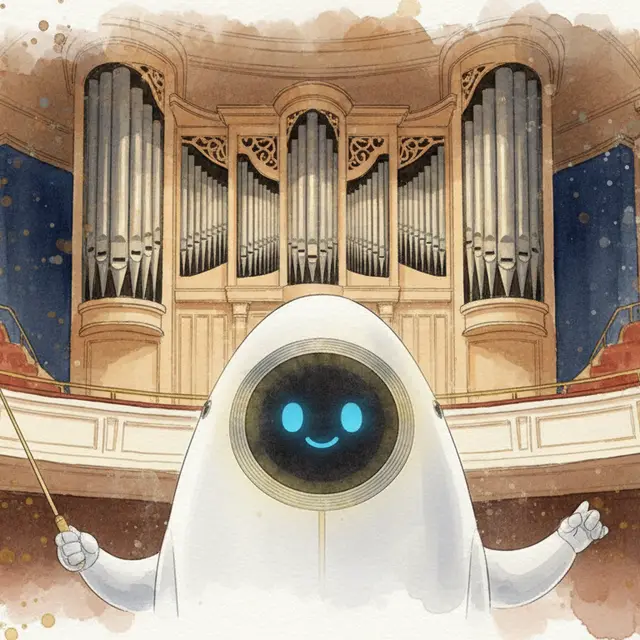
How it sounds
It is eight in the evening inside a gilded hall where heavy red velvet drapes swallow the street noise as if the outside world had ceased to exist. The air smells of varnished spruce wood and dry rosin dust, that fine powder hanging in the air while the musicians tune in tense silence. You sit in the twelfth row, hands gripped hard against your knees, and the cold at the back of your neck is the warning that the instruments are ready.
The conductor lifts the ivory baton and for two entire seconds there is not a single sound in the building; only motes of light suspended in the beams slanting through the high windows. Then the exposition breaks open: the solo cello launches the theme, a grave line asking for no permission, a confession rising from the floor straight into your sternum. At the first bar of the development, the brass enters all at once, a wall of bronze pressing you against the back of your seat without a touch.
There are no words because none could bear this weight. The full orchestra erects a cathedral with every section, an edifice of chords standing over the abyss of silence. The timpani reverberates in your ribs, keeping time in another register entirely, one where every second measures an entire epoch. Your throat aches from holding your breath.
Palette: gold / navy blue / terracotta / silver gray
- BPM
- 72 BPM
- Family
- Hall of Centuries
- Serial
- SAL-02
- Rarity
- Epic
- Style strength
- 98
- Experimentation
- 20
Typical structure
[Exposition] heroic theme → [Development] → [Recapitulation] → [Climax] tutti → [Coda] triumphant
The data above is merely the visible facade. Behind it lie two invisible problems: how to maintain the architectural tension of a tutti without the volume drowning the main melody, and how to make a single-bar silence weigh heavier than the clash of brass. That lives inside an unpublished internal distillate of eight parameters that the engine crosses with your story before raising the first note. Upon completion, an internal judge measures the score against six dimensions of the canon and repairs every bar that drops in stature. The gilded hall can be rented. The architecture of collapse, cannot.
How a lyric in this style thinks
A lyric written for Sinfonía Romántica does not describe emotion — it enacts it at architectural scale. Where most song forms compress feeling into a verse and release it in a chorus, the romantic symphony builds a structure so large that the listener must move through it the way you move through a cathedral: discovering proportion only after you have already been dwarfed by it. The form exists to give dignity to experiences too heavy for ordinary language, and the first thing any serious writer must understand is that this genre does not whisper. It was built for the moment when a human being has nothing left but magnitude.
The emotional logic of Sinfonía Romántica is not linear but dialectical. The exposition presents a primary theme — typically grave, declarative, launched from the low strings and carrying the full weight of whatever story you are telling — and then introduces a contrasting secondary theme that complicates rather than resolves the first. Think of it as stating the wound and then stating what the wound cost you, in that order.
The development section is where the lyric, if there is one, must do its hardest work: it fragments those themes, transposes them into unfamiliar registers, and presses them against each other until something close to breaking point is reached. This is not a bridge in the pop sense. It is a crucible. The writing here should feel unstable, chromatic, rhythmically displaced — as if the ground beneath the words has shifted and will not settle.
The recapitulation returns the opening material, but now it carries everything the development has put it through. Repeated lines land differently the second time because the listener has been somewhere terrible and come back. This is one of the genre's most powerful structural tools: verbatim repetition that feels nothing like repetition, because the context has been transformed.
The climax — the full tutti, every section of the orchestra arriving simultaneously — is the moment the lyric must be absolutely still, because the music will say what no word can. And the coda, marked triumphant in this form, is not a happy ending. It is a dignified one. There is a difference, and the difference is everything.
Sensory language in Sinfonía Romántica lives in the physical register: the resonance of a low brass chord felt in the sternum before it is heard by the ear, the tension of varnished spruce under a bow moving at the threshold of its own weight, the way rosin dust hangs in concert-hall air like suspended time. The palette runs to deep amber, navy, terracotta, and the silver-gray of exhausted light. This genre does not use domestic objects or kitchen-table detail — not because they are small, but because they belong to a different scale of intimacy. The romantic symphony operates in epochs, not afternoons. If your lyric reaches for a coffee cup or a car key, you are in the wrong room.
What separates a genuine Sinfonía Romántica lyric from a generic imitation is the quality of containment. The genre is vast, but it is not loose. Every dynamic surge is prepared; every silence is structural. At 72 BPM the pulse is slow enough to make every bar feel weighted, and a producer working in Suno will want sweeping strings carrying the thematic material, heroic brass arriving in layered entries rather than all at once, and timpani anchoring the low end with the authority of something geological rather than rhythmic.
The weirdness dial sits at 20 — close to the centre of gravity, not experimental — because the romantic symphony earns its strangeness through harmonic density and emotional extremity, not through textural novelty. Write into that density. Give the silence before the exposition the same attention you give the exposition itself. The held breath is part of the architecture.
- FULL ORCHESTRA
- EMOTION WITHOUT WORDS
- INSTRUMENTAL
Sample excerpt
Brass rises through the navy blue expanse, a bronze chord striking against the marble floor. The timpani marks the slow advance, of heavy iron doors closing once more. We built this empire out of ash and stone, now the grand hall stands entirely alone.
Hear the brass swell where the memory burns, a whole world turning as the dark returns. Let the strings rise till the rafters break, this is the weight that only gold can take.
Workshop note — Because this style relies on grand orchestral architecture, the lyrics use heavy, physical nouns like bronze, iron, and stone to anchor the massive soundscape. Line lengths are measured and deliberate, moving with the heavy gravity of the brass section while completely avoiding small domestic details. The language stays grand and monumental, matching the immense volume of the full orchestra without ever resorting to conversational filler.
Sample excerpt written by MUSAI Song. Your lyrics are written from scratch, based on your story.
When to choose this style
Choose this carta when your story has grown too vast for any ordinary sentence to contain it. It works for the day you had to let a father go without telling him you forgave him, or for the precise moment a love snapped not from a lack of care, but because life demanded a scale too immense for two people. It serves for a solitary victory nobody witnessed, the one you won standing against every odd while leaving your body hollow, demanding an architecture that restores dignity to grief.
This is the carta of absolute volume and ironclad containment. Do not choose it for stories that ask for domestic intimacy, kitchen table talks, or mild reconciliations where life simply resumes; the romantic symphony does not know how to whisper and will drown in small details. Neither does it suit a cheerful birthday nor a loss that only asks for quiet time and distance. If you are looking for a close, fragile confession at the keyboard, the carta is Virtuoso Romantic Piano.
Your story in this style
MUSAI Song writes original lyrics from your story, in the Romantic Symphony style, and delivers the finished sung song, the ready-to-use style recipe, and an illustrated art plate with its numbered certificate, private by default; public only if its owner publishes it.
- Original lyrics written from your story
- A finished sung song, ready to play and share
- Art plate with a unique seal and a numbered certificate, private by default; public only if its owner publishes it
Frequently asked questions
What BPM is Romantic Symphony?
Romantic Symphony usually runs at 72 BPM.
What does Romantic Symphony sound like?
A full symphony orchestra telling a story without words. The romantic symphony is the architecture of human emotion built entirely in sound.
What song structure does Romantic Symphony use?
[Exposition] heroic theme → [Development] → [Recapitulation] → [Climax] tutti → [Coda] triumphant
How do I write Romantic Symphony lyrics?
Tell MUSAI Song your story and pick Romantic Symphony: it writes original lyrics for this style at 72 BPM, you edit them word by word, and you get the song sung in Romantic Symphony, with an illustration of the song and its numbered certificate. $19 USD per song, one-time payment.
Explore more styles
- Adagio for Strings
- Baroque Cantata
- Baroque Harpsichord
- Bel Canto Opera
- Chamber Music
- Choral Mass
- Classic Choral Hymn
- Classic Film Score
- Classical Ballet
- Classical Minimalism
- Classical Sonata
- Dramatic Overture
- Festive Overture
- Impressionism
- Neoclassicism
- Operatic Aria
- Oratorio
- Orchestral Suite
- Piano Concerto
- Piano Nocturne
- Renaissance Sacred Music
- Requiem
- Romantic Lied
- String Quartet
Your idea or story, sung in this style
Card · secure payment via Stripe, charged in USD
If it doesn't move you, we give you your money back · 7 days