Piano Concerto
Eighty-eight keys to say what words can't hold.
Get your song in Piano Concerto
Make yours in this styleHear it before you pay.$19 USD · your first song for $5.50 USDIf it doesn't move you, we give you your money back · 7 days.

Example in a sibling style: Viennese Waltz
“Bailamos el Error”
- Ximena giraba en el patio,
- tu vestido color lavanda,
- ensayaste contra la madera
- los pasos que el violín te anda.
Example made with MUSAI Song · sample story · See its certificate MUS-9QMRYG
Piano Concerto is a style from the Hall of Centuries family. 76 BPM.
What is Piano Concerto?
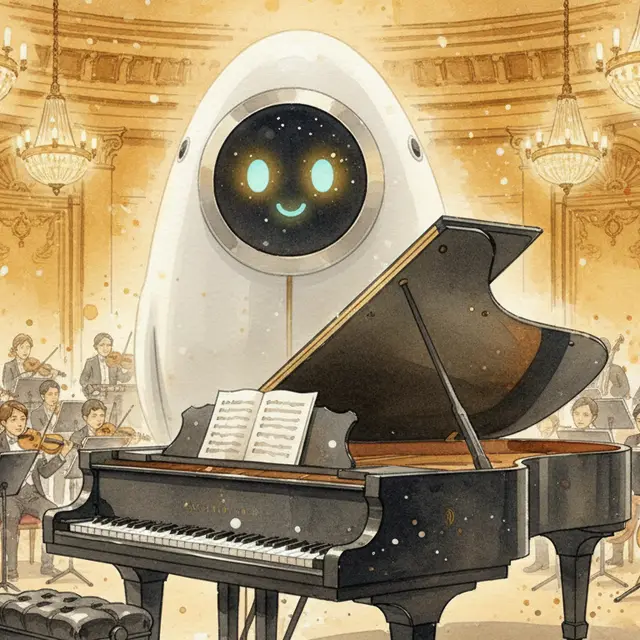
The piano and orchestra converse like two passionate lovers. The romantic piano concerto: virtuosity, drama, and a torrent of emotion at two hands.
How it sounds
The air inside the drawing room is thick. It is midnight, and the heat from three hundred candles is melting the wax down the bronze sconces, leaving a heavy scent of warm tallow and worn red velvet. You sit in the front row of the gallery, close enough to the stage to see the frantic pencil marks on the dog-eared score and the white trace of rosin dusting the pianist's fingers. The wooden floorboards groan each time the entire orchestra takes a collective breath before an attack.
Outside, the city sleeps in the dark, but inside this room, time has fractured. The concerto does not open with a gentle theme, but with a sudden, brutal stroke from the tutti: the bowed strings moving in unison, pulled to the absolute physical limit of the wood, slicing the air like a whip. The piano answers instantly, not with sweetness, but with a furious bass assault that vibrates through the soles of your shoes. It is a dialogue of equals where neither side yields an inch.
The violin bows fly in rigid synchronization, horsehairs snapping and dangling under the flickering light, while the soloist’s hands race across the eighty-eight ivory keys with a velocity that borders on violence. Every note is driven straight into the chest. When the cadenza arrives, the rest of the instruments drop away into a heavy, suspended silence, the exact threshold where the soloist stands alone over the edge of their own virtuosity. Sweat cuts a path down the temple, dripping onto the varnished lacquer.
There is no quarter given, only the relentless, overflowing torrent of two forces crashing against each other until the final, resounding chord.
Palette: piano black / living room gold / keys ivory
- BPM
- 76 BPM
- Family
- Hall of Centuries
- Serial
- SAL-03
- Rarity
- Epic
Typical structure
[Tutti] orchestra → [Piano entrance] → [Piano-orchestra dialogue] → [Cadenza] solo virtuoso → [Coda] tutti
The details above are just the surface of the score. Behind this brief lies an unprinted technical abyss: balancing the friction between solo fury and orchestral weight without sounding theatrical, and calculating the exact fracture point where rubato bends time without losing its pulse. All of that lives in a hidden eight-parameter distillate that the engine cross-references with your exact conflict. Once finished, an internal judge tests the lyrics against six dimensions of the canon and forces a rewrite on anything that falls flat. The notes belong to any keyboard. The rupture, does not.
How a lyric in this style thinks
A lyric written for Concierto para Piano does not describe emotion — it enacts a collision. The form demands that feeling arrive at full force from the first line, the way a tutti chord from a full orchestra strikes before the ear has time to brace. This is the essential logic of the romantic piano concerto as a lyrical model: two forces of equal weight enter the same space and refuse to yield. There is no gentle introduction, no careful framing of context. The opening statement is already at maximum pressure, and everything that follows is the negotiation between that pressure and the soloist's response — the piano voice that answers not with sweetness but with its own furious insistence.
The emotional register of this genre lives entirely outside moderation. The tone is not warm or confessional; it is declarative and unsparing. Desire, pride, grief, and triumph are not filtered through irony or understatement — they are stated at full volume and then developed, the way a theme is developed across a movement. Repetition works here not as a comfort device but as a structural insistence, the way a rhythmic motif returns in different registers to prove it has not been resolved.
Line length tends toward the long and weighted, phrases that carry their full cargo without breaking early. The rhythm is relentless but not mechanical — it breathes in surges, accelerating through a passage and then suspending at exactly the moment when the soloist stands alone in the cadenza, all orchestral support dropped away, the lyric stripped to a single voice over silence.
The sensory world of Concierto para Piano is specific and physical. Warm tallow, worn velvet, lacquered wood, rosin dust on fingers, floorboards groaning under collective weight — these are the textures that anchor the grand emotion in a real room, a real body, a real moment of consequence. The imagery gravitates toward weight and velocity: things that vibrate through the soles of shoes, hands moving across keys with a speed that borders on violence, horsehair snapping under tension.
What this genre never reaches for is the domestic or the diminutive. There are no quiet kitchens, no half-remembered details, no soft afternoon light. The scale is always architectural. The palette runs to piano black, ivory, and living-room gold — deep, saturated, without pastel or apology.
Structurally, a lyric in this form follows the concerto's own logic: an orchestral declaration that establishes the stakes, a solo entrance that answers and complicates, a sustained dialogue in which neither voice subordinates itself, a cadenza passage where the central voice stands fully exposed without accompaniment, and a coda that does not resolve so much as conclude by force.
In practice this means the lyric should open with its largest statement, develop it through increasing intensity rather than through narrative sequence, and arrive at the cadenza moment — the most vulnerable and technically demanding passage — somewhere in the final third, before the tutti coda drives the piece to its close. The sections fall where they do because the emotion demands escalation, not reflection.
What separates a genuine Concierto para Piano lyric from a generic dramatic song is the quality of the dialogue. Generic imitations treat the tension as decoration — they reach for grand language without structural counterweight. The real form requires that two forces actually argue, that the lyric contain within it something that pushes back against its own central claim. The piano does not merely perform against the orchestra; it contests the orchestra's authority.
A lyric that simply declares a single overwhelming feeling and repeats it is not working in this genre — it is missing the concerto's essential architecture, which is always a conversation between equals who cannot agree and cannot stop.
For production, the Suno prompt anchors this in the 19th-century concerto tradition: virtuosic grand piano foregrounded against full orchestra, dramatic interplay, sweeping melodic development, a tempo around 76 BPM that feels deliberate and weighty rather than rushed. The vocal delivery, if any voice enters at all, should carry the weight of the piano line — not ornamented for its own sake, but driven by the phrase's internal momentum. Every choice, lyrical and sonic, should feel like a leap made without a net and without regret.
- PIANO VS ORCHESTRA
- EMOTIONAL TORRENT
- INSTRUMENTAL
Sample excerpt
I left the blueprints on the mahogany desk, the ink still wet, staining the grain like a bruise. You demanded a hearth, a steady pulse of home, while I only knew the geometry of the storm. I traded the silence of our velvet curtains for the weight of iron rafters and high, cold glass.
Now the orchestra screams what I cannot speak, my fingers bleeding white across the ivory keys, crashing against the brass until the floorboards break.
Workshop note — This style demands a grand, sweeping narrative where the piano acts as the protagonist fighting against the weight of the orchestra. Keep your lines heavy with nouns and verbs of motion to allow the music to provide the necessary emotional scale, avoiding small, internal musings in favor of dramatic, externalized conflict.
Sample excerpt written by MUSAI Song. Your lyrics are written from scratch, based on your story.
When to choose this style
Choose this card when your history refuses shades of gray and demands absolute scale. It works for a passion that overflowed every sensible boundary, for a fierce reconciliation that required burning the bridges first, or for a monumental achievement that cost you your peace and sanity. Use it when pride and desire collide head-on, when you are done explaining things quietly and need to strike with the whole truth. It fits a life lived at a relentless tempo where every choice was a leap without a net.
Do not pick it for quiet griefs, minor regrets, or mild nostalgia; romantic keys do not know how to whisper and they despise moderation. It fails for polite gratitude or everyday affection. If you are looking for an intimate, restrained register, the card is Nocturne for Piano.
Your story in this style
MUSAI Song writes original lyrics from your story, in the Piano Concerto style, and delivers the finished sung song, the ready-to-use style recipe, and an illustrated art plate with its numbered certificate, private by default; public only if its owner publishes it.
- Original lyrics written from your story
- A finished sung song, ready to play and share
- Art plate with a unique seal and a numbered certificate, private by default; public only if its owner publishes it
Frequently asked questions
What BPM is Piano Concerto?
Piano Concerto usually runs at 76 BPM.
What does Piano Concerto sound like?
The piano and orchestra converse like two passionate lovers. The romantic piano concerto: virtuosity, drama, and a torrent of emotion at two hands.
What song structure does Piano Concerto use?
[Tutti] orchestra → [Piano entrance] → [Piano-orchestra dialogue] → [Cadenza] solo virtuoso → [Coda] tutti
How do I write Piano Concerto lyrics?
Tell MUSAI Song your story and pick Piano Concerto: it writes original lyrics for this style at 76 BPM, you edit them word by word, and you get the song sung in Piano Concerto, with an illustration of the song and its numbered certificate. $19 USD per song, one-time payment.
Explore more styles
- Adagio for Strings
- Baroque Cantata
- Baroque Harpsichord
- Bel Canto Opera
- Chamber Music
- Choral Mass
- Classic Choral Hymn
- Classic Film Score
- Classical Ballet
- Classical Minimalism
- Classical Sonata
- Dramatic Overture
- Festive Overture
- Impressionism
- Neoclassicism
- Operatic Aria
- Oratorio
- Orchestral Suite
- Piano Nocturne
- Renaissance Sacred Music
- Requiem
- Romantic Lied
- Romantic Symphony
- String Quartet
Your idea or story, sung in this style
Card · secure payment via Stripe, charged in USD
If it doesn't move you, we give you your money back · 7 days