Shōmyō (Japanese Temple Chant)
One bell strike, and the present lasts forever.
Get your song in Shōmyō (Japanese Temple Chant)
Make yours in this styleHear it before you pay.$19 USD · your first song for $5.50 USDIf it doesn't move you, we give you your money back · 7 days.
Shōmyō (Japanese Temple Chant) is a style from the Sacred Ground family. 46 BPM, Experimentation 30, Style strength 94.
What is Shōmyō (Japanese Temple Chant)?
Buddhist monks intoning sacred syllables beneath the toll of a bell. Shōmyō, the chant of the Japanese temple, is deep, spacious, and serene with the weight of centuries.
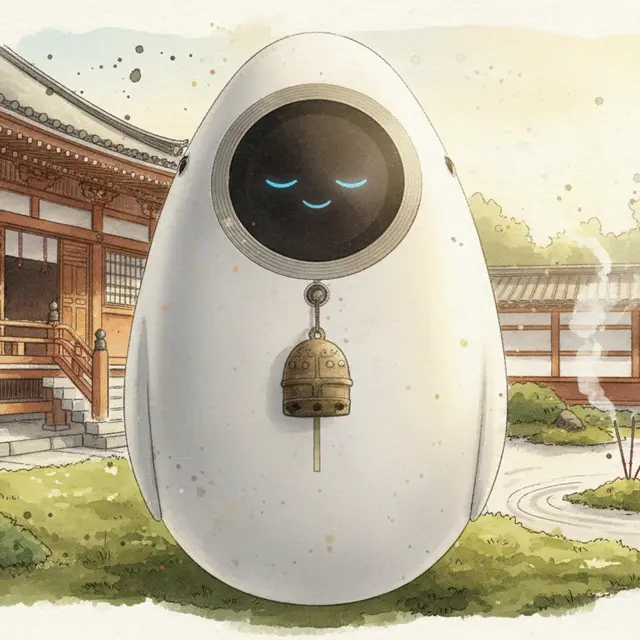
How it sounds
It is four-fifty in the morning at a monastery at the foot of Mount Hiei. Mist slips through the cracks of the sliding rice-paper doors, clinging to the cedar floorboards that barely groan beneath an unseen weight. Outside, ancient pines emerge slowly against a sky shifting from black to ash gray. The air smells of cold damp, spent ash inside the bronze censer, and aged paper. You sit upon the zabuton, knees pressed into the rush matting, feeling the chill of the stone rise steadily through your legs.
Suddenly, the first strike of the bronze bell shatters the air. It is no sharp chime: it is a dense body expanding, a vibration you feel not merely in your ears but across your ribs, raising the hair on your arms before fading with extreme slowness among the trees. Immediately following, the wooden mokugyo begins its steady pulse: a dry, hollow strike, like the heart of heavy timber beating at forty-six pulses per minute. Then the monks' voices slide upward from the depth of the chest.
They sing no notes: they sustain deep syllables that hover and brush against one another, an unbroken thread that seems to possess neither beginning nor end. The sound is thick enough to touch, as though the air itself had turned solid and heavy. Every breath is deep, measured, an exercise in absolute presence where time stops racing and gathers quietly in the corners of the temple.
Palette: bronze gold / moss green / orange wood / white
- BPM
- 46 BPM
- Family
- Sacred Ground
- Serial
- TIE-28
- Rarity
- Common
- Style strength
- 94
- Experimentation
- 30
Typical structure
[Bell] → [sustained deep chant] → [rhythmic mokugyo] → [deepening] → [resonant silence]
What you see on the surface is merely the tempo and basic instrumentation. Beneath lie two complex problems: how to maintain tension without accelerating the pace, and how to make a single sustained syllable carry genuine emotional weight without falling into religious didacticism. That lives within an internal distillate of eight unpublished parameters, and the engine crosses them with every detail of your story. Upon completion, an internal judge measures the lyrics against six dimensions of the canon and repairs anything sounding like devotional cliché. The temple can be sketched by anyone. The stillness, no.
How a lyric in this style thinks
A Shōmyō lyric does not deliver emotion — it holds space for it. Where most song forms push feeling toward the listener, this tradition asks the listener to move inward, following syllables that hover rather than resolve. The genre name itself, Shōmyō, refers to the liturgical chant practice of Japanese Buddhist monasteries, and understanding that origin is essential to writing within it: these are not verses that argue or confess. They are sustained utterances that mark the presence of something too large for ordinary speech. The lyric's function is to name weight without lifting it, to speak of loss or forgiveness or the long stillness after grief without asking for any response at all.
The emotional register sits in amber-gold and deep shadow, never in urgency. Feeling arrives the way the bronze bell's tone arrives — as a physical fact, dense and expanding, not as a cry. Line length in Shōmyō-inflected writing is deliberately uneven in stress but even in breath: each phrase must be singable on a single, controlled exhale, which means short declarative clauses with long vowel sounds at their centers. Repetition is not a hook device here; it is a deepening mechanism.
The same syllable or phrase returns not to emphasize but to allow the listener to settle further into it, the way a second bell strike finds the body already open. A line repeated three times in a Shōmyō structure means something entirely different at the third iteration — it has become interior architecture.
The sensory field is extremely specific and must be honored rigorously. Cedar and cold stone, spent ash in bronze, the dry hollow knock of the mokugyo at a pulse that hovers around forty-six beats per minute — these are the textures that anchor the lyric in something real. Mist, old paper, rush matting, the slow shift from black sky to ash gray: the genre lives in pre-dawn, in threshold moments, in the pause between one state and another. It never reaches for the dramatic or the picturesque. There are no storms, no burning, no rivers in flood.
The image vocabulary is mineral and still: what has weight, what has age, what does not move quickly. If an image could appear in a tourist photograph, discard it. The right image is the one you notice only when everything else has gone quiet.
Structurally, Shōmyō follows a logic of gradual deepening rather than escalation. The opening is the bell — a single event, unrepeated, that initiates the sacred frame. What follows is sustained chant, where the lyric carries its main statement not in a chorus but in the act of sustaining itself over time. The mokugyo's steady pulse provides the only rhythmic scaffold, and the lyric should honor that by avoiding syncopation or rhythmic surprise.
The deepening section is where most writers fail: it requires adding density through harmonic weight and slower syllabic delivery, not through new information. The structural close is resonant silence, which means the final phrase must be written to dissolve rather than land. End on an open vowel. End on a question that does not want an answer. The lyric's last task is to leave room.
What separates a genuine Shōmyō-informed lyric from a generic imitation is restraint applied at the level of the verb. Imitations reach for transcendence by naming it — peace, eternity, the infinite. Real writing in this tradition names the cedar plank, the cold rising through the knees, the hair lifting on the arm before the mind has registered the sound. The spiritual dimension is never announced; it is the quality of attention brought to the concrete detail.
In production terms, the vocal must sit low in the chest register, with minimal vibrato, and the mix should allow silence to function as an active element — not absence but presence. Reverb that decays slowly, no hard compression, no bright transients. The mokugyo sits in the mid-range like a patient heartbeat, and nothing competes with it. Write for that room.
- MONK CHANT
- CENTURIES OF STILLNESS
Sample excerpt
bronze struck at dawn the cedar pillar holds the roof ink black tea cools in the clay bowl no name remains on the threshold
slow breath in the cold hall moss green steps under grey mist the bell dissolves into amber silence
Workshop note — This piece uses sparse, image-heavy lines that leave vast intervals of quiet between syllables, mimicking the architectural weight of a timber temple. The rhythm stays tied to the heavy strike of the wooden block, avoiding modern cadence or conversational rhyme entirely. The effect is meditative and unhurried, holding space for profound absence without decoration.
Sample excerpt written by MUSAI Song. Your lyrics are written from scratch, based on your story.
When to choose this style
Choose this card when you need to name a profound loss that no longer asks for tears, but for silence. It works when a life chapter closes abruptly and the only remaining task is learning to inhabit the empty space. For when an elder fades slowly in a hospital bed and you wish to honor their stillness without theatricality. For a long grief, the kind that spans years and settles into the walls of a house, or when you must forgive someone and forgiveness requires no words, only the steady resolve to drop the weight.
This card fits anyone seeking solemnity, preferring the pause over the speech and presence over explanation. Do not choose it for loud celebrations, birthdays, euphoric reunions, or stories driven by rapid action and speed. If you seek a light, everyday gratitude, the letter is Bhajan Devocional.
Your story in this style
MUSAI Song writes original lyrics from your story, in the Shōmyō (Japanese Temple Chant) style, and delivers the finished sung song, the ready-to-use style recipe, and an illustrated art plate with its numbered certificate, private by default; public only if its owner publishes it.
- Original lyrics written from your story
- A finished sung song, ready to play and share
- Art plate with a unique seal and a numbered certificate, private by default; public only if its owner publishes it
Frequently asked questions
What BPM is Shōmyō (Japanese Temple Chant)?
Shōmyō (Japanese Temple Chant) usually runs at 46 BPM.
What does Shōmyō (Japanese Temple Chant) sound like?
Buddhist monks intoning sacred syllables beneath the toll of a bell. Shōmyō, the chant of the Japanese temple, is deep, spacious, and serene with the weight of centuries.
What song structure does Shōmyō (Japanese Temple Chant) use?
[Bell] → [sustained deep chant] → [rhythmic mokugyo] → [deepening] → [resonant silence]
How do I write Shōmyō (Japanese Temple Chant) lyrics?
Tell MUSAI Song your story and pick Shōmyō (Japanese Temple Chant): it writes original lyrics for this style at 46 BPM, you edit them word by word, and you get the song sung in Shōmyō (Japanese Temple Chant), with an illustration of the song and its numbered certificate. $19 USD per song, one-time payment.
Explore more styles
- Acoustic Worship
- African American Spiritual
- African Spiritual
- Byzantine Chant
- Celestial Sacred (Ambient)
- Choir Gospel
- Classic Christian Hymn
- Contemporary Gospel
- Devotional Bhajan
- Devotional Sufi (Dhikr)
- Ethiopian Sacred (Coptic)
- Gospel Blues
- Gregorian Chant
- Healing Chant
- Jewish Niggun
- Kirtan & Mantra
- Latin Praise
- Meditation Mantra
- Modern Worship
- Native Ceremonial
- Orchestral Gospel (Finale)
- Praise Break Gospel
- Russian Orthodox Hymn
- Sacred Sephardic Song
Your idea or story, sung in this style
Card · secure payment via Stripe, charged in USD
If it doesn't move you, we give you your money back · 7 days