Sacred Sephardic Song
It carries two exiles and sings them as if they were one.
Get your song in Sacred Sephardic Song
Make yours in this styleHear it before you pay.$19 USD · your first song for $5.50 USDIf it doesn't move you, we give you your money back · 7 days.
Sacred Sephardic Song is a style from the Sacred Ground family. 70 BPM, Experimentation 24, Style strength 94.
What is Sacred Sephardic Song?
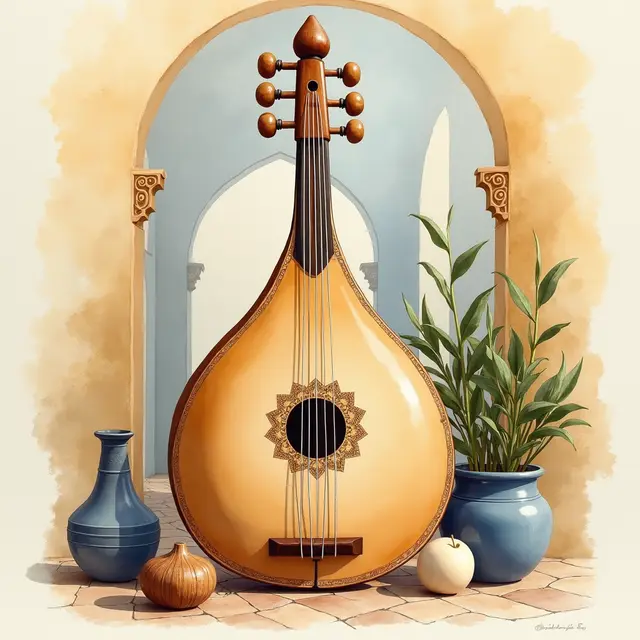
An oud and a voice singing in Ladino, melodies shaped by a thousand years of exile and faith. Sephardic sacred song, the holy memory of the Jewish Mediterranean, is tender, ornamented, and deeply moving.
How it sounds
It is five-thirty in the morning in an old limestone house within the old quarter, before traffic starts and the street fills with foreign footsteps. Light enters through the wrought-iron balcony, filtering into a thick, golden beam that illuminates dust motes hanging in the cool air. On the raw wood table sit a clay pitcher of chilled water, a braided loaf covered by a linen cloth, and a heavy iron key that has opened the same door for three centuries.
The musician tunes the oud slowly, tightening the strings with microscopic turns until the fret buzz disappears and only a warm wood grain vibrating against the chest remains. When the hand plucks the first note, the sound does not strike: it floats, expands across the room, and brushes against the hydraulic floor tiles. Then the voice enters, singing in Ladino, a tongue that belongs to no current map yet lives in the throat like an inherited secret.
Each melisma climbs with care, bending vowels with infinite tenderness, ornamenting ancient grief until it becomes a caress. There is no rush in the tempo. The frame drum sounds from afar, a dry scrape of skin against wood marking a centuries-old pulse. The scent of orange blossom drifts through the open window alongside the salt of the nearby sea. Everything halts at that exact point where family memory stops being a mere recollection and turns into a prayer.
Palette: amber gold / mahogany brown / grayish blue / plant green
- BPM
- 70 BPM
- Family
- Sacred Ground
- Serial
- TIE-22
- Rarity
- Common
- Style strength
- 94
- Experimentation
- 24
Typical structure
[Oud Intro] → [Verse] → [Ornamented chorus] → [Verse 2] → [Serene cadence]
The data above is copied in a minute. What cannot be copied is the judgment: how the vocal melisma slides without falling into operatic excess, where the oud must breathe so the silence weighs as much as the note. All of that lives in an internal distillate of eight unpublished parameters, and the engine crosses it with your family history before writing a single line. When finished, an internal judge measures the lyric against six dimensions of the canon and repairs anything that sounds formulaic. The Ladino is learned. The exact tremor of ancient faith, no.
How a lyric in this style thinks
A lyric in Canto Sefardí Sacro does not express emotion so much as it holds it in custody. The song becomes a vessel for something that cannot be said plainly without diminishing it — the accumulated weight of exile, the tenderness of a faith kept alive in kitchens and whispered prayers rather than in grand institutions. This is sacred Sephardic song, rooted in the Ladino tongue, and its first demand on a lyricist is restraint: the grief is ancient, the gratitude is enormous, and neither benefits from declaration.
What works instead is the image placed quietly on the table — a key, a braided loaf, a grandmother's hands pressing dough at an hour when the rest of the city still sleeps. The lyric trusts the object to carry the feeling without being told what to feel.
Ladino itself is part of the instrument here. Even if your lyric is written in English, it should behave like Ladino in its architecture: sentences that curve rather than drive forward, vowels that seem to linger at the end of a phrase as if reluctant to release. Melisma is not decoration in this genre — it is semantic. When the voice bends a single syllable through four or five microtonal ornaments, it is saying something the words cannot hold alone.
Practically, this means your lyric lines need to be short enough to sustain that ornamentation without collapsing under syllable count. Lines of seven to ten syllables work well. Lines that run past fourteen become prose, and this genre is not prose — it is closer to liturgy.
The sensory field of Canto Sefardí Sacro is Mediterranean and domestic simultaneously: limestone, wrought iron, orange blossom, the dry resonance of a frame drum heard from another room, the warm-wood vibration of an oud string felt more in the chest than the ear. The ney enters like a breath that has been held for centuries. What the genre refuses is contemporary texture — no traffic noise, no screens, no irony, no urban shorthand. It also refuses sentimentality that has not been earned by time.
The emotion must feel old, not because it is performed as old, but because the images chosen are genuinely irreplaceable. A lyric that reaches for universality too quickly loses the specific gravity that makes sacred Sephardic song move a listener at all.
Structurally, the genre follows a logic of deepening rather than escalation. The oud introduction is not a preamble — it is the first statement of the melodic argument, and the voice, when it enters, continues that argument rather than starting a new one. The verse establishes place and memory; the ornamented chorus does not pivot to a hook in the pop sense but instead lifts the same material into a more devotional register, as if the same sentence were now being spoken in prayer rather than in conversation.
The second verse adds a further layer of time — a grandparent's time, a generation further back — and the serene cadence at the close does not resolve so much as it releases. The listener is left holding something, not handed a conclusion.
What separates a genuine Canto Sefardí Sacro lyric from an imitation is the quality of its silence — the things it refuses to explain. A generic sacred lyric tells you it is sacred by announcing solemnity. A real Sephardic sacred lyric earns that weight by naming one concrete thing and then stopping, trusting the melodic ornament and the resonance of the oud to complete the thought. If you find yourself writing a line that explains the significance of what you just described, delete the explanation. The iron key needs no caption.
The Friday bread needs no footnote. This genre has survived a thousand years precisely because it understood that certain truths are better carried in the throat than argued on the page.
- MEMORY IN LADINO
- MEDITERRANEAN FAITH
Sample excerpt
The iron key rests heavy in my palm, Cold metal from a door long turned to dust. I trace the notches worn by desert wind, Where my grandfather hid the scent of rosemary, And left a trail of crumbs across the sea.
O, the amber light of memory returns, Turning the ink black tides into a path home, Blessed is the silence that remembers the name.
Workshop note — This genre relies on elongated, melismatic phrasing where single syllables are stretched across multiple notes to evoke a sense of timeless longing. The lyrics function best when they anchor a grand historical burden to a singular, tactile object like a key or a loaf of bread, avoiding abstract emotional declarations. Refrain from using hurried rhythms or contemporary slang, as the gravity of this style demands a slow, deliberate cadence that honors the ancestral weight of the melody.
Sample excerpt written by MUSAI Song. Your lyrics are written from scratch, based on your story.
When to choose this style
Choose this card when you need to honor a long-carried family heritage, when you bear a surname that crossed borders and want it to sound like ancient light. It works for a grandmother who guarded songs in a forgotten tongue so her grandchildren would know who they were. For the moment a child inherits an old key and grasps the exact weight of what was once lost. To give thanks to those who endured in silence, keeping the fire lit in a small kitchen where Friday bread was kneaded with tears and gratitude.
This card fits best when a story asks for tender solemnity, when the pain of exile or distance turns into a blessing spoken without shouting. Do not choose it for a modern argument, an urban breakup, or a quick career milestone: Sephardic song does not understand contemporary urgency or irony. Forcing this tone onto a light anecdote will sound like a museum costume. If you seek an intimate, gathered devotion without the weight of historical diaspora, the letter is Nigún Judío.
Your story in this style
MUSAI Song writes original lyrics from your story, in the Sacred Sephardic Song style, and delivers the finished sung song, the ready-to-use style recipe, and an illustrated art plate with its numbered certificate, private by default; public only if its owner publishes it.
- Original lyrics written from your story
- A finished sung song, ready to play and share
- Art plate with a unique seal and a numbered certificate, private by default; public only if its owner publishes it
Frequently asked questions
What BPM is Sacred Sephardic Song?
Sacred Sephardic Song usually runs at 70 BPM.
What does Sacred Sephardic Song sound like?
An oud and a voice singing in Ladino, melodies shaped by a thousand years of exile and faith. Sephardic sacred song, the holy memory of the Jewish Mediterranean, is tender, ornamented, and deeply moving.
What song structure does Sacred Sephardic Song use?
[Oud Intro] → [Verse] → [Ornamented chorus] → [Verse 2] → [Serene cadence]
How do I write Sacred Sephardic Song lyrics?
Tell MUSAI Song your story and pick Sacred Sephardic Song: it writes original lyrics for this style at 70 BPM, you edit them word by word, and you get the song sung in Sacred Sephardic Song, with an illustration of the song and its numbered certificate. $19 USD per song, one-time payment.
Explore more styles
- Acoustic Worship
- African American Spiritual
- African Spiritual
- Byzantine Chant
- Celestial Sacred (Ambient)
- Choir Gospel
- Classic Christian Hymn
- Contemporary Gospel
- Devotional Bhajan
- Devotional Sufi (Dhikr)
- Ethiopian Sacred (Coptic)
- Gospel Blues
- Gregorian Chant
- Healing Chant
- Jewish Niggun
- Kirtan & Mantra
- Latin Praise
- Meditation Mantra
- Modern Worship
- Native Ceremonial
- Orchestral Gospel (Finale)
- Praise Break Gospel
- Russian Orthodox Hymn
- Shamanic Chant
Your idea or story, sung in this style
Card · secure payment via Stripe, charged in USD
If it doesn't move you, we give you your money back · 7 days