Kirtan & Mantra
The harmonium breathes, and suddenly you forget you didn't know the words.
Get your song in Kirtan & Mantra
Make yours in this styleHear it before you pay.$19 USD · your first song for $5.50 USDIf it doesn't move you, we give you your money back · 7 days.
Kirtan & Mantra is a style from the Sacred Ground family. 90 BPM.
What is Kirtan & Mantra?
A harmonium and Sanskrit mantras repeated until the heart opens wide. Kirtan: the devotional call-and-response practice of yoga tradition, meditative, ascending, and luminous.
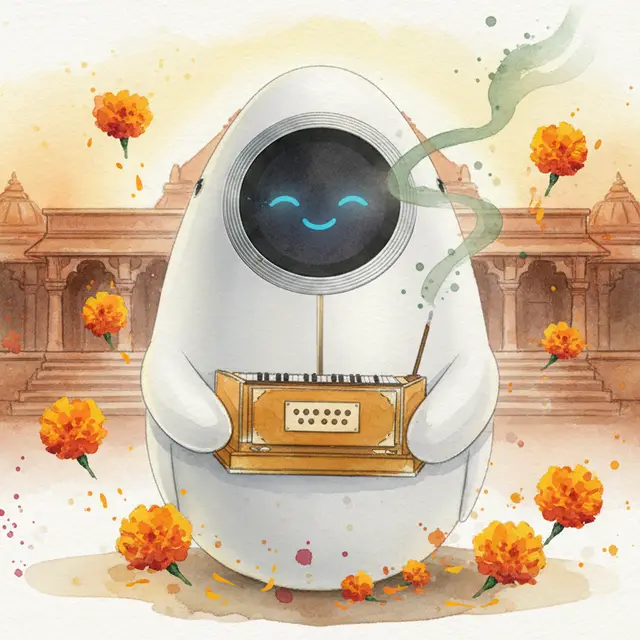
How it sounds
It is half past five in the morning in a cold stone vestibule where the sun has not yet spilled, though the air already tastes of warm sandalwood and freshly torn marigold petals. Your bare feet press against the rough floor, and the chill climbs your ankles to anchor your bones. At the back of the long room, lit only by the flickering flame of a ghee lamp, someone pumps the bellows of an old dark wood harmonium. The sound rises thick, held like a horizon that refuses to shift. There is no rush.
The first chord floats in the air and the tabla answers with a dry, muffled strike that rattles your diaphragm before settling into a steady pulse. Someone beside you begins to chant in Sanskrit, a short phrase, barely four words sliding across the tongue like oil. The voice is fragile at first, a doubting thread, but by the tenth repetition it finds its footing. You join in. First with your mouth closed, letting the vibration strike your palate and chest from within. Then you open your voice.
The sound stops being yours and belongs to everyone, a thick wall bouncing off the stone walls and returning magnified. Someone marks the tempo with brass kartals crashing together with a sharp metallic gleam, cutting through the dense drone every two beats. The mantra repeats fifty times, a hundred, five hundred, until the words lose their meaning and turn into pure friction, a heat rising from your stomach that melts your shoulders. There is no cold in your feet anymore.
There is only air coming in, voice pushing out, and a slow-accelerating pulse climbing an invisible spiral until palms begin to clap in unison, driving a rhythm that no longer needs to stop.
Palette: saffron orange / ochre gold / muted green / cyan blue
- BPM
- 90 BPM
- Family
- Sacred Ground
- Serial
- TIE-06
- Rarity
- Rare
Typical structure
[Slow mantra] → [Call and response] → [Gradual acceleration] → [Ecstatic peak] → [Return to stillness]
What you see above is merely dust on the road. Writing kirtan without falling into empty monotony requires calculating the exact weight of each repetition and knowing the precise second a Sanskrit consonant must open so the voice sounds like internal fire rather than mechanical prayer. All of that lives inside an unpublished eight-parameter distillate, and the engine crosses it with the exact story you brought here. When it finishes, an internal judge measures the lyrics against six dimensions of the canon and sends back anything that falls short. The harmonium can be bought anywhere. The aperture cannot.
How a lyric in this style thinks
A kirtan lyric does not argue, explain, or arrive at a conclusion. It dissolves. Where most songwriting moves from problem to resolution through narrative logic, kirtan moves through repetition until the original weight of the words becomes irrelevant and what remains is only vibration and breath. The lyric is not a vehicle for meaning; it is a vehicle for duration. You write a kirtan lyric the way you light a ghee lamp — the flame is not the point, the sustained burning is. This is the fundamental craft decision: you are not crafting a story arc, you are crafting a threshold that a voice can cross fifty times in a row without losing faith in the crossing.
The structural logic of kirtan follows a precise thermal model. The piece opens with a slow mantra — typically a Sanskrit phrase of four to eight syllables — stated plainly, almost tentatively, by a single voice or instrument. The harmonium holds a drone beneath it, thick and warm, and the tabla enters with a dry, grounded strike that marks time without urgency. At this stage the lyric asks nothing of the listener except presence.
The call-and-response section arrives not as a formal change but as a natural breath exchange: one voice offers the phrase, the gathered voices return it. The lyric's job here is to be simple enough to catch on first hearing, which means choosing Sanskrit phrases that carry phonetic clarity rather than linguistic complexity. The repetition does not bore — it accumulates. By the thirtieth return the phrase has shed its semantic shell and what moves through the room is pure resonance, a heat that rises from the sternum.
Line length in kirtan is short by design, rarely more than six syllables in a single call unit. The rhythm is syllabic and even, anchored to the tabla's cycle rather than to a Western verse-chorus tension. There is no bridge in the narrative sense, no volta, no twist. Instead, the gradual acceleration section does the work that a bridge does in other genres: it changes the emotional temperature without changing the lyric content.
The kartals — brass hand cymbals — begin to cut through the drone every two beats, and the tempo climbs an invisible spiral. The words you chose at the opening are now being delivered at twice the speed, which means your lyric must survive that acceleration without sounding clumsy. This is the test: a phrase that works slowly but stumbles when the pulse doubles was not built for kirtan.
The sensory field of kirtan is specific and non-negotiable. Sandalwood, cold stone, the smell of warm ghee, marigold petals, the particular roughness of a bare floor underfoot — these are the textures that belong here. The harmonium's sustained chord is the tonal center of the world. What kirtan never uses is the imagery of rupture: no shattering, no breaking, no screaming silence. It also refuses irony and the anecdotal detail that grounds other sacred genres in personal narrative.
If you find yourself writing a lyric that tells a specific story with named emotions, you have drifted out of kirtan and into devotional folk. Kirtan trusts the Sanskrit phrase to carry emotional weight without annotation.
The ecstatic peak arrives not through lyrical escalation but through communal velocity — palms clapping, voices stacking, the drone becoming a wall of amber sound — and then the return to stillness is achieved by the same instrument: repetition, now slowing, now thinning, until one voice is left holding the phrase alone and the lamp is the only thing still moving.
What separates a real kirtan lyric from a generic imitation is the willingness to be boring on the page and transcendent in the room. Written down, a kirtan lyric looks almost embarrassingly thin. Four words. A colon. The same four words again. The sophistication is entirely in the architecture of time and the precision of the phonetic choice.
For Suno or any prompt-based production, this means your style markers must carry the structural information that the lyric withholds: specify the building devotional trance, the call-and-response pattern, the gradual BPM acceleration, and the return to meditative space. The lyric you hand to the tool should be repetitive by design, not by accident. Trust the repetition. That trust is the craft.
- MANTRA THAT OPENS
- CALL AND RESPONSE
Sample excerpt
Sit by the clay stove where the ash is grey Hold the copper bowl until it stops shaking We repeat the ancient name until the rooms widen We let the dry weight drop from the collarbone
Govinda, Govinda, the river turns Govinda, Govinda, the banks fall away Om shanti, shanti, the breath is an open door Om shanti, shanti, we walk through clean
Workshop note — This sample relies on steady repetition and ancient syllables to build an ascending meditative state without relying on narrative plot. The lines use concrete physical grounding like clay and copper to anchor the devotional focus. Avoid clever twists or irony here, as the genre demands absolute sincerity and a willingness to stay with one unchanging truth.
Sample excerpt written by MUSAI Song. Your lyrics are written from scratch, based on your story.
When to choose this style
Choose this card when your story needs to drop a heavy burden through sheer persistence rather than conversation. It works to forgive someone who is no longer here, when a grudge has grown so old it asks only for rest. To thank a mother who held an entire household together without asking to be seen. For when you have survived a long illness and want to celebrate that your body remembered how to beat on its own. For a family reunion where explanations are useless and you only need to look each other in the eye while singing.
Kirtan does not serve sarcasm, nor anecdotal storytelling with a neat moral, nor a cynical farewell. It also fails if you want to vent with shouts or process a rage that needs to break things; this music does not destroy, it aligns. If you are looking for an intimate, quiet shelter for a recent loss, the card is Sacred Sefardic Chant.
Your story in this style
MUSAI Song writes original lyrics from your story, in the Kirtan & Mantra style, and delivers the finished sung song, the ready-to-use style recipe, and an illustrated art plate with its numbered certificate, private by default; public only if its owner publishes it.
- Original lyrics written from your story
- A finished sung song, ready to play and share
- Art plate with a unique seal and a numbered certificate, private by default; public only if its owner publishes it
Frequently asked questions
What BPM is Kirtan & Mantra?
Kirtan & Mantra usually runs at 90 BPM.
What does Kirtan & Mantra sound like?
A harmonium and Sanskrit mantras repeated until the heart opens wide. Kirtan: the devotional call-and-response practice of yoga tradition, meditative, ascending, and luminous.
What song structure does Kirtan & Mantra use?
[Slow mantra] → [Call and response] → [Gradual acceleration] → [Ecstatic peak] → [Return to stillness]
How do I write Kirtan & Mantra lyrics?
Tell MUSAI Song your story and pick Kirtan & Mantra: it writes original lyrics for this style at 90 BPM, you edit them word by word, and you get the song sung in Kirtan & Mantra, with an illustration of the song and its numbered certificate. $19 USD per song, one-time payment.
Explore more styles
- Acoustic Worship
- African American Spiritual
- African Spiritual
- Byzantine Chant
- Celestial Sacred (Ambient)
- Choir Gospel
- Classic Christian Hymn
- Contemporary Gospel
- Devotional Bhajan
- Devotional Sufi (Dhikr)
- Ethiopian Sacred (Coptic)
- Gospel Blues
- Gregorian Chant
- Healing Chant
- Jewish Niggun
- Latin Praise
- Meditation Mantra
- Modern Worship
- Native Ceremonial
- Orchestral Gospel (Finale)
- Praise Break Gospel
- Russian Orthodox Hymn
- Sacred Sephardic Song
- Shamanic Chant
Your idea or story, sung in this style
Card · secure payment via Stripe, charged in USD
If it doesn't move you, we give you your money back · 7 days