Rage Rap
Your neck gets it before your brain does.
Get your song in Rage Rap
Make yours in this styleHear it before you pay.$19 USD · your first song for $5.50 USDIf it doesn't move you, we give you your money back · 7 days.
Rage Rap is a style from the Street and Verse family. 150 BPM.
What is Rage Rap?
Distorted synths and blown-out 808s pushed to the breaking point. Rage rap: trap at its most explosive, mosh-pit energy, chaotic and fully electric.
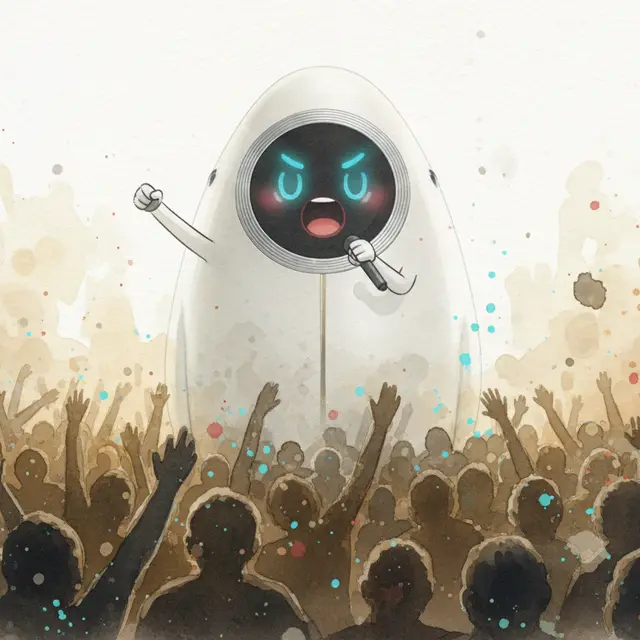
How it sounds
You're in the third row and the stage smoke is thick enough that the lights become solid columns you can follow with your eyes all the way to the ceiling. You can't see the person singing. You see a silhouette when the strobe allows it and nothing the rest of the time.
The 808 is saturated to the exact point before breaking, and when the drop lands the subwoofer pushes your chest backward with a force you could measure. Not a metaphor: the air moves. The synths don't make melody, they claw, screeching in the upper register like metal on metal, and there's an instant where you can't tell whether this is still music or already something else.
The voice doesn't rap, it spits. Short syllables, monosyllabic English, words that hit more by shape than by meaning. Every line arrives as a shove. When the flow breaks, it really breaks: it loses the count for two beats and returns, and that small betrayal is what keeps you alert.
And here's what matters: this rage isn't against anyone. There's no person you're shouting at. It's a nervous system at its limit finding the only exit left, which is noise. It's the body saying what the head has spent weeks failing to arrange into a sentence.
When it ends there are two seconds of complete silence before someone screams, and in those two seconds you realise you spent the whole track not breathing properly.
Palette: warm beige / cyan / black / red
- BPM
- 150 BPM
- Family
- Street and Verse
- Serial
- CLL-28
- Rarity
- Common
Typical structure
[Intro] → [Build] → [Chaotic Drop] → [Verse] → [Final Drop]
The figures above are public on purpose: they aren't the work. Writing rage rap well means solving things that don't fit in a table — when a word earns its place by shape rather than meaning, how to break the flow for two beats without it sounding like a mistake, where to cut a line so the hit lands on the right syllable. That sits in this card's internal distillation, eight parameters the engine crosses with your story before writing a single line. Afterwards, an internal judge scores it against the canon and repairs what slipped. The sound can be replicated. The cutting instinct can't.
How a lyric in this style thinks
A rage rap lyric doesn't describe pressure — it performs it. The words don't explain what's wrong; they enact the state of a nervous system that has run out of room. This is the defining move of the genre: you are not writing about being overwhelmed, you are delivering the experience of it in real time, syllable by syllable, with no interpretive buffer between the line and the listener's chest. Rage rap operates at 150 BPM on a blown-out 808 that sits at the exact threshold of distortion, and the lyric has to match that threshold — not narrate it from a safe distance.
The emotional register is raw but not sentimental. Anger here has no clear address. There's no villain named, no grievance itemised, no story arc that resolves. What you're capturing is diffuse, accumulated pressure — the kind that builds across weeks of swallowed words and reasonable behaviour until the body finds the only exit left, which is noise. That means your imagery should be physical and immediate: pressure in the sternum, static behind the eyes, the jaw that won't unclench. Concrete body sensations outperform abstract complaints every time. The lyric earns its intensity not through explanation but through precision about what the body is doing right now.
Line length in rage rap is short and percussive. Monosyllables carry more weight than polysyllables because they hit harder against the grid. You're writing for a flow that spits, not sings — each word arrives as a shove, and the space between words is just as loaded as the words themselves. Repetition is structural, not decorative: a phrase repeated three times across a verse isn't laziness, it's pressure building in a sealed container. When the flow breaks — loses the count, stumbles for two beats before snapping back — that rupture is intentional. It keeps the listener alert and signals that the speaker is at the edge of control, not performing control.
The sensory field of rage rap is ink black and electric. Saturated synths clawing in the upper register, subwoofer displacement you can feel in your ribcage, stage smoke thick enough that the light becomes solid. The genre lives in enclosed spaces with bad air and good sound systems. It never reaches for pastoral imagery, never slows for a metaphor that requires assembly. If you're writing a simile that takes more than half a line to land, cut it. The lyric should move faster than the listener can think — understanding arrives after the fact, if at all. That's not a flaw, it's the contract.
Structurally, rage rap builds before it detonates. The intro and build sections exist to create a pressure differential — you're loading the room before the chaotic drop releases it. The verse that follows the drop is where the lyric can show its only flash of specificity: one concrete image, one line that's slightly more personal than the rest, enough to anchor the listener before the final drop pulls the floor away again. That moment of near-clarity before the last explosion is what separates a real rage rap lyric from a generic imitation.
Generic imitations stay at maximum volume throughout. A real one knows that the drop hits hardest when the listener has been given one brief second to think they understand what's happening.
- SATURATED SYNTHS
- MOSH-PIT ENERGY
Sample excerpt
Clock ticking loud in the ink black hall Sweat dripping down on the drywall Ten thousand volts in the back of my throat Shaking the floor while I cut at the rope No steady pulse just a glitch in the frame I’m burning the ledger and killing the name.
Push it to the red line Snap the circuit board now Static in the system Watch the whole thing bow.
Workshop note — Rage rap requires short, percussive bursts of text that function as rhythmic percussion rather than traditional storytelling. By stripping away metaphors and focusing on physical, immediate sensations like static and voltage, the lyrics leave space for the distorted 808s to dominate the sonic landscape. Avoid long sentences or complex rhyme schemes, as the energy must remain clipped, aggressive, and entirely kinetic.
Sample excerpt written by MUSAI Song. Your lyrics are written from scratch, based on your story.
When to choose this style
Choose this card when the pressure is individual and has nowhere to aim. It works for anxiety that can't be explained by one concrete cause, for the weeks when everything weighs without anything serious having happened. For anger at yourself. For someone sick of their own patience. For the athlete or the gamer before competing, when what's needed isn't calm but voltage. For the story of someone who endures too much in silence, and for whom this song grants permission not to endure for three minutes.
It works particularly well as a gift for a young person who doesn't talk about how they feel but plays music very loud.
Don't choose it for anything requiring nuance: the lyric here is short, in English, and hits more than it explains. Nor for a story with names, dates, or a dedication meant to be understood word by word.
And if what you want is celebration among people, the euphoria of the shared jump, the right card is Rage: same tempo, aimed outward.
Your story in this style
MUSAI Song writes original lyrics from your story, in the Rage Rap style, and delivers the finished sung song, the ready-to-use style recipe, and an illustrated art plate with its numbered certificate, private by default; public only if its owner publishes it.
- Original lyrics written from your story
- A finished sung song, ready to play and share
- Art plate with a unique seal and a numbered certificate, private by default; public only if its owner publishes it
Frequently asked questions
What BPM is Rage Rap?
Rage Rap usually runs at 150 BPM.
What does Rage Rap sound like?
Distorted synths and blown-out 808s pushed to the breaking point. Rage rap: trap at its most explosive, mosh-pit energy, chaotic and fully electric.
What song structure does Rage Rap use?
[Intro] → [Build] → [Chaotic Drop] → [Verse] → [Final Drop]
How do I write Rage Rap lyrics?
Tell MUSAI Song your story and pick Rage Rap: it writes original lyrics for this style at 150 BPM, you edit them word by word, and you get the song sung in Rage Rap, with an illustration of the song and its numbered certificate. $19 USD per song, one-time payment.
Explore more styles
- Afro-Trap
- Boom Bap
- Cloud Rap
- Confessional Hip-Hop
- Conscious Hip-Hop
- Dirty South
- Drill
- Dub
- East Coast Hip-Hop
- Emo Rap
- French Rap
- G-Funk
- Gangsta Rap
- Grime
- Hardcore Hip-Hop
- Jazz Rap
- Latin Boom Bap
- Latin Melodic Trap
- Latin Trap
- Mumble Rap
- Old-School Hip-Hop
- Phonk
- Plugg
- Ragga Hip-Hop
Your idea or story, sung in this style
Card · secure payment via Stripe, charged in USD
If it doesn't move you, we give you your money back · 7 days