Mathcore
The time signature breaks on purpose — and means every second of it.
Get your song in Mathcore
Make yours in this styleHear it before you pay.$19 USD · your first song for $5.50 USDIf it doesn't move you, we give you your money back · 7 days.
Mathcore is a style from the Storm and Steel family. 180 BPM, Experimentation 42, Style strength 89.
What is Mathcore?
Dissonant riffs and erratic rhythms that defy all logic. Mathcore: raw power as a violent puzzle, chaotic, technical, and intensely unpredictable.
How it sounds
It is three-fifteen in the morning inside a rehearsal room where the acoustic foam hangs in tattered strips from the walls like dead skin. The tube amplifier hums at a frequency that drills straight into the bone behind your left ear. You are sitting on the cold concrete floor, a pick still wedged between sweat-slicked fingers and a drop of dried blood caked under the cuticle of your index finger.
The previous riff packed thirteen notes into a seven-six time signature, a mathematical trap you forced through three times until your hands refused the memory and your forearm seized up like a rusted torque wrench. Across the room, the strobe tuner display flashes in aggressive red, refusing to lock onto a single pitch because the low-drop tuning on loose strings vibrates too violently to settle. There is no chorus to cling to, only a wall of jagged dissonance where every snare hit sounds like twisted sheet metal scraping against pavement.
Someone barks a sharp cue and the pattern shatters before it even forms, an eighteen-second freefall where guitar and drums sprint in opposite directions until they smash head-on into a calculated silence that hurts worse than the noise. Sweat snakes down your spine like acid. Your brain keeps trying to reassemble the puzzle of the shifting meters, but your body now registers every abrupt transition purely as a blunt blow to the solar plexus.
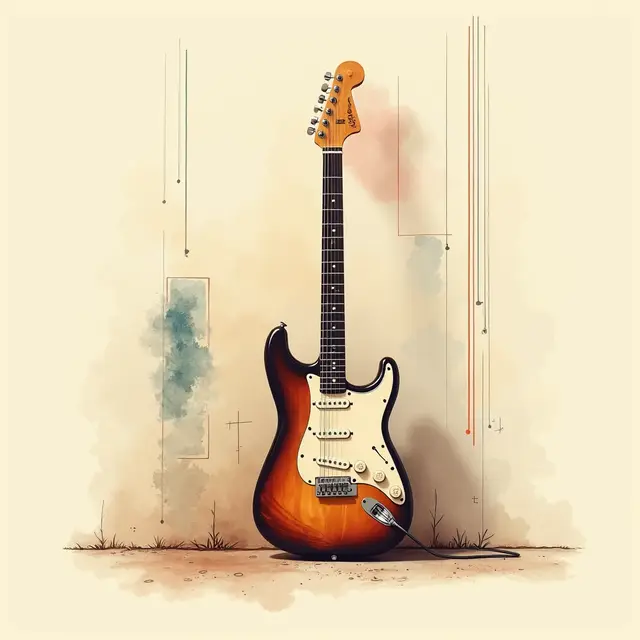
Palette: brown orange sunburst / black / muted cyan / lines orange red
- BPM
- 180 BPM
- Family
- Storm and Steel
- Serial
- ACE-25
- Rarity
- Common
- Style strength
- 89
- Experimentation
- 42
Typical structure
[Section A] chaotic → [Section B] → [Abrupt shift] → [Section C] → [Outro]
The data above can be copied in a minute. What cannot be copied is the architecture of the fracture: exactly how many beats to hold in suspension before the listener's brain loses the thread, and how to make dissonance sound like a visceral necessity rather than a conservatory exercise. All of that lives inside an unreleased distillate of eight parameters, which the engine cross-references with your story before writing a single line. Afterward, an internal judge measures the lyrics against six canonical dimensions and sends back anything that misses the mark for repair. The seven-six meter can be programmed anywhere. The mathematics of tearing yourself apart, no.
How a lyric in this style thinks
A mathcore lyric does not tell you what happened. It performs the cognitive state of someone for whom sequence itself has become the enemy — where cause and effect have decoupled and left only the sensation of gears grinding without purchase. The genre operates on a structural refusal: no verse that builds patiently toward a chorus, no chorus at all in the conventional sense, no release that earns its catharsis through accumulation.
Instead, mathcore lyrics arrive in compressed detonations, fragments that feel like they were written mid-seizure and then cut apart with metal shears and reassembled in the wrong order. The emotion does not build — it erupts, collapses, restarts at a different tempo, and collides with itself. That is not a flaw in the writing. That is the entire point.
The base tone in mathcore sits somewhere between clinical fury and total cognitive overload. Anger is present, but it is not the warm, cathartic anger of a power chord anthem. It is the cold, structural anger of someone who has traced every variable in a failed system and found that the math was always wrong. Emotion arrives through compression — short, percussive phrases that carry more weight than their syllable count suggests, often stacked against one another without connective tissue. Lines do not breathe. They do not explain.
They assert, cut off, reassert from an oblique angle. Repetition exists, but it mutates on each return: the same phrase re-enters with a syllable dropped, a stress shifted, or a word replaced by something semantically adjacent but tonally colder. Nothing loops clean.
The sensory world of mathcore is mechanical and industrial without being romantic about either. Concrete floors, fluorescent flicker, the smell of solder and sweat, cable burns, the specific pressure of a time signature that will not resolve — these are the textures this genre inhabits. It does not use pastoral imagery, organic softness, or any language that implies the natural world as comfort. Water in a mathcore lyric is not a river; it is hydraulic pressure. A body in this genre is a system under load, not a vessel for sentiment.
What the genre categorically rejects is the metaphor of healing — no wounds closing, no light finding its way through. The vocabulary stays in the register of mechanical failure: stripped threads, sheared bolts, tolerances exceeded, feedback loops that cannot be interrupted.
Structurally, mathcore lyrics follow the same logic as the music's time signatures: they are arithmetically precise at the micro level and deliberately incoherent at the macro level. A section will lock into an almost hypnotic internal rhythm — eight words, seven syllables, eight words, five syllables — and then a line will arrive that is twenty-three syllables long and feels like it was injected at the wrong bar. The abrupt shift that the genre's canon demands is not just a musical event; it should be a textual event.
Something in the lyric should break its own grammar at that moment — a sentence that stops mid-clause, a word that belongs to a completely different register, a repetition that suddenly refuses to complete. The outro does not resolve. It stops, or it frays to a single syllable held past comfort.
What separates a genuine mathcore lyric from a generic imitation is the absence of self-pity and the presence of forensic precision. Weak attempts at the genre use chaos as an excuse for vagueness — screamed abstractions about darkness or pain that could belong to any heavy genre. The real work is specific: a particular failure, a particular mechanism, a particular moment when a particular variable exceeded its tolerance.
The lyric should feel like someone who has done the math three times and arrived at an answer that proves the problem was unsolvable from the start. The screamed vocal delivery that sits over drop-tuned guitars running at 180 BPM and erratic polyrhythmic drums is not an emotional release — it is a report delivered at maximum volume by someone who no longer expects to be understood, only heard.
- ERRATIC RHYTHMS
- VIOLENT PUZZLE
Sample excerpt
Six screws on the workbench. I counted seven when I started. My thumb is split on the casing. Where did the iron go? Symmetry collapsed. Voltage spikes in the hallway floorboards.
Disjointed. Rerouted. Dead circuit, cold snap. Logic is a jagged tooth. Spit it out.
Workshop note — Mathcore lyrics prioritize sudden, percussive bursts of text that mimic the frantic, irregular time signatures of the instrumentation. This sample works because it avoids traditional rhyming schemes, opting instead for clipped, technical imagery that creates a sense of psychological claustrophobia. Keep your phrasing clipped and avoid flowing metaphors; the goal is to map the breakdown of a system, not to express emotional resolution.
Sample excerpt written by MUSAI Song. Your lyrics are written from scratch, based on your story.
When to choose this style
Choose this card when your personal history operates as a system that flat-out refuses to play by logical rules. It works when you are processing a betrayal that fits no narrative of villains and heroes, but rather a snapped gear that shredded your hands while you tried to fix it. For the exact second a life plan collapses entirely, not from sorrow, but from an accumulation of structural flaws nobody wanted to admit. For articulating the fury of overthinking a situation until thought itself becomes a razor-sharp edge turning inward.
For a family dynamic that ran on cold, surgical precision until someone skipped a beat and broke the symmetry forever. Do not choose this if you want a liberating catharsis where pain dissolves into clean tears or an epic shout: mathcore does not redeem, it dissects. It also fails for sweet nostalgia or lukewarm reconciliations where rough edges get sanded down by time. If your narrative demands a direct, linear physical release, this card will feel like a broken iron suit.
If you need a heavy frontal impact with a steady, pounding march that requires no deciphering of shattered maps, the card is Heavy Metal.
Your story in this style
MUSAI Song writes original lyrics from your story, in the Mathcore style, and delivers the finished sung song, the ready-to-use style recipe, and an illustrated art plate with its numbered certificate, private by default; public only if its owner publishes it.
- Original lyrics written from your story
- A finished sung song, ready to play and share
- Art plate with a unique seal and a numbered certificate, private by default; public only if its owner publishes it
Frequently asked questions
What BPM is Mathcore?
Mathcore usually runs at 180 BPM.
What does Mathcore sound like?
Dissonant riffs and erratic rhythms that defy all logic. Mathcore: raw power as a violent puzzle, chaotic, technical, and intensely unpredictable.
What song structure does Mathcore use?
[Section A] chaotic → [Section B] → [Abrupt shift] → [Section C] → [Outro]
How do I write Mathcore lyrics?
Tell MUSAI Song your story and pick Mathcore: it writes original lyrics for this style at 180 BPM, you edit them word by word, and you get the song sung in Mathcore, with an illustration of the song and its numbered certificate. $19 USD per song, one-time payment.
Explore more styles
- Black Metal
- Blackgaze
- Death Metal
- Deathcore
- Djent
- Doom Metal
- Folk Metal
- Glam Metal
- Gothic Metal
- Grindcore
- Groove Metal
- Hardcore Punk
- Heavy Metal
- Industrial
- Industrial Metal
- Melodic Death Metal
- Melodic Metalcore
- Metalcore
- Nu-Metal
- NWOBHM
- Post-Metal
- Power Metal
- Progressive Metal
- Sludge Metal
Your idea or story, sung in this style
Card · secure payment via Stripe, charged in USD
If it doesn't move you, we give you your money back · 7 days