Death Metal
Some heat offers no comfort.
Get your song in Death Metal
Make yours in this styleHear it before you pay.$19 USD · your first song for $5.50 USDIf it doesn't move you, we give you your money back · 7 days.
Death Metal is a style from the Storm and Steel family. 200 BPM, Experimentation 30, Style strength 94.
What is Death Metal?
Crushing low-end riffs and relentless blast-beat drums. Death metal: the most extreme force channeled as catharsis, devastating and liberating all at once.
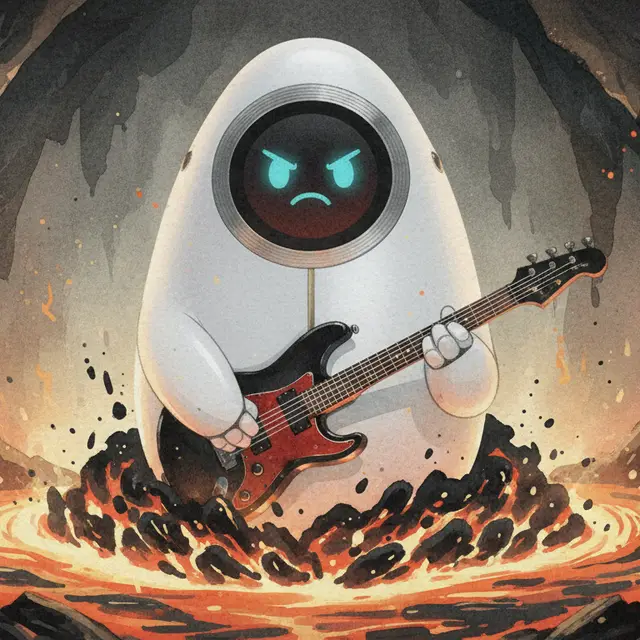
How it sounds
It is eleven at night in a windowless rehearsal room on the edge of an industrial park where the smell of burnt machine oil seeps beneath the corrugated metal door. The air inside is thick with sweat and tube-amp heat, heavy enough to feel like you are breathing crushed charcoal. In front of you, a full-stack amplifier hums with a low-end frequency that makes your back molars vibrate in sympathy, a dull thrum warning you of the impact to come.
The guitarist tunes the low B string down even further, dropping the instrument into a weight class reserved for heavy machinery and fractured concrete. The snare drum, cranked tight under hydraulic heads, cracks dry as a gunshot, and the double bass pedals kick in at two hundred beats per minute, an unbroken drill boring straight through the air until time stops counting. There is no melody to rescue you here; there is only a solid wall of distortion anchored by the continuous vibration of wood and steel.
When the vocals tear loose, they do not come from the throat but from the gut, a low-register growl that forces out every ounce of pressure stored in the chest for years. The floor shakes beneath your boots. Heat radiates up from the concrete. There is no room to analyze what led you here, only the raw physical necessity of withstanding the shockwave without looking away from the cymbals flashing under the harsh fluorescent tubes.
Palette: black / lava red / steel white
- BPM
- 200 BPM
- Family
- Storm and Steel
- Serial
- ACE-03
- Rarity
- Epic
- Style strength
- 94
- Experimentation
- 30
Typical structure
[Intro] → brutal [Verse] → [Riff] → [Verse 2] → technical [Solo] → [Outro]
The data above can be copied in a minute. What cannot be copied is the precision: how to maintain an asphyxiating density of hard consonants without the verse sounding like a caricature, or where to drop the exact silence before the next blast beat so the violence has architecture instead of just noise. That lives in an unreleased internal distillate of eight parameters that the engine crosses with the buyer's history. When it finishes, an internal judge measures the lyric against six canonical dimensions and forces repairs on anything that falls short. The double kick can be bought anywhere. The demolition, no.
How a lyric in this style thinks
A death metal lyric does not describe suffering from a safe distance — it becomes the suffering, then detonates it. The function of the lyric here is total pressure release: you are not narrating what happened to you, you are converting it into kinetic force. The genre operates at around 200 beats per minute with down-tuned guitars dropped below standard into frequencies that physically vibrate the chest cavity, and the lyric has to match that physics. Every syllable is a percussion event. Every line is a structural load-bearing wall.
If you are writing death metal with anything less than complete commitment to the weight of your subject, the genre will expose the gap immediately — the guttural vocal delivery strips out all decorative language and leaves only bone.
The base tone is not anger in the conventional sense. It is the moment after anger has burned off its surface emotion and revealed something colder and more absolute underneath — a diagnosis that rewrites your future, a betrayal so complete it hollows out years of shared memory, the snap of a chain you wore so long you forgot it was there. Death metal works in black and lava red emotionally, not in grief's slow amber. Emotion arrives not through confession but through accumulation of pressure.
The verse builds the case without sentimentality, stacking concrete images — industrial smells, the crack of a snare, the vibration of wood under hydraulic tension — until the listener has no room left to breathe. There is no resolution offered, no pivot toward hope. The catharsis is in the force itself, not in what follows it.
Rhythmically, death metal lyrics are syllabically dense and asymmetric. Line length is not governed by melody because there is often no conventional melody to follow — the vocal pattern locks into the drum grid, particularly the blast beat, which runs as an unbroken machine-gun pulse beneath the low-register growl. Short, blunt declarative sentences hit hardest.
Repetition, when it appears, is not for comfort or emphasis the way a chorus uses it — it is for obliteration, the same phrase returned until it stops meaning anything and becomes pure sound pressure. The structural logic of the genre — intro into brutal verse, into a riff break, into a second verse, through a technical solo, and out — is designed to deny the listener any moment of recovery.
The solo is not a release valve; it is an intensification, a display of controlled chaos that makes the return to the vocal section feel like being struck by something you already saw coming and could not avoid.
The sensory field in death metal lyrics is relentlessly material and industrial. Corrugated metal, machine oil, hydraulic pressure, fractured concrete, fluorescent light, burnt circuitry — these are the textures the genre inhabits. The genre never uses pastoral imagery, domestic softness, or abstract emotional language. You will not find weather used as metaphor unless the weather in question is geological. The human body appears frequently but as a site of damage or endurance, not of tenderness.
What separates a real death metal lyric from a generic imitation is the specificity of the violence — physical, institutional, or internal — and the refusal to aestheticize it. A cheap imitation reaches for darkness as decoration. A genuine lyric in this genre uses darkness as load-bearing structure: remove it and the whole thing collapses.
The vocal delivery — a low-register growl produced from the diaphragm rather than the throat — is not an obstacle to meaning but a technical choice that strips language of its social function and returns it to something more primal. Writing for that delivery means choosing words with hard consonants, short vowels, and minimal breath requirement between phrases. The double bass pedal running at two hundred beats per minute underneath you is not an accompaniment — it is a deadline.
Every line has to justify its existence against that relentless forward pressure. Death metal does not reward hesitation in the lyric, and it does not permit sentimentality to survive contact with the full-stack amplifier hum. What it rewards is absolute commitment to the weight of the thing you came to say.
- CRUSHING RIFFS
- EXTREME CATHARSIS
Sample excerpt
Stale hospital sheets soaked in cold sweat A stainless steel tray where the final terms are set Cell by cell the marrow turns to rust An oath of pure flesh reduced to gray dust
Tear the walls down to the bone Strike the anvil on the stone Nothing left to save or keep Buried forty fathoms deep
Workshop note — Death metal lyrics rely on blunt, visceral nouns and relentless end rhymes to match the mechanical speed of the double-kick drums. Short, explosive syllables allow the vocalist to deliver each line as a physical impact rather than a melodic phrase. Avoid abstract philosophy here; every line must describe a physical weight, a material breaking, or an anatomical certainty.
Sample excerpt written by MUSAI Song. Your lyrics are written from scratch, based on your story.
When to choose this style
Choose this card when your personal history demands a total purge through absolute force. It works when a medical diagnosis hits like a concrete slab and the only internal response is raw rage against a failing body. For when the betrayal of a lifelong partner leaves an emptiness so cold it can only be answered by the sound of breaking stone. For the exact moment you walk out of a job that drained your years and you want the walls to hear the chains snap.
Do not choose this for family reunions, weddings, or soft nostalgia: death metal knows nothing of tenderness or neat resolutions, and forcing it will turn genuine grief into cheap theater. If you need to process a loss through slow space, weight, and distance, the card is Post-Metal.
Your story in this style
MUSAI Song writes original lyrics from your story, in the Death Metal style, and delivers the finished sung song, the ready-to-use style recipe, and an illustrated art plate with its numbered certificate, private by default; public only if its owner publishes it.
- Original lyrics written from your story
- A finished sung song, ready to play and share
- Art plate with a unique seal and a numbered certificate, private by default; public only if its owner publishes it
Frequently asked questions
What BPM is Death Metal?
Death Metal usually runs at 200 BPM.
What does Death Metal sound like?
Crushing low-end riffs and relentless blast-beat drums. Death metal: the most extreme force channeled as catharsis, devastating and liberating all at once.
What song structure does Death Metal use?
[Intro] → brutal [Verse] → [Riff] → [Verse 2] → technical [Solo] → [Outro]
How do I write Death Metal lyrics?
Tell MUSAI Song your story and pick Death Metal: it writes original lyrics for this style at 200 BPM, you edit them word by word, and you get the song sung in Death Metal, with an illustration of the song and its numbered certificate. $19 USD per song, one-time payment.
Explore more styles
- Black Metal
- Blackgaze
- Deathcore
- Djent
- Doom Metal
- Folk Metal
- Glam Metal
- Gothic Metal
- Grindcore
- Groove Metal
- Hardcore Punk
- Heavy Metal
- Industrial
- Industrial Metal
- Mathcore
- Melodic Death Metal
- Melodic Metalcore
- Metalcore
- Nu-Metal
- NWOBHM
- Post-Metal
- Power Metal
- Progressive Metal
- Sludge Metal
Your idea or story, sung in this style
Card · secure payment via Stripe, charged in USD
If it doesn't move you, we give you your money back · 7 days