Folk Metal
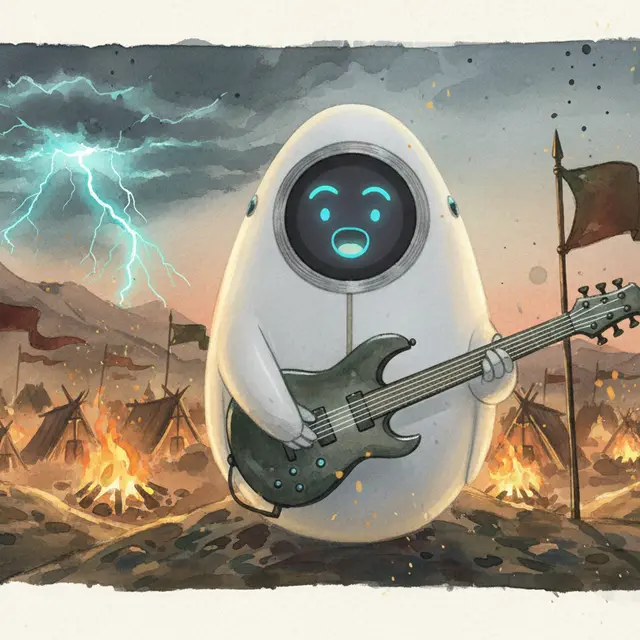
A campfire can also be a declaration of war.
Get your song in Folk Metal
Make yours in this styleHear it before you pay.$19 USD · your first song for $5.50 USDIf it doesn't move you, we give you your money back · 7 days.
Folk Metal is a style from the Storm and Steel family. 150 BPM, Experimentation 30, Style strength 91.
What is Folk Metal?
Heavy guitars layered with fiddle, flute, and tavern-hall choruses. Folk metal brings the epic force of ancient traditions — festive, warlike, and soaked in mead.
How it sounds
The Great Hall reeks of green timber, rendered pig fat, and the fresh, sharp sweat of today's forced march. Outside, the fjord rain batters the thick oak planks with the dull fury of an endless army, but inside, the air burns with the dense smoke of indoor hearths and the sour-sweet sting of mead spilling over horn rims. You stand atop the central trestle table, your mud-caked boots leaving dark stains on the scarred timber, while the iron weight of the axe at your belt reminds you that tomorrow belongs only to those who can still lift steel.
The fiddle strikes a high, razor-sharp trino that digs into the nape of your neck before plunging headlong into a furious dance of horsehair and gut. Instantly, the bone flute cuts through the din with a high, festive whistle that hauls even the weariest man back to his feet. Then the guitars drop: a wall of heavy tuning, an engine of fire and charcoal that vibrates right through the soles of your worn-out boots.
Sixty voices erupt in unison into a raucous tavern roar, a choir of throats roughened by cheap wine and bad weather that rattles the damp stone foundations. There is no timidity in this racket; there is only an ancestral urgency, the violent certainty that the night is short, that death waits just beyond the harbor, and that the only honest answer to the cold world is to shout louder than the gale.
Palette: earth brown / gray steel / neon cyan / fire orange
- BPM
- 150 BPM
- Family
- Storm and Steel
- Serial
- ACE-17
- Rarity
- Rare
- Style strength
- 91
- Experimentation
- 30
Typical structure
[Intro] folk → [Verse] → [Chorus] festive → [Instrumental] folk → [Final chorus with shouts]
What you see above is merely the scenery posted at the gates of the hall. Behind this facade lie two writing problems a table cannot solve: how to maintain martial grit without slipping into medieval faire parody, and how to weld the breakneck speed of a peasant fiddle to heavy metal low end without drowning the words in mud. That tension lives in an internal distillate of eight parameters crossed with your anecdote before a single line is drawn. Once finished, an internal judge measures the pulse against six canons and strips away every soft phrase. The tavern beat can be copied. The ancient fury, cannot.
How a lyric in this style thinks
A folk metal lyric does not describe a scene — it commands one into existence. The words arrive like a boot kicking open a door: declarative, physical, and loud enough to be heard over sixty hoarse voices and a wall of drop-tuned guitars. This is a genre built on collective urgency, where the lyric's first job is to pull every person in the room onto their feet and make them feel that whatever is being celebrated, mourned, or defied belongs to all of them equally. The emotion never trickles in; it floods. Folk metal operates in the register of earned pride, hard survival, and the specific joy of people who have come through something brutal and are still standing to drink about it.
Line length in folk metal tends to be short and percussive, cut to fit a galloping rhythm sitting around 150 BPM. Think four to six syllables per line in the verse, punching hard on the downbeat, with the occasional longer line thrown in to create forward momentum before the chorus crashes the gate. Repetition is not a crutch here — it is the architecture. The chorus phrase needs to be simple enough that someone who has never heard the song before can be shouting it by the second rotation.
Rhyme schemes stay obvious: AABB or ABAB, nothing that asks the listener to think. The vocal delivery alternates between a single narrator voice in the verse and a gang chant in the chorus, and that shift is where the whole emotional logic of the genre lives. The verse tells the story; the chorus makes it communal property.
The sensory field of folk metal is narrow and deliberate. You reach for wood, iron, fire, mud, wet stone, animal fat, and rough fabric. You reach for the smell of green timber and the weight of an axe at a belt. You do not reach for glass, chrome, fluorescent light, or anything that belongs to an office or a city grid. The instruments doing the structural work — fiddle cutting high and sharp above the guitars, bone flute punching through the low-end roar, accordion locking into the gallop — are not decoration.
They are load-bearing walls, and the lyric should acknowledge that acoustic world without being precious about it. Concrete nouns earn their place here: horn, scar, hearth, harbor, march. Abstract nouns do not survive the tempo.
Structurally, folk metal builds toward collectivity rather than interiority. The intro section typically belongs to the folk instruments alone, establishing the modal flavour and the tempo before the guitars drop and reframe everything as something heavier and more urgent. The verse carries the specific narrative — the crew, the crossing, the wound, the victory — and the language stays grounded and particular. The festive chorus opens the frame wide, trading the specific for the universal shout.
The instrumental break in the middle is not a rest; it is an escalation, a moment where the fiddle or flute takes a melodic line that the lyrics have already established and drives it harder. The final chorus adds shouts, layered gang vocals, sometimes a key shift or a tempo push, because folk metal does not end quietly.
What separates a genuine folk metal lyric from a generic imitation is the quality of the specific detail in the verse. Generic imitations reach immediately for myth and abstraction: ancient gods, endless battles, vague kingdoms. A real folk metal lyric earns its epic register by starting small and true — the calloused hands, the three fools who opened the shop, the mud-caked boots on the trestle table — before widening outward into the communal roar. The epic feeling has to be justified by the particular story underneath it. When the chorus calls on the whole hall to answer, the listener needs to believe they know exactly whose story this is and why it deserves the noise.
- METAL WITH FOLK
- WARRIOR FEAST
Sample excerpt
The iron hinges groaned against the frost, We dragged the timber up the mountain spine. Seven winters since the harvest cost Us every bushel of the rye and vine. My palms are mapped in ink black calloused lines, We carved our names into the frozen pine.
So pour the amber heavy in the horn! We hold the ridge until the sun is torn. With stomp of boot and iron on the floor, We toast to ghosts and ready for the roar!
Workshop note — Folk metal relies on a driving, gallop-style rhythm that matches the percussive nature of the verse, using concrete imagery of physical labor to anchor the narrative. The chorus functions as a communal anthem, prioritizing high-energy, repetitive phrasing that invites a group to shout along rather than sing gently. Avoid flowery metaphors here; the language should feel like stone, wood, and salt-stained iron.
Sample excerpt written by MUSAI Song. Your lyrics are written from scratch, based on your story.
When to choose this style
Choose this card when the story tells of a crew holding the line against hard times, a gang of friends who crossed the country broke and celebrated over roasted meat, or a hard-won victory seized without asking for permission. It works for the brother who came back from the northern woods with calloused hands and a fresh scar, for the anniversary of the shop three fools opened when nobody believed in them, or to send off someone who lived like a force of nature. This is the music for raising a horn to the fallen, for reclaiming a rough, mountain-bred lineage, or for turning a heavy grief into a rowdy feast where nobody hides their face.
Do not choose it for a fragile romance, a quiet breakup, or introspective mourning: folk metal does not know how to weep softly and demands hot blood and wooden rafters. Neither for corporate office stories nor for intimate confessions under the bedsheets. If you seek an atmosphere of urban density and cold mechanical tension, the card is Industrial.
Your story in this style
MUSAI Song writes original lyrics from your story, in the Folk Metal style, and delivers the finished sung song, the ready-to-use style recipe, and an illustrated art plate with its numbered certificate, private by default; public only if its owner publishes it.
- Original lyrics written from your story
- A finished sung song, ready to play and share
- Art plate with a unique seal and a numbered certificate, private by default; public only if its owner publishes it
Frequently asked questions
What BPM is Folk Metal?
Folk Metal usually runs at 150 BPM.
What does Folk Metal sound like?
Heavy guitars layered with fiddle, flute, and tavern-hall choruses. Folk metal brings the epic force of ancient traditions — festive, warlike, and soaked in mead.
What song structure does Folk Metal use?
[Intro] folk → [Verse] → [Chorus] festive → [Instrumental] folk → [Final chorus with shouts]
How do I write Folk Metal lyrics?
Tell MUSAI Song your story and pick Folk Metal: it writes original lyrics for this style at 150 BPM, you edit them word by word, and you get the song sung in Folk Metal, with an illustration of the song and its numbered certificate. $19 USD per song, one-time payment.
Explore more styles
- Black Metal
- Blackgaze
- Death Metal
- Deathcore
- Djent
- Doom Metal
- Glam Metal
- Gothic Metal
- Grindcore
- Groove Metal
- Hardcore Punk
- Heavy Metal
- Industrial
- Industrial Metal
- Mathcore
- Melodic Death Metal
- Melodic Metalcore
- Metalcore
- Nu-Metal
- NWOBHM
- Post-Metal
- Power Metal
- Progressive Metal
- Sludge Metal
Your idea or story, sung in this style
Card · secure payment via Stripe, charged in USD
If it doesn't move you, we give you your money back · 7 days