Traditional Mariachi
The trumpet doesn't announce — it declares.
Get your song in Traditional Mariachi
Make yours in this styleHear it before you pay.$19 USD · your first song for $5.50 USDIf it doesn't move you, we give you your money back · 7 days.

A real example in this style
“El Vapor de Lupita”
- Te plantabas al pie del metro Constitución,
- cinco en punto, de frío y de afán,
- con la olla humeando y el atole de guayaba,
- vapor que a tres hijos nos dio pan.
Example made with MUSAI Song · sample story · See its certificate MUS-MURRZP
Traditional Mariachi is a style from the Roots That Hold Fast family. 100 BPM.
What is Traditional Mariachi?
Violins that laugh and trumpets that celebrate. The festive soul of Mexico dressed in its finest, ready for a serenade or the town square. Mariachi, Mexico's iconic ensemble tradition, brings warmth and pride to every note.
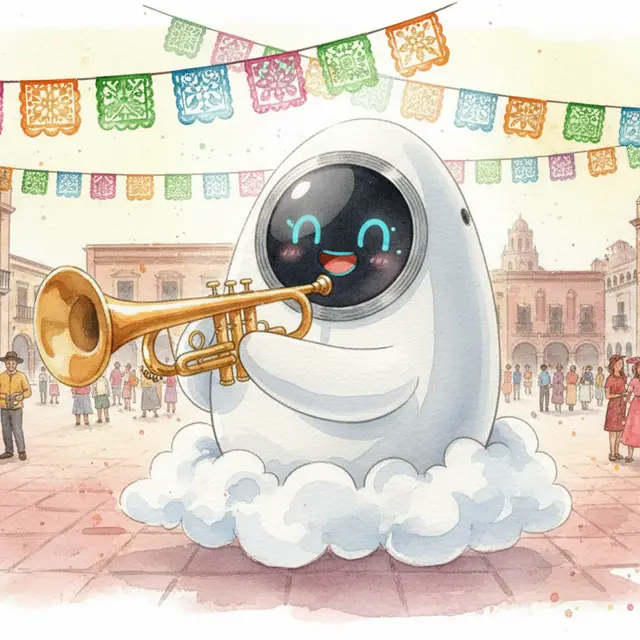
How it sounds
The three o'clock sun hits the pink quarried stone of the town square with blinding force, tearing a sharp glare from the silver buttons of the charro suit. You stand near the frame of an old doorway, feeling the weight of the guitarrón thrumming against your chest, the wood still warm from the heavy afternoon heat. The trumpet strikes without asking permission, a jet of golden brass cutting through the dry air and slamming against closed balconies until someone is forced to pull back a curtain.
The violins refuse to merely accompany; they chase the melody like children laughing across arches, racing each other at a speed that defies your pulse. Two feet away, dust kicks up as spurs stamp the exact beat into the flagstones, a dry thud answering the bass drum with the gravity of the earth itself. Someone walks past carrying a tray of clay cups where mezcal sweats, the scent of cooked agave mixing with toasted leather and the afternoon dust. There is no hesitation in the air; the music is an order obeyed by singing aloud.
A voice hollers from across the corner, a falsetto ripping the open sky and cracking deliberately just before the crowd roars back in approval. Everything vibrates at the exact same pitch, a pride so heavy it aches in the throat, a celebration that offers no apologies for existing under the open sky.
Palette: trumpet gold / suelo quarry stone pink / chopped paper green
- BPM
- 100 BPM
- Family
- Roots That Hold Fast
- Serial
- RAI-05
- Rarity
- Epic
Typical structure
[Intro] violins and trumpets → [Verse] → [Festive chorus] → [Trumpet instrumental] → [Verse 2] → [Final chorus] with shouts
What you see in the data is only the surface. Behind it lie two stubborn writing problems: how to keep the pride standing tall without sliding into tourist parody, and how to make the brass converse with the lyric without drowning the personal confession. That lives inside an unpublished internal distillate of eight parameters that the engine crosses with your story. When it finishes, an internal judge measures the lyrics against six dimensions of the canon and forces a rewrite on anything that smells like a postcard. The charro suit can be rented. The pride, no.
How a lyric in this style thinks
A lyric in Mariachi Tradicional does not invite the listener in — it summons them. The voice makes a public declaration, and the brass confirms it. From the first measure, the song claims space: the town square, the courtyard, the open air above a crowded table. This is a genre built around the act of announcement, which means every line has to earn its right to be heard at full volume. Restraint is not a virtue here. If you are writing in this style, the lyric must know exactly what it is celebrating and say so without blinking.
The emotional architecture of Mariachi Tradicional moves from pride to fiercer pride, not from tension to resolution. The opening verse plants a flag — a name, a place, a moment of arrival or recognition — and the festive chorus lifts that flag into the air for everyone to see. There is no ambiguity about what the song is for. The shouts that punctuate the final chorus, those sharp vocal cries that crack the open sky just before the crowd answers, are not ornament: they are the lyric's highest emotional note, and the words leading to them must earn that release. Emotion in this genre arrives like the trumpet itself, without asking permission.
Rhythmically, the son and jarabe patterns that drive Mariachi Tradicional at around 100 BPM demand lines with strong, countable syllables and clear landing points. The vihuela's syncopated strum and the guitarrón's deep, chest-level pulse create a grid that the lyric must lock into rather than float over. Long, winding sentences lose the plot immediately; short declarative phrases with hard final consonants fare best, because the violin lines are already racing each other across the melody and the lyric needs to match that velocity without tripping. Repetition is structural, not lazy: the chorus returns to the same image because the crowd is meant to sing it back.
The sensory world of this genre is specific and non-negotiable. Quarried stone warming under a three o'clock sun, the scent of cooked agave, spurs striking flagstones, the weight of silver buttons on a charro suit, clay cups sweating in the afternoon heat — these are the textures that authenticate a Mariachi Tradicional lyric. Abstract language collapses under the weight of the brass. You do not write about love in the abstract; you write about a name being shouted from across a square. You do not write about the passage of time; you write about a man's eightieth year and every table covered with food. The genre never lives indoors, never whispers, and has no use for shadows or dim corners.
Structurally, the trumpet instrumental break is not a rest — it is the lyric's argument made in pure sound, and the second verse must enter with renewed authority, not wind down. The final chorus with its shouts is the genre's climax, and it must feel inevitable rather than sudden. What separates a genuine Mariachi Tradicional lyric from a generic imitation is the specificity of the pride being expressed. Generic versions celebrate vague joy. Real ones celebrate a particular grandfather, a particular valley, a particular return. The brass can carry almost anything, but it cannot manufacture the weight of a real name spoken in the public square.
- VIOLINS AND TRUMPETS
- DRESSED-UP PRIDE
Traditional Mariachi at a glance
How LYRA uses this style card
The style card is just one of the inputs. LYRA combines your story (names, memories and phrases) with the rhyme and meter of this style, shapes the song's arc and reviews the lyrics before handing them to you.
- Your story, fact by fact. LYRA reads what you wrote and lists the facts: who it's for, what you call them, the occasion, the place, the memories and the phrases exactly as you said them. Each fact carries its literal quote from your story; what isn't there doesn't go into the song.
- The Traditional Mariachi card, one input among several. From this card it takes the tempo, the section structure, the syllable mold and the rhyme type of this style. The card sets the shape; what gets sung comes from your story.
- A plan for every section. Before writing, it plans each section: which lines rhyme with which, the word each line ends on and how many syllables it carries. The chorus is planned to come back, and every section has to move something: the song goes somewhere.
- Writes, then measures. It counts each line's syllables with their stress and flags the lines that break their section's mold. It checks that the lines the plan pairs actually rhyme, that the chorus sings your phrase word for word, and that every name in your story appears, with no names nobody gave.
- Reviews and rewrites what fails. It audits the whole lyric: rhyme, scheme, meter, repetition and clichés, plus over-fancy words. If it doesn't pass, if a name is missing or an invented one shows up, or if something you asked to leave out appears, it rewrites those sections before handing it to you.
- You have the final word. You read the lyrics, change them word by word and hear your song sung in Traditional Mariachi before you pay.
Sample excerpt
The dust of the high road is off my leather boots. My hands are steady holding the latch to the gate. I brought back the story of the iron-wrought cities, And a heavy ring of keys for the door of this house. The neighbors look out from behind their lace curtains, To see the man who departed with nothing but his shadow.
Sound the trumpets until the glass in the windows hums! Let the violins rise like the scent of the harvest. I am home with my pride and a name that rings clear, Let the whole valley hear that the circle is closed.
Workshop note — This genre thrives on declarative, larger-than-life storytelling that demands to be heard in the open air. The lines favor strong, physical imagery like iron keys and vibrating glass to establish presence, while the chorus acts as a public announcement rather than a personal secret. Avoid internalizing your thoughts; in this style, every emotion must be projected with the confidence of a brass section.
Sample excerpt written by MUSAI Song. Your lyrics are written from scratch, based on your story.
When to choose this style
Choose this card when you need to raise your voice for something others prefer kept quiet. It works to celebrate a grandfather turning eighty with a house full of people and food covering every table. For the fierce pride of a small town that sent its first kid to university and wants the whole valley to know without false modesty. To thank a mother who carried the weight of the world alone and now deserves to hear her name shouted by brass in the public square. It fits the return of someone who left with nothing and comes back standing tall.
Do not choose it for quiet sorrow, grief that begs for silence, or a low-voiced farewell: mariachi does not know how to whisper or hide in a dark corner. Neither is it meant for tepid reconciliations where old guilts still need dividing. If you are looking for muted pain and settling scores in the dim light, the card is Bolero Ranchero.
Your story in this style
MUSAI Song writes original lyrics from your story, in the Traditional Mariachi style, and delivers the finished sung song, the ready-to-use style recipe, and an illustrated art plate with its numbered certificate, private by default; public only if its owner publishes it.
- Original lyrics written from your story
- A finished sung song, ready to play and share
- Art plate with a unique seal and a numbered certificate, private by default; public only if its owner publishes it
Frequently asked questions
What BPM is Traditional Mariachi?
Traditional Mariachi usually runs at 100 BPM.
What does Traditional Mariachi sound like?
Violins that laugh and trumpets that celebrate. The festive soul of Mexico dressed in its finest, ready for a serenade or the town square. Mariachi, Mexico's iconic ensemble tradition, brings warmth and pride to every note.
What song structure does Traditional Mariachi use?
[Intro] violins and trumpets → [Verse] → [Festive chorus] → [Trumpet instrumental] → [Verse 2] → [Final chorus] with shouts
How do I write Traditional Mariachi lyrics?
Tell MUSAI Song your story and pick Traditional Mariachi: it writes original lyrics for this style at 100 BPM, you edit them word by word, and you get the song sung in Traditional Mariachi, with an illustration of the song and its numbered certificate. $19 USD per song, one-time payment.
Explore more styles
- Andean Huayno
- Appalachian Old-Time
- Argentine Tango
- Balkan Brass
- Bluegrass
- Bolero Ranchero
- Cajun
- Cape Verdean Morna
- Celtic Folk
- Corrido Tumbado
- Creole Waltz
- Epic Ranchera
- Flamenco Rumba
- Greek Rebetiko
- Huapango Huasteco
- Irish Ballad
- Joropo Llanero
- Klezmer
- Milonga
- Moroccan Gnawa
- Nordic Folk
- Norteño with Sax
- Pacific Currulao
- Portuguese Fado
Your idea or story, sung in this style
Card · secure payment via Stripe, charged in USD
If it doesn't move you, we give you your money back · 7 days