Flamenco Rumba
Even the Mediterranean dances when you play it right.
Get your song in Flamenco Rumba
Make yours in this styleHear it before you pay.$19 USD · your first song for $5.50 USDIf it doesn't move you, we give you your money back · 7 days.

Example in a sibling style: Bolero Ranchero
“El Chocolate de Refugio”
- Llegó otra vez el aire del primero de noviembre,
- y subo el cempasúchil que compré en el mercado;
- la veladora tiembla, la canela ya la enciendo,
- y tu voz se nos quedó, Refugio, en el retrato.
Example made with MUSAI Song · sample story · See its certificate MUS-R7E8AS
Flamenco Rumba is a style from the Roots That Hold Fast family. 110 BPM, Experimentation 18, Style strength 92.
What is Flamenco Rumba?
Flamenco's cheerful cousin: a guitar that makes you clap along and a chorus that sticks with you. Mediterranean sun and feet that never stop.
How it sounds
It is noon and the whitewashed walls are almost blinding. You are standing in the town square, right where the heat rises in invisible waves from the pavement, making the distant silhouettes waver. Someone starts keeping time against an old wooden table, and the guitar cuts right in with a clean, aggressive strum that forces your shoulders to twitch without a second thought. Fingernails brush the nylon strings in a dry, lightning-fast rattle while the thumb drops heavy to anchor the bass.
Next to you, a wooden box answers with a sharp slap that punches straight into your ribs. There are no expensive amplifiers or effect pedals here; just the raw sound of wood struck with skill and a resonance box smelling of dry pine and accumulated summer heat. Someone raises a glass of chilled white wine and laughter merges with handclaps striking three against four, a syncopation that forces your own feet to answer against the ground. The air smells of salt blown in from the coastal promenade, burnt rosemary, and warm skin.
There is no room for quiet melancholy here; the rhythm pushes you forward, demanding that you spin or lift your arms because staying still while the guitar accelerates feels like fighting the current of a river that only knows how to run toward the light.
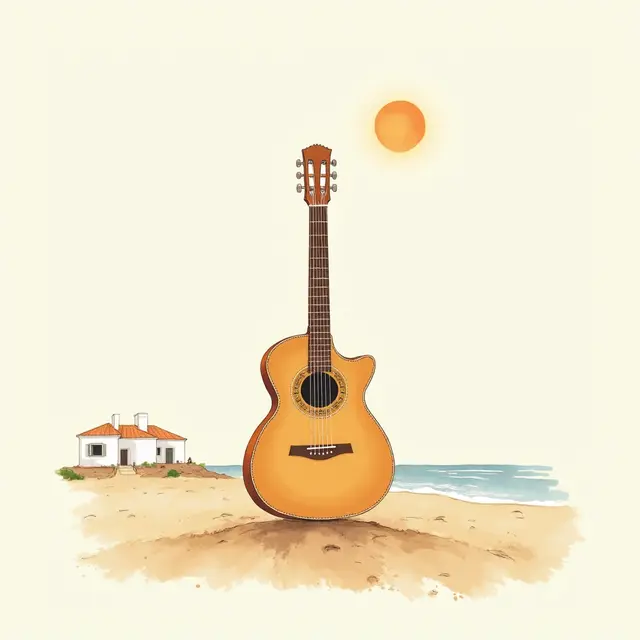
Palette: white / sea blue / orange
- BPM
- 110 BPM
- Family
- Roots That Hold Fast
- Serial
- RAI-10
- Rarity
- Common
- Style strength
- 92
- Experimentation
- 18
Typical structure
[Intro] rhythmic guitar → [Verse] → [Catchy Chorus] → [Verse 2] → [Chorus] → final handclaps
The data above can be copied in a minute with a guitar and some handclaps. What cannot be copied is the exact tension between the sharp slap of the box and the lightness of the strum, nor how to prevent the joy from sounding like a manufactured postcard. All of that lives in an internal distillate of eight unpublished parameters, and the engine crosses them with the buyer's actual history. Upon completion, an internal judge measures the lyrics against six dimensions of the canon and repairs any line that feels forced. The tempo is found anywhere. The festive spirit, not.
How a lyric in this style thinks
A lyric in Rumba Flamenca does one thing before anything else: it pulls the body into motion. The words are not there to be weighed or pondered — they are designed to land on the beat and carry the listener forward before the mind has time to object. This is the cheerful, street-born branch of flamenco, stripped of its heavier ceremonial weight and rebuilt for open-air squares, clay-pitcher wine, and the kind of joy that needs an audience. The lyric's job is to be irresistible, and that irresistibility is structural, not accidental.
The emotional register sits in a narrow, concentrated band: full-throated celebration, reunion warmth, the pride of a moment that has finally arrived. There is no ambiguity here, no shadow tucked into the second verse as a twist. Rumba Flamenca does not deal in gray. The feeling arrives immediately, in the first two lines, and the rest of the lyric amplifies rather than complicates it. Concrete images carry that feeling: whitewashed walls, a glass raised in sunlight, the sound of sandals on stone, salt air off the coast.
You are not writing about abstract happiness — you are writing about this table, this afternoon, these specific hands clapping. The sensory field is always Mediterranean and always outdoors: heat, light, wood, skin, the smell of rosemary on hot pavement. Interior rooms, rainy cities, and anything that suggests enclosure or introspection belong to a different genre entirely.
Rhythmically, the lyric has to mesh with one of the most physically insistent guitar patterns in folk music. The strumming in Rumba Flamenca is not decorative — it is aggressive and percussive, the nails dragging across nylon strings in a dry, rapid rasgueado while the thumb drops to anchor the bass on the strong beats. The cajón punches in with a slap that you feel in the chest rather than just hear.
Lines in the verse need to be short enough to sit inside that rhythm without fighting it, typically six to ten syllables, landing on the beat with a consonant that pops. The chorus expands slightly — it breathes a little more — but it still has to be singable at 110 BPM by someone who is already clapping along. If the chorus takes longer than three seconds to memorise, it is too complicated.
Repetition in Rumba Flamenca is not laziness; it is the mechanism. The hook phrase of the chorus is meant to be sung again before the section ends, and then again after the second verse, and the listener should be singing it before the song is halfway through. Vocally, the delivery is warm and direct — a male lead voice that pushes forward with confidence, not strain, sitting comfortably in the middle register with enough grit to cut through the guitar but none of the anguished falsetto of deeper flamenco forms.
The structure follows a clean logic: a rhythmic guitar intro that establishes the groove before a single word is sung, a first verse that sets the scene in the most concrete terms possible, a chorus that names the celebration outright, a second verse that adds a detail or a face to the story, and then the chorus again, extended by handclaps that fade rather than cut.
What separates a real Rumba Flamenca lyric from a generic imitation is the specificity of its joy. Generic versions celebrate something vague — life, love, the moment. A genuine one names the grandmother who still raises her arms, the friend who came back with dust on his boots and stories that take three nights to tell, the wedding where the wine pitcher never quite empties. The rhythm does the persuading; the lyric does the naming. Get those two things right and the feet answer before the chorus even arrives.
- GUITAR THAT PULLS YOU IN
- HANDCLAPS IN THE SUN
Sample excerpt
You pulled the old guitar from the closet floor, Dusting off the wood with a linen sleeve. The orange light spills through the open door, And the heavy silence is starting to leave. Pour the wine from the clay jug into the glass, There are stories enough for the evening to pass.
Oh, let the rhythm strike the stone, We are never dancing here alone. With a clap and a turn and a golden grin, Let the celebration now begin.
Workshop note — Rumba Flamenca thrives on short, punchy lines that mirror the percussive strum of the guitar and handclaps. The chorus should function as a call-and-response hook, keeping the rhyme scheme simple and repetitive to encourage spontaneous movement. Avoid complex metaphors; focus instead on immediate, tactile actions that invite the listener to join the circle.
Sample excerpt written by MUSAI Song. Your lyrics are written from scratch, based on your story.
When to choose this style
Choose this card when the story calls for unfiltered celebration, an outburst of joy that needs no heavy explanations. It works for a grandmother's landmark birthday where she still dances with her arms raised high, for the return of someone who left years ago and comes back with pockets full of tales, or for an open-air courtyard wedding where wine flows from clay pitchers. It fits when old friends reunite after a decade and the past becomes a party instead of a grievance. Choose this rumba when victory is loud rather than silent, when you want the listener to tap their feet and smile before the first verse ends.
Do not choose it to tell a deep heartbreak, a recent loss, or a betrayal that still hurts to breathe through; this style does not know how to cry softly, and forcing it toward sadness creates a hollow party. It is useless for the gray nostalgia of a rainy afternoon in the city either. If you are looking for pain sung through a tight throat with your eyes fixed on the horizon, the card is Bolero Ranchero.
Your story in this style
MUSAI Song writes original lyrics from your story, in the Flamenco Rumba style, and delivers the finished sung song, the ready-to-use style recipe, and an illustrated art plate with its numbered certificate, private by default; public only if its owner publishes it.
- Original lyrics written from your story
- A finished sung song, ready to play and share
- Art plate with a unique seal and a numbered certificate, private by default; public only if its owner publishes it
Frequently asked questions
What BPM is Flamenco Rumba?
Flamenco Rumba usually runs at 110 BPM.
What does Flamenco Rumba sound like?
Flamenco's cheerful cousin: a guitar that makes you clap along and a chorus that sticks with you. Mediterranean sun and feet that never stop.
What song structure does Flamenco Rumba use?
[Intro] rhythmic guitar → [Verse] → [Catchy Chorus] → [Verse 2] → [Chorus] → final handclaps
How do I write Flamenco Rumba lyrics?
Tell MUSAI Song your story and pick Flamenco Rumba: it writes original lyrics for this style at 110 BPM, you edit them word by word, and you get the song sung in Flamenco Rumba, with an illustration of the song and its numbered certificate. $19 USD per song, one-time payment.
Explore more styles
- Andean Huayno
- Appalachian Old-Time
- Argentine Tango
- Balkan Brass
- Bluegrass
- Bolero Ranchero
- Cajun
- Cape Verdean Morna
- Celtic Folk
- Corrido Tumbado
- Creole Waltz
- Epic Ranchera
- Greek Rebetiko
- Huapango Huasteco
- Irish Ballad
- Joropo Llanero
- Klezmer
- Milonga
- Moroccan Gnawa
- Nordic Folk
- Norteño with Sax
- Pacific Currulao
- Portuguese Fado
- Pure Flamenco
Your idea or story, sung in this style
Card · secure payment via Stripe, charged in USD
If it doesn't move you, we give you your money back · 7 days