Cajun
The bayou doesn't explain itself — you feel it in your feet before you walk in.
Get your song in Cajun
Make yours in this styleHear it before you pay.$19 USD · your first song for $5.50 USDIf it doesn't move you, we give you your money back · 7 days.

Example in a sibling style: Traditional Mariachi
“El Vapor de Lupita”
- Te plantabas al pie del metro Constitución,
- cinco en punto, de frío y de afán,
- con la olla humeando y el atole de guayaba,
- vapor que a tres hijos nos dio pan.
Example made with MUSAI Song · sample story · See its certificate MUS-MURRZP
Cajun is a style from the Roots That Hold Fast family. 130 BPM, Experimentation 16, Style strength 94.
What is Cajun?
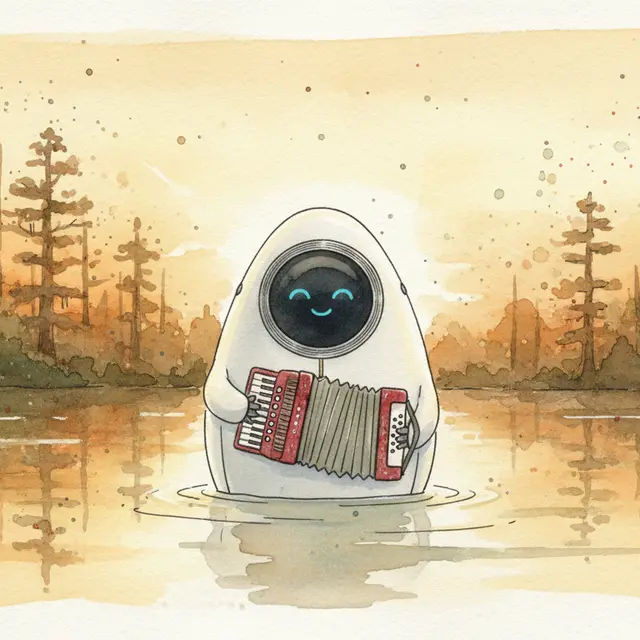
Accordion and fiddle from the bayou singing in Cajun French. A swamp party and two-step dancing on old wooden floors.
How it sounds
The air clings thick to the skin before you even push through the screen door of the dance hall, heavy with swamp steam, damp lumber, and stale beer. Outside, the sun drops low over the stagnant bayou water, painting the hanging cypress moss in a dirty, bruised amber. Inside, the pine floorboards groan beneath rubber boots and worn leather soles that already know every knot in the wood. The heat smells of dried sweat, engine grease, and the green tang of the marsh that drifts in through wide-open window frames.
In the corner, an old man forces the bellows of a diatonic accordion with a dry, relentless push that cuts the air, dragging a nasal, cutting cry from the reeds that prickles the back of the neck. Right beside him, the fiddle rips into a fast, clawing two-step, bowing the strings with a rough, reckless joy that demands no pause. A small metal triangle keeps time from a dark corner, a sharp, piercing ping that strikes against the teeth like a needle. There is no room here to dwell on what got left behind.
Couples spin locked tight, skirts brush knees, bodies collide and break apart to a crude, driving arithmetic that the accordion forces out of sheer lung power. Dust kicks up from the cracks in the floor, hanging in the slanting rays of light like tiny scales against sweating skin. Nobody looks out the window.
The black water keeps rising through the roots, the world slowly drowning in mud, but in here the bow keeps sawing across the strings and a heavy boot hits the pine floor again and again, beating out a furious rhythm that stays one step ahead of the silence.
Palette: swamp green brown orange amber
- BPM
- 130 BPM
- Family
- Roots That Hold Fast
- Serial
- RAI-27
- Rarity
- Common
- Style strength
- 94
- Experimentation
- 16
Typical structure
[Intro] accordion → [Verse] → [Chorus] → [Instrumental] fiddle → [Final Chorus]
What you see above is merely the surface scenery put into words. Beneath it lie raw technical problems that refuse to fit in a spreadsheet: how to keep the mix of archaic French and rural English sounding like real marsh talk instead of a tourist gimmick, and how to make the fiddle and accordion breathe inside the lyric without drowning the story. That balance lives in an unreleased internal distillate of eight parameters that the engine crosses directly with your personal history. Once the draft finishes, an internal judge measures it against six strict canons of the genre and forces a rewrite on anything that rings false. The accordion is bought in a shop. The pulse of the bayou, no.
How a lyric in this style thinks
A Cajun lyric does not process grief — it outpaces it. The song arrives already moving, already loud, already inside the room before you've finished explaining what happened. That is the essential function of the form: to replace the slow explanation with a body in motion. The accordion opens the door, the fiddle kicks it shut behind you, and the lyric's job is to keep up with the tempo that the instruments have already set at 130 beats per minute.
Emotion in Cajun music does not build toward release; it begins at release and dares you to sustain it. The pain, the loss, the river that took the roof — all of it is acknowledged in passing, the way you acknowledge a pothole by steering around it rather than stopping to measure its depth.
The sensory field is specific and non-negotiable. Cajun lyrics live in concrete, physical places: pine floors, screen doors, the smell of engine grease cut with swamp air, rubber boots finding their grip on warped wood. The bayou is not a metaphor here — it is a location, a smell, a water level. The language reaches for textures you can feel in your palms: bellows leather, fiddle rosin, a cold bottle neck. What Cajun writing never uses is abstraction. There are no inner landscapes, no psychological distances, no careful emotional qualifications.
If a man is proud, he stands straight. If a woman is grieving, she dances harder. The lyric earns its emotional weight by staying stubbornly on the surface of physical things.
Repetition in Cajun is structural, not decorative. The chorus exists to be shouted back, and it will come around more than once because the people in that dance hall need something to hold onto while their boots are finding the beat. Lines tend to be short and rhythmically blunt, landing on the downbeat the way a heavy sole hits pine. The two-step pulse — ONE-two-THREE-four — governs how syllables stack; a lyric that fights that arithmetic will lose.
Rhyme schemes are simple and functional, usually couplets or ABAB quatrains, because the ear is already busy tracking the diatonic accordion's nasal cut and the fiddle's reckless bow. Complexity in the melody is handled by the instruments. Complexity in the lyric is handled by accumulation: the same hard truth said three different ways until it becomes something you can dance to.
The structural logic of a Cajun song follows a clear, kinetic arc. The accordion intro establishes the key and tempo before a single word is sung — this is not preamble, it is permission. The verses carry the story in short, declarative lines, usually two or three images per verse, never lingering. The chorus distills everything into the one thing worth repeating. Then the fiddle instrumental arrives not as a break but as a conversation, the instrument finishing the sentence the lyric started. The final chorus returns with the crowd already knowing the words. Notice how little time the form allocates to explanation: Cajun structure trusts the listener to fill in what is left unsaid.
What separates a genuine Cajun lyric from a generic imitation is the refusal of sentimentality. An imitation will slow down at the emotional peak, add an extra line to make sure you understood what was lost. A real Cajun lyric accelerates past that moment, turns the corner hard, and gives you the next image before you've finished processing the last one. The triangle's sharp ping keeps striking between every measure, a needle that will not let the room go soft.
If you are writing in this genre and you feel the lyric getting tender and still, that is the signal to cut the line in half and push the tempo. The swamp keeps rising, the bow keeps moving, and the boot keeps hitting the floor — because stopping is the only thing the song cannot afford.
- BAYOU ACCORDION
- TWO-STEP
Sample excerpt
The cypress knees are peaking through the silt at morning tide, I hitched the mule to pull the rusted tractor from the slide. My brother’s got the hammer and a bottle of the rye, We’re fixing up the rafters underneath an amber sky. The floorboards creak like fiddles when we dance across the mud, Just sweat and iron spirit running thick inside our blood.
Oh, step it out and shake the dust from off your heavy boots, We’re planting down our laughter deep among the bayou roots. Keep the accordion wheezing while the river starts to rise, With a fiddle tune to swallow up the sorrow in your eyes.
Workshop note — This style relies on a steady, driving two-step rhythm that mandates short, punchy lines designed to be shouted over a loud accordion. The chorus functions as a communal rally point, using repetitive, rhythmic language to push back against hardship rather than dwelling on it. Avoid introspective or flowery metaphors, as the Cajun aesthetic favors concrete physical actions and the immediate, gritty reality of the swamp.
Sample excerpt written by MUSAI Song. Your lyrics are written from scratch, based on your story.
When to choose this style
Choose this card when the story calls for a celebration that refuses to look away from the blow it took. It works when a crew of cousins decides to rebuild the workshop after the river took the roof, cutting through the silence with work and an open bottle on the workbench. For the grandfather who taught everyone to two-step on the warped porch with calloused hands and a crooked grin, proving the land can break your back without breaking your stride.
For the family packing up a leaking house for good, replacing farewell tears with a loud, crowded kitchen table where nobody sits down. For the return home from the oil rigs with grease under the fingernails and pride still intact. Do not choose it if you need a quiet ballad for weeping alone in the kitchen, nor for a delicate love confession or a fresh loss that still requires slow explanations. If you are looking for an intimate, whispered confession, the card is Huapango Huasteco.
Your story in this style
MUSAI Song writes original lyrics from your story, in the Cajun style, and delivers the finished sung song, the ready-to-use style recipe, and an illustrated art plate with its numbered certificate, private by default; public only if its owner publishes it.
- Original lyrics written from your story
- A finished sung song, ready to play and share
- Art plate with a unique seal and a numbered certificate, private by default; public only if its owner publishes it
Frequently asked questions
What BPM is Cajun?
Cajun usually runs at 130 BPM.
What does Cajun sound like?
Accordion and fiddle from the bayou singing in Cajun French. A swamp party and two-step dancing on old wooden floors.
What song structure does Cajun use?
[Intro] accordion → [Verse] → [Chorus] → [Instrumental] fiddle → [Final Chorus]
How do I write Cajun lyrics?
Tell MUSAI Song your story and pick Cajun: it writes original lyrics for this style at 130 BPM, you edit them word by word, and you get the song sung in Cajun, with an illustration of the song and its numbered certificate. $19 USD per song, one-time payment.
Explore more styles
- Andean Huayno
- Appalachian Old-Time
- Argentine Tango
- Balkan Brass
- Bluegrass
- Bolero Ranchero
- Cape Verdean Morna
- Celtic Folk
- Corrido Tumbado
- Creole Waltz
- Epic Ranchera
- Flamenco Rumba
- Greek Rebetiko
- Huapango Huasteco
- Irish Ballad
- Joropo Llanero
- Klezmer
- Milonga
- Moroccan Gnawa
- Nordic Folk
- Norteño with Sax
- Pacific Currulao
- Portuguese Fado
- Pure Flamenco
Your idea or story, sung in this style
Card · secure payment via Stripe, charged in USD
If it doesn't move you, we give you your money back · 7 days