Appalachian Old-Time
More things got settled on that porch than in any city.
Get your song in Appalachian Old-Time
Make yours in this styleHear it before you pay.$19 USD · your first song for $5.50 USDIf it doesn't move you, we give you your money back · 7 days.

Example in a sibling style: Bolero Ranchero
“El Chocolate de Refugio”
- Llegó otra vez el aire del primero de noviembre,
- y subo el cempasúchil que compré en el mercado;
- la veladora tiembla, la canela ya la enciendo,
- y tu voz se nos quedó, Refugio, en el retrato.
Example made with MUSAI Song · sample story · See its certificate MUS-R7E8AS
Appalachian Old-Time is a style from the Roots That Hold Fast family. 120 BPM, Experimentation 18, Style strength 94.
What is Appalachian Old-Time?
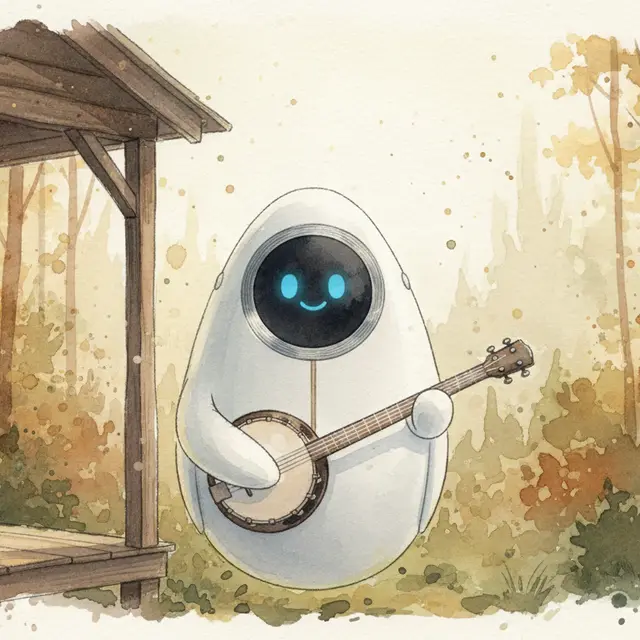
Clawhammer banjo and an old-time fiddle on the porch. The raw root of North America, older than everything else, rocking gently through the afternoon.
How it sounds
A porch of boards that no longer sit level, on a West Virginia hillside, half past four on an October afternoon. The fog has not come up from the valley yet, but you can see it waiting down there among the pines for the light to drop.
Two chairs. On one, a five-string banjo with a skin head, so old the rim carries the mark of two generations of knees. The right hand does not pick: it falls. Down-stroke with the back of the nail, thumb catching the fifth string on the way back. Never up. Never.
On the other chair, a fiddle in cross tuning, the four strings set so they ring against each other even when nobody touches them. The bow is not after the pretty note. It scrapes a little. It leaves the air inside.
There is no count-in. One of them starts and the other joins on the second bar, and from there neither will look at the other for eight minutes.
You can hear the creek below, fast from the week's rain. You can hear a board creak every time a heel marks the beat. It smells of pine resin and of woodsmoke from the house next door.
The voice comes in late and comes in low. It says four things, all of them concrete, and none of them explains anything.
And when the tune comes around for the fifteenth time, you are no longer listening to it: you are waiting for it.
Palette: wood brown / forest green / gold amber
- BPM
- 120 BPM
- Family
- Roots That Hold Fast
- Serial
- RAI-26
- Rarity
- Common
- Style strength
- 94
- Experimentation
- 18
Typical structure
[Intro] fiddle+banjo → [Verse] → [Chorus] → [Instrumental break] → [Final Verse]
The numbers above are the surface, and in old-time the surface is deceptively small: two instruments and a tempo. What does not fit in a table is everything else. How to write with the economy the genre demands, where one word too many sounds like pretending. Which concrete image survives fifteen repeats without turning into filler. How to say something deep without allowing yourself a single adjective. That lives in this card's internal distillation, eight parameters that are not published, and the engine crosses them with your story before writing. Then an internal judge measures against six dimensions of the canon and repairs. The banjo stroke can be learned in a month. Saying little and having it land cannot.
How a lyric in this style thinks
A lyric in Appalachian old-time does not explain grief or pride or longing — it names the objects those feelings live inside, and then it stops. The genre works by accumulation of the concrete: a fence post, a hand-dug well, a name carved into a beam. The emotion arrives through selection, not declaration. If you are writing old-time, your job is to choose four things that are true and let them stand without commentary. The song trusts the listener to close the distance.
The base tone is restraint that borders on severity. Nothing is softened and nothing is inflated. A verse in Appalachian old-time tends to run short — four lines, sometimes six — and the lines themselves stay close to spoken cadence, the kind of sentence a man might say once and not repeat. But repetition is structural, not rhetorical: the tune comes around fifteen times because that is how old-time works, the melody a wheel, and the lyric sits in the wheel's groove.
The chorus, when it exists, is not a lift — it is a return, a restatement, the same door you already walked through. The instrumental break between verses is not decoration; it is where the song breathes and the listener remembers what was just said.
The sensory field is specific and it is regional. Woodsmoke, creek water running fast after rain, pine resin, the sound of a heel marking time on a board that needs replacing. The clawhammer banjo — that falling right hand, nail down, never up — sets a rhythmic pulse that feels inevitable rather than driven, and the fiddle in cross tuning adds a resonance that seems to come from the room rather than the instrument. Vocally, the delivery comes in late and comes in low. There is no vibrato reaching for feeling. The voice states. If a word is held, it is held because the meter requires it, not because the singer wants you to notice the hold.
What the genre never uses is equally important. No metaphor that requires explanation. No abstract noun doing the emotional work — no resilience, no legacy, no love as a concept. No imagery that belongs to a landscape the song has not earned: no ocean, no desert, no city skyline. The porch, the hillside, the valley fog, the creek — these are not atmosphere added afterward. They are the argument of the song. Place in old-time is not setting; it is subject.
The difference between a real old-time lyric and a generic imitation is usually one of restraint versus sentiment. The imitation reaches for the feeling directly — it tells you this is a hard life, this is a proud family, this is what was lost. The genuine article picks up a specific tool, names its weight, says who used it last, and ends the verse. The grief is in the specificity, not in the statement of grief. Write toward the quietest true thing you know about the person or the place, and resist every instinct to explain why it matters. In Appalachian old-time, the unexplained detail is the whole point.
- PORCH BANJO
- RAW ROOTS
Sample excerpt
The cedar chest sits by the cellar door, His iron vise clamped to the white oak floor. A bottle of oil and an old jackplane, He smoothed out the knots in the white pine grain. He never spoke twice if a look would do, He kept the old hammer and pushed it through.
Hold to the handle, turn down the light, The hickory holds through the mountain night. Lay down your hammer when the sun goes thin, Where the river goes out and the woods come in.
Workshop note — Old-time lyricism relies on concrete tools, timber, and simple physical actions rather than abstract declarations of emotion. Short, rhymed couplets mirror the driving bounce of the clawhammer banjo and thumb-picked rhythm. The chorus grounds itself in place and physical labor, keeping the sentiment quiet and enduring.
Sample excerpt written by MUSAI Song. Your lyrics are written from scratch, based on your story.
When to choose this style
Choose this card when the story is made of work and of place. For a grandfather who fixed things with his hands all his life. For a family three generations deep in the same town. For someone who left the country for the city and never quite finished leaving. For a house that was sold. For a quiet father, the kind who taught by doing and not by explaining. For a sober farewell, with no speech.
It works when what needs honouring is the steadiness, not the event.
Do not choose it if the story asks for grandeur, ceremony or a feeling declared out loud: old-time does not raise its volume and does not know how to make promises. Not for the urban either, nor for modern humour, nor for a passion in a hurry. And if you want that same reverence for someone taken to monumental scale, with an orchestra and a choir behind it, the card is Anthem Orquestal.
Your story in this style
MUSAI Song writes original lyrics from your story, in the Appalachian Old-Time style, and delivers the finished sung song, the ready-to-use style recipe, and an illustrated art plate with its numbered certificate, private by default; public only if its owner publishes it.
- Original lyrics written from your story
- A finished sung song, ready to play and share
- Art plate with a unique seal and a numbered certificate, private by default; public only if its owner publishes it
Frequently asked questions
What BPM is Appalachian Old-Time?
Appalachian Old-Time usually runs at 120 BPM.
What does Appalachian Old-Time sound like?
Clawhammer banjo and an old-time fiddle on the porch. The raw root of North America, older than everything else, rocking gently through the afternoon.
What song structure does Appalachian Old-Time use?
[Intro] fiddle+banjo → [Verse] → [Chorus] → [Instrumental break] → [Final Verse]
How do I write Appalachian Old-Time lyrics?
Tell MUSAI Song your story and pick Appalachian Old-Time: it writes original lyrics for this style at 120 BPM, you edit them word by word, and you get the song sung in Appalachian Old-Time, with an illustration of the song and its numbered certificate. $19 USD per song, one-time payment.
Explore more styles
- Andean Huayno
- Argentine Tango
- Balkan Brass
- Bluegrass
- Bolero Ranchero
- Cajun
- Cape Verdean Morna
- Celtic Folk
- Corrido Tumbado
- Creole Waltz
- Epic Ranchera
- Flamenco Rumba
- Greek Rebetiko
- Huapango Huasteco
- Irish Ballad
- Joropo Llanero
- Klezmer
- Milonga
- Moroccan Gnawa
- Nordic Folk
- Norteño with Sax
- Pacific Currulao
- Portuguese Fado
- Pure Flamenco
Your idea or story, sung in this style
Card · secure payment via Stripe, charged in USD
If it doesn't move you, we give you your money back · 7 days