Sound Bath
The body understands the frequency even when the mind arrives late.
Get your song in Sound Bath
Make yours in this styleHear it before you pay.$19 USD · your first song for $5.50 USDIf it doesn't move you, we give you your money back · 7 days.

Example in a sibling style: Ambient Folk
“Before the Sun, Her Kitchen”
- Before the sun climbs the hill
- you fill the kettle by the sink,
- the apron tied like a crown,
- coffee first, before you think.
Example made with MUSAI Song · sample story · See its certificate MUS-7JKR33
Sound Bath is a style from the Breathing Silence family. 45 BPM, Experimentation 38, Style strength 84.
What is Sound Bath?
Crystal bowls and gongs whose resonances wrap around you like a wave bath. The sound bath: a therapeutic sonic immersion, deep, healing, and so still it relaxes every cell.
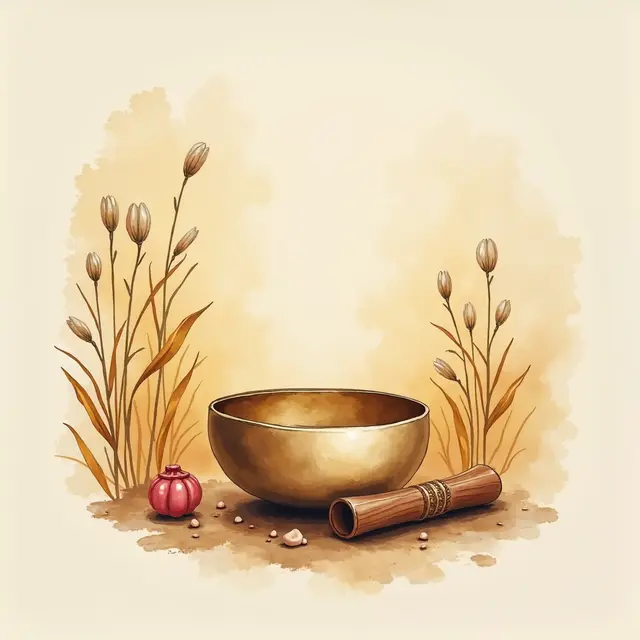
How it sounds
It is six in the evening in a room with lime-washed walls and pale wooden floors, where afternoon light filters softly, losing its sharp edges against a raw linen curtain. You are lying flat on your back on a thin mat, arms slightly away from your torso, palms turned upward to catch the cool air rising from the floor. Set on a rubber ring before you sits a ten-inch frosted quartz singing bowl, as white as sea salt. The tip of your index finger, still damp with warm water, begins tracing the outer rim in a circular, steady, patient motion.
At first it is a dry, almost imperceptible friction, the sound of glass resisting skin. But suddenly the movement finds its exact pitch and the bowl wakes up: a pure, round, indivisible note that comes from nowhere and fills every corner. You feel the vibration before it reaches your ears; it travels through the oak boards, climbs your ankles, and settles against your breastbone like a warm weight that forces out all the air you have held since morning. Two meters away, a bronze gong hangs suspended from a black iron frame.
When a wool-headed mallet strikes its center with a minimal gesture, the metal does not ring—it opens. A mass of deep overtones rolls outward like oil over water, an invisible wave that passes through your clothes, travels the skin of your arms, and completely envelops you. There is no melody to hold onto, no beat to mark the passing hours. Layers of resonance pile upon one another, sound riding on silence like heavy silk, until you no longer know where your body ends and the vibration holding the air begins.
Palette: warm gold / reddish brown / pink / ochre
- BPM
- 45 BPM
- Family
- Breathing Silence
- Serial
- SIL-15
- Rarity
- Common
- Style strength
- 84
- Experimentation
- 38
Typical structure
[Bowls] → [Gong] → [Layered resonance] → [Final rest]
What you see above is merely the surface, the visible set design. Two specific writing problems in this genre are the temptation to slip into cheap sentimentality when discussing peace and the risk of drafting text so diffuse it loses all physical grounding. That lives inside an unpublished internal distillate of eight parameters, and the engine cross-references it with your story. When finished, an internal judge measures the lyric against six canons and repairs what fails. The bowl rings itself. The stillness does not.
How a lyric in this style thinks
A sound bath lyric does not tell a story so much as it clears the space where a story used to press. Where most genres move forward through narrative tension, sound bath moves inward through dissolution — the lyric's function is to release the listener from the obligation of meaning, one layer at a time. The writing works not by delivering emotion but by removing the structures that have been holding emotion in place. Think of it less as a text to be read and more as a set of permissions to stop carrying something.
That is what distinguishes it from ambient writing that merely feels vague: a real sound bath lyric is precise about what it is letting go of, even when the language itself becomes sparse.
The tonal register sits in warm ochre and deep amber — not cold, not bright, not urgent. Emotion in this genre does not arrive as a wave but as a slow settling, the way heat leaves a stone at dusk. If grief is present, it has already burned past its sharp phase and arrived at a dense, quiet fatigue. The line lengths in sound bath lyrics tend to be short and widely spaced, with silence treated as a structural element rather than a gap between words.
Repetition here is not the hook-driven repetition of pop; it is the repetition of a mantra or a breath cycle, where the same phrase returns slightly transformed by the resonance that has accumulated around it. The rhythm follows the body's slowest clock — the exhale, the pause before the next inhale — rather than a metered pulse.
The sensory field is deliberately narrow and tactile. This genre lives in lime-washed walls, pale wooden floors, the coolness rising from stone or oak, the weight of still air against a chest that has been holding its breath for months. The objects that appear in a sound bath lyric are few and physical: a bowl's frosted rim, the grain of a wooden mallet, the particular quality of light at six in the evening when it has lost its edge. What the genre never uses is the language of velocity — no traffic, no screens, no urgent verbs.
Urban grit and cold industrial texture belong to other cards. Metaphors of water are permitted but should move slowly: oil spreading across a surface, not a breaking wave. The vibration that travels through a floor into a body is the genre's central image, and it earns its place because it is anatomically true.
Structurally, a sound bath composition follows the logic of the canon sections on this card: an opening where the crystal bowls establish a single sustained frequency, a middle passage where the gong opens its mass of overtones, a layering phase where resonances accumulate without resolving into melody, and a final rest that is not a conclusion but a cessation. The lyric, if present at all, maps onto this arc.
Words appear most densely at the opening, thin out through the middle, and may reduce to a single syllable or disappear entirely by the final rest. The silence at the end is not empty — it carries everything the earlier sections moved through the room. Writing against this structure, by crowding the final section with words or explanation, collapses what the whole piece has been building.
What separates a genuine sound bath lyric from a generic imitation is the absence of resolution language. An imitation reaches for comfort, for the assurance that things will be all right, for the warm summary. A real sound bath lyric trusts that the resonance itself is the statement and that the body, given enough still time, knows what to do with it.
The production context reinforces this: sustained healing frequencies, crystal and Tibetan bowls at tempos around 45 BPM, immersive overtones that make the boundary between instrument and room uncertain. The vocal delivery, when it exists, is close-miked and unhurried, often more breath than pitch. If you are writing for this genre and you feel the impulse to explain what the listener should feel, remove that line. The bowl does not explain itself. Neither should the lyric.
- CRYSTAL BOWLS
- WAVE BATH
- INSTRUMENTAL
Sample excerpt
The kettle hums its cooling metal song, I set the heavy ceramic mug on oak. Dust motes drift in a shaft of amber light, my shoulders drop away from my ears. The list of things to mend stays on the desk, unopened in the stillness of the room.
Let the deep blue resonance wash the walls, empty space is a soft bed for the lungs, only the slow pulse remains.
Workshop note — Sound bath lyrics rely on extreme brevity and physical sensory details to mirror the decelerating rhythm of the music. By focusing on mundane, quiet actions rather than emotional analysis, the words act as anchors that allow the listener to settle into the sonic vibration. Avoid rhyming or metrical complexity, as any forced structure will clash with the organic, floating nature of the bowls.
Sample excerpt written by MUSAI Song. Your lyrics are written from scratch, based on your story.
When to choose this style
Choose this card when your personal story calls for absolute truce after years of sustained burden. It works for when a caregiver finally leaves a bedside and needs to empty the body of urgency; for the exact moment you accept that a loss will not be resolved with explanations but with still time; for the end of a physical grief where anger has burned down to a thick, heavy fatigue that asks only for earth. It fits a quiet anniversary, making peace with an empty house after a hard move, or marking a private reconciliation with yourself after a season of relentless self-criticism.
Sound bath does not serve stories that demand noisy catharsis, dramatic confessions, or euphoric closures. Do not look here for the epic of a professional achievement or the rush of sudden passion; if your narrative requires plot twists and sharp tension, this atmosphere will feel too soft and vague. If you seek urban grit and cold edges, the letter is Drill.
Your story in this style
MUSAI Song writes original lyrics from your story, in the Sound Bath style, and delivers the finished sung song, the ready-to-use style recipe, and an illustrated art plate with its numbered certificate, private by default; public only if its owner publishes it.
- Original lyrics written from your story
- A finished sung song, ready to play and share
- Art plate with a unique seal and a numbered certificate, private by default; public only if its owner publishes it
Frequently asked questions
What BPM is Sound Bath?
Sound Bath usually runs at 45 BPM.
What does Sound Bath sound like?
Crystal bowls and gongs whose resonances wrap around you like a wave bath. The sound bath: a therapeutic sonic immersion, deep, healing, and so still it relaxes every cell.
What song structure does Sound Bath use?
[Bowls] → [Gong] → [Layered resonance] → [Final rest]
How do I write Sound Bath lyrics?
Tell MUSAI Song your story and pick Sound Bath: it writes original lyrics for this style at 45 BPM, you edit them word by word, and you get the song sung in Sound Bath, with an illustration of the song and its numbered certificate. $19 USD per song, one-time payment.
Explore more styles
- Ambient
- Ambient Folk
- Ambient Lullaby
- Ambient Piano
- Chillhop
- Chillout
- Cinematic Ambient
- Dark Ambient
- Deep Ambient
- Downtempo
- Drone
- Field Recording Ambient
- Generative Ambient
- Healing Frequencies
- Jazzhop
- Lo-Fi Hip-Hop
- Lo-Fi Study
- Meditation Music
- Minimalism
- Nature Soundscape
- Neoclassical
- New Age
- Piano Solo
- Post-Minimalism
Your idea or story, sung in this style
Card · secure payment via Stripe, charged in USD
If it doesn't move you, we give you your money back · 7 days