Nature Soundscape
Rain keeps the tempo and the forest has no complaints.
Get your song in Nature Soundscape
Make yours in this styleHear it before you pay.$19 USD · your first song for $5.50 USDIf it doesn't move you, we give you your money back · 7 days.

Example in a sibling style: Ambient Folk
“Before the Sun, Her Kitchen”
- Before the sun climbs the hill
- you fill the kettle by the sink,
- the apron tied like a crown,
- coffee first, before you think.
Example made with MUSAI Song · sample story · See its certificate MUS-7JKR33
Nature Soundscape is a style from the Breathing Silence family. 45 BPM, Experimentation 40, Style strength 83.
What is Nature Soundscape?
Rain, forest, and a distant thunderclap wrapped in a barely-there pad. The natural soundscape: the calm of staying still and listening to the rain — immersive, present, and asking nothing in return.
How it sounds
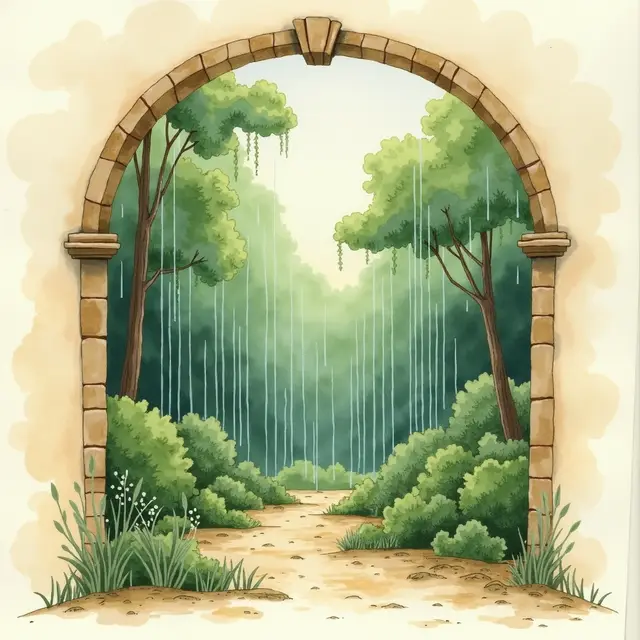
It is Sunday afternoon and the light through the frosted kitchen glass carries the flat grey of an old photograph. Outside, heavy rain beats steadily against the broad leaves of the garden, a thick drumroll that erases the exact line where the trees end and the grey sky begins. There is no traditional music here. What fills the room is a low pad drifting in the deepest frequency registers, a nearly imperceptible hum that sustains the air as if the floorboards themselves were breathing.
A dull, distant thunder rolls across the hills without urgency, a rumble that carries no threat because it arrives stripped of intent. The sharp smell of wet topsoil seeps through a cracked windowpane, mixing with the steam rising from a mug of tea no one is drinking. You sit on the edge of the wooden chair, forearms resting flat on the grain, watching a single water droplet slide slowly down the pane until it vanishes into the frame. Every second weighs the exact same as the last.
Your breathing synchronizes with the cadence of the storm, not by choice, but because the sound fills every available cubic inch of the room, leaving no vacuum for the clatter of thoughts. There is no chorus waiting around the corner, no impending resolution. Just this steady volume, damp moss yielding beneath the weight of water, and the absolute stillness of time refusing to move forward.
Palette: forest green / stone ochre / rain gray blue
- BPM
- 45 BPM
- Family
- Breathing Silence
- Serial
- SIL-25
- Rarity
- Common
- Style strength
- 83
- Experimentation
- 40
Typical structure
[Sound landscape] → [natural layers] → [soft pad] → [dissolution]
What you see above is merely the surface scenery. Beneath it lie two hidden structural hurdles: preventing the ambient atmosphere from drifting into dull monotony through micro-shifts in pad density, and keeping the vocal lines suspended so they never compete with the raw physical weight of the field recordings. That relies on an unreleased internal distillate of eight parameters which the engine intersects directly with your raw history. Once finished, an internal judge measures the output against six canonical dimensions and sends back any lines that disrupt the absolute stillness. The rain samples belong to anyone. The patience, not.
How a lyric in this style thinks
A lyric written for Paisaje Natural doesn't argue or confess — it witnesses. The words do not push toward meaning; they hold a space open long enough for meaning to arrive on its own, the way rain fills a garden without deciding to. This is a genre built entirely on presence rather than progression, and that distinction governs every craft choice you make from the first syllable to the last fade. The emotional register is not sadness, not peace exactly, but something closer to the specific quality of attention that comes after a long period of noise has finally ended. Stone ochre and rain-grey-blue are the colours of this territory. Forest green is its floor.
Line length in Paisaje Natural behaves like breathing at rest: unhurried, slightly uneven, never driven by a beat. Because the BPM sits around 45 and the production is built from low-register pads, distant field recordings, and environmental texture rather than percussion, your syllables have nowhere urgent to go. Long lines work here — lines that carry subordinate clauses the way a slow river carries leaves — but only if you resist the urge to resolve them cleanly.
Let a line end on a preposition, on a soft vowel, on a word that points toward something just out of frame. Repetition, when it appears, should feel less like a chorus hook and more like the way a single water droplet reappears on a windowpane: the same event, slightly different weight. A phrase returned to twice carries the full gravity of duration.
The sensory field of this genre is almost entirely tactile and olfactory before it is visual. Wet topsoil, the grain of a wooden surface under a forearm, the temperature of an empty room, the particular flatness of grey light through frosted glass — these are your materials. What the genre refuses is anything synthetic, urban, or accelerated: no neon, no crowds, no sharp angles of city sound.
The instruments that anchor the production — sustained ambient pads, barely-processed field recordings of rain on broad leaves, the low rumble of distant thunder stripped of any dramatic intent — should be reflected in the language itself. Write words that have texture rather than colour. Name the moss, the cracked windowpane, the steam rising from something no one is drinking.
Structurally, Paisaje Natural follows a logic of layering rather than narrative arc. The canonical sections — sound landscape, natural layers, soft pad, dissolution — describe a gradual deepening rather than a story with turns. In practice this means your lyric, if it has one, should not arrive at a revelation. It should arrive at a slightly different quality of the same stillness.
The opening lines establish the environmental frame; the middle layers add one or two more sensory details without escalating; the closing moves toward dissolution, which in lyric terms means sentences that grow shorter, more elliptical, or trail off into pure sonic texture. There is no chorus waiting around the corner. If you write one in, you have left the genre.
What separates a genuine Paisaje Natural lyric from a generic imitation is the complete absence of emotional instruction. A weak attempt in this genre will tell the listener how to feel — peaceful, calm, released — and in doing so will break the spell entirely. The real thing never names its own effect. It records: a single droplet moving down glass until it vanishes into the frame, the synchronization of breath with a storm that happened without asking permission. The listener's nervous system does the rest.
Vocally, if there is any voice at all, it should arrive late, softly, close-miked, as if the speaker is talking to no one in particular — not whispering for drama, but simply not projecting, the way you speak in a room you are not sure is empty.
- RAIN AND FOREST
- LISTENING TO THE RAIN
- INSTRUMENTAL
Sample excerpt
Moss creeps over the damp stone step, Rain patterns tracing the porch light, A single tea cup holds the morning warmth, While the pine needles bow under the weight, Everything here holds its own steady rhythm.
Just the gray horizon holding still, Deep blue silence settling in the eaves, No heavy words left to carry.
Workshop note — This genre relies on brevity and negative space, prioritizing sensory observation over complex storytelling. By keeping lines sparse and rhythmic, the lyrics mimic the slow, predictable falling of rain, allowing the listener to inhabit the environment rather than chase a plot. Avoid active verbs or forced rhyme schemes to keep the atmosphere unbound and undisturbed.
Sample excerpt written by MUSAI Song. Your lyrics are written from scratch, based on your story.
When to choose this style
Choose this carta when your story requires total shelter rather than narrative fireworks. It fits the precise stillness that arrives years after a storm has passed, when moving out to the countryside finally feels like coming to a halt. It works for the quiet morning when grief stops tearing at the edges and settles into a landscape you can walk through without flinching. For returning to an empty ancestral house where the rooms hold the same slow temperature.
Do not pick this if you need high drama, sudden turns, or loud external conflict; this format cannot yell or pick up the pace. It is entirely unsuited for euphoric celebrations or frantic farewells. If you need a rhythmic pulse to drive the narrative forward, the carta is Downtempo.
Your story in this style
MUSAI Song writes original lyrics from your story, in the Nature Soundscape style, and delivers the finished sung song, the ready-to-use style recipe, and an illustrated art plate with its numbered certificate, private by default; public only if its owner publishes it.
- Original lyrics written from your story
- A finished sung song, ready to play and share
- Art plate with a unique seal and a numbered certificate, private by default; public only if its owner publishes it
Frequently asked questions
What BPM is Nature Soundscape?
Nature Soundscape usually runs at 45 BPM.
What does Nature Soundscape sound like?
Rain, forest, and a distant thunderclap wrapped in a barely-there pad. The natural soundscape: the calm of staying still and listening to the rain — immersive, present, and asking nothing in return.
What song structure does Nature Soundscape use?
[Sound landscape] → [natural layers] → [soft pad] → [dissolution]
How do I write Nature Soundscape lyrics?
Tell MUSAI Song your story and pick Nature Soundscape: it writes original lyrics for this style at 45 BPM, you edit them word by word, and you get the song sung in Nature Soundscape, with an illustration of the song and its numbered certificate. $19 USD per song, one-time payment.
Explore more styles
- Ambient
- Ambient Folk
- Ambient Lullaby
- Ambient Piano
- Chillhop
- Chillout
- Cinematic Ambient
- Dark Ambient
- Deep Ambient
- Downtempo
- Drone
- Field Recording Ambient
- Generative Ambient
- Healing Frequencies
- Jazzhop
- Lo-Fi Hip-Hop
- Lo-Fi Study
- Meditation Music
- Minimalism
- Neoclassical
- New Age
- Piano Solo
- Post-Minimalism
- Slow Cinematic Piano
Your idea or story, sung in this style
Card · secure payment via Stripe, charged in USD
If it doesn't move you, we give you your money back · 7 days