New Age
Nature had its own playlist long before you did.
Get your song in New Age
Make yours in this styleHear it before you pay.$19 USD · your first song for $5.50 USDIf it doesn't move you, we give you your money back · 7 days.

Example in a sibling style: Ambient Piano
“The Night We Didn't End”
- The lamp is low, the kettle cooled,
- your breathing slow beside me now.
- No words to say, none needed here,
- just the warm weight of your hand.
Example made with MUSAI Song · sample story · See its certificate MUS-CURUNS
New Age is a style from the Breathing Silence family. 65 BPM, Experimentation 32, Style strength 86.
What is New Age?
Soft pads, harp, and nature sounds that heal little by little. New age: the music of well-being and inner peace, serene, luminous, and made for reconnecting with calm.
How it sounds
It is six in the morning in a room where the wooden floorboards creak beneath bare feet. There is no direct light yet, only that translucent grey sliding through the window blinds and settling over a mug of tea that has already lost its steam. The air smells of dry humidity, of soil aired out before the sun warms the stone. Outside, the first blackbirds test the air with three short notes, identical, repeated until they feel like home. Inside, the analog pads lift a layer of frequencies so wide and open that the chest forgets how to contract.
There are no beats. There is no pulse keeping score of the passing hours. Only a harp string falling every few seconds, round and cold, exactly like a dewdrop letting go of an oak leaf, cutting through the air to strike the moss. Your breathing, without you forcing it, locks into that interval. Your shoulders drop an inch. Your jaw lets go.
There is nothing in this room that needs fixing, not a single urgency left to answer; what happened yesterday and what comes next dissolve in this bed of harmonics where the sound doesn't arrive from outside, but seems to seep right out of the plaster, the timber, the empty space between your hands and your knees. You stay there, motionless, holding the cold ceramic, feeling the weight of the months turn translucent and fall away on its own, slow, grain by grain, like sand settling at the bottom of still water.
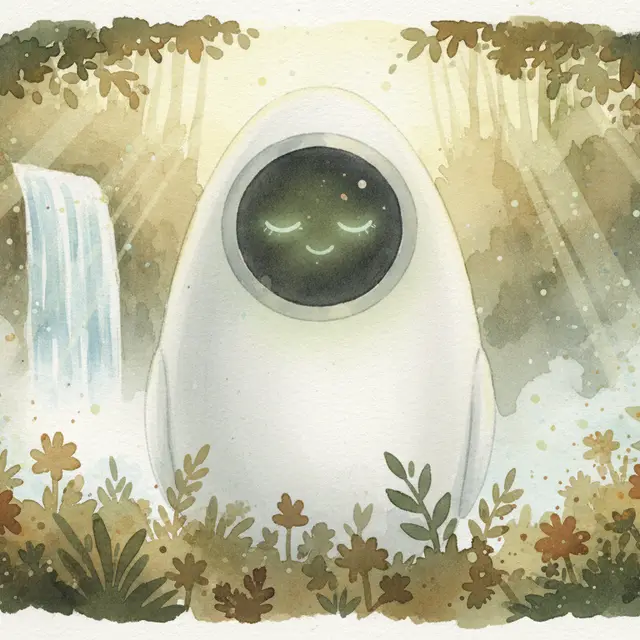
Palette: sage green / warm gold / pale blue / terracotta
- BPM
- 65 BPM
- Family
- Breathing Silence
- Serial
- SIL-05
- Rarity
- Rare
- Style strength
- 86
- Experimentation
- 32
Typical structure
[Intro] nature sounds → [Theme] piano → [Strings/harp] → [Soft climax] → [Outro]
The data above can be copied in a minute. What cannot be copied is the architecture of the pause: how many exact seconds of silence must live between arpeggios so the mind never waits for a hit, nor how an analog pad is tuned to warm without turning heavy. All of that sits in an unpublished internal distillate, and it is what the engine crosses with your story before writing a single line. When it finishes, an internal judge measures the lyric against six dimensions of the canon and sends back what sounds too human or too cold. The harp is for sale. The stillness, not.
How a lyric in this style thinks
A lyric written for New Age does not argue, explain, or resolve. It holds a single moment open long enough for the listener to step inside it and breathe. Where most genres move toward a destination, New Age stays in the hallway — that charged, still space between one version of yourself and the next — and asks the lyric to do the same. The emotion does not arrive as statement or declaration. It seeps in through texture, through the weight of a ceramic mug, through the specific quality of early-morning light before it has any warmth in it.
If you are writing for this genre, your first job is to slow the lyric down until it matches the pace of something settling rather than something happening.
The base tone of New Age is not happiness and not sadness. It is the particular feeling of having put something down after carrying it for a long time — relief with a residue of ache still in it. Emotion arrives sideways, through the body rather than the mind. Line length tends toward the longer and the unhurried; short percussive lines feel wrong here because there are no beats to catch them.
Repetition works differently than in pop or folk: a phrase returns not to drive a hook home but because it is still true, still sitting there, the way a harp note decays slowly and you keep hearing it after the string has stopped vibrating. Rhythm in the lyric should feel pulled by breath, not by a metronome. If you read a line aloud and your chest tightens to finish it in time, the line is too short or too urgent for this genre.
The sensory field of New Age is specific and worth mapping carefully. This is music that lives in dawn interiors, in the interval between the last night-sound and the first birdsong, in the physical sensation of shoulders dropping an inch. Concrete objects are welcome — floorboards, bare feet, cold ceramic, the smell of soil before the sun reaches stone — but they must carry no aggression and no urgency. What New Age never uses: cities at speed, neon, hard consonant clusters that land like a punch, any image with sharp edges or velocity.
The palette is amber light through linen, the weight of water in still air, the sound a dewdrop makes when it lets go of a leaf. Terracotta and pale blue rather than anything electric or acid.
Structurally, New Age follows an arc of gradual opening rather than tension and release. An intro built on nature sounds — birdsong, water, the creak of timber — establishes the room before a word is sung, if words come at all. The piano theme enters quietly, not announcing itself. Harp and strings arrive as a second breath, widening the harmonic space.
What functions as a soft climax in this genre would register as a midpoint in almost any other: a slight increase in density, a chord that catches light differently, a moment where the pads bloom a half-step wider. Then the outro does not conclude so much as it allows the sound to become transparent and let the room back in. Lyrically, this means your last image should not tie anything off. Leave the knot loose. The listener needs to feel that the moment continues after the track ends.
What separates a genuine New Age lyric from a generic imitation is restraint at the level of the word, not just the production. Generic versions reach for abstraction — peace, light, healing — and end up saying nothing the ear can hold onto. A real lyric in this genre stays with the grain of the specific: the exact number of notes the blackbird repeats before it stops, the way grief no longer burns but aches when the rain changes pressure, the decision to stop pushing at a locked door and simply sit on the floor beside it.
The feeling of inner stillness is earned through precision about the outer world, not through vague reassurance. Soft piano and gentle synth pads can carry enormous emotional weight, but only if the lyric gives them something concrete to illuminate rather than something abstract to illustrate.
- HARP AND NATURE
- HEALING MUSIC
- INSTRUMENTAL
Sample excerpt
The dust settles on the hallway floorboards, where we sat while the tea went cold. You watch the oak tree sway against the fence, no longer searching for the words we held.
The amber light grows long and still, a quiet truce upon the windowsill.
Workshop note — This genre thrives on slow, rhythmic breathing rather than narrative propulsion, using short, evocative lines that leave space for the listener to internalize the peace. Keep the vocabulary grounded in simple textures like wood and glass, avoiding metaphors that demand too much intellectual effort. The chorus should function as a meditative mantra that anchors the verse, prioritizing a sense of presence over a traditional resolution.
Sample excerpt written by MUSAI Song. Your lyrics are written from scratch, based on your story.
When to choose this style
Choose this card when you need to tell the story of a truce after years of friction. It works to forgive a parent who aged overnight and now only knows how to stare out the window. For the exact second when someone decides to stop pushing against a locked door and just sits on the hallway floor to rest. For a grief that no longer burns like an open wound, but feels like a wide scar that the rain makes ache every now and then. It serves to thank someone who stayed quiet while everyone else shouted opinions.
Do not choose it to tell of a noisy victory, a promotion, a settled score, or a breakup where there are still plates left to break: new age has no teeth and no speed for rage. If your story asks for explicit drama, cinematic tension, or a sharp conclusion, this card will leave you wanting. If you are looking for closure with the tension left intact, the card is Generative Ambient.
Your story in this style
MUSAI Song writes original lyrics from your story, in the New Age style, and delivers the finished sung song, the ready-to-use style recipe, and an illustrated art plate with its numbered certificate, private by default; public only if its owner publishes it.
- Original lyrics written from your story
- A finished sung song, ready to play and share
- Art plate with a unique seal and a numbered certificate, private by default; public only if its owner publishes it
Frequently asked questions
What BPM is New Age?
New Age usually runs at 65 BPM.
What does New Age sound like?
Soft pads, harp, and nature sounds that heal little by little. New age: the music of well-being and inner peace, serene, luminous, and made for reconnecting with calm.
What song structure does New Age use?
[Intro] nature sounds → [Theme] piano → [Strings/harp] → [Soft climax] → [Outro]
How do I write New Age lyrics?
Tell MUSAI Song your story and pick New Age: it writes original lyrics for this style at 65 BPM, you edit them word by word, and you get the song sung in New Age, with an illustration of the song and its numbered certificate. $19 USD per song, one-time payment.
Explore more styles
- Ambient
- Ambient Folk
- Ambient Lullaby
- Ambient Piano
- Chillhop
- Chillout
- Cinematic Ambient
- Dark Ambient
- Deep Ambient
- Downtempo
- Drone
- Field Recording Ambient
- Generative Ambient
- Healing Frequencies
- Jazzhop
- Lo-Fi Hip-Hop
- Lo-Fi Study
- Meditation Music
- Minimalism
- Nature Soundscape
- Neoclassical
- Piano Solo
- Post-Minimalism
- Slow Cinematic Piano
Your idea or story, sung in this style
Card · secure payment via Stripe, charged in USD
If it doesn't move you, we give you your money back · 7 days