Slow Cinematic Piano
The sea didn't applaud, but it didn't leave either.
Get your song in Slow Cinematic Piano
Make yours in this styleHear it before you pay.$19 USD · your first song for $5.50 USDIf it doesn't move you, we give you your money back · 7 days.

Example in a sibling style: Ambient Folk
“Before the Sun, Her Kitchen”
- Before the sun climbs the hill
- you fill the kettle by the sink,
- the apron tied like a crown,
- coffee first, before you think.
Example made with MUSAI Song · sample story · See its certificate MUS-7JKR33
Slow Cinematic Piano is a style from the Breathing Silence family. 62 BPM, Experimentation 30, Style strength 88.
What is Slow Cinematic Piano?
Emotive piano and strings that swell slowly like the most tender scene in a film. Slow cinematic piano is calm with a heart full of cinema — moving, vast, and beautiful in the way it holds silence.
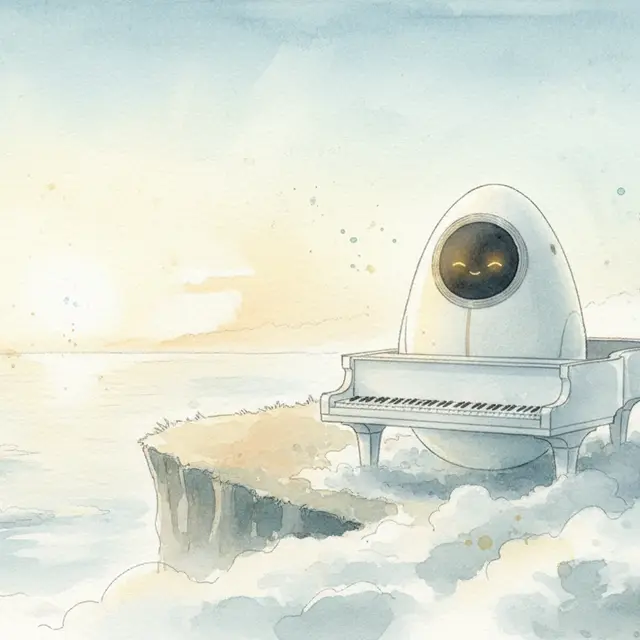
How it sounds
It is six in the morning and the kitchen window still holds the condensation from the night before. Outside, the mist does not fall; it hangs, thick and grey, erasing the exact line where the garden ended and the open field began. There is no traffic noise. Only the distant hum of a transformer no one fixes and the steady drip of a gutter emptying slowly. You sit on the wooden chair with lukewarm coffee between your hands, waiting for the first chord to hold its own weight.
It is a single piano key, a low E that stretches and vibrates in the cold air before finding company. The strings enter so gradually you do not hear them arrive; you simply notice that the room has suddenly grown wider, as if the walls had stepped back two feet. The bow brushes the string with a clean friction, a whisper of horsehair over metal that smells of damp earth and old timber. There is no hit. There is no percussion to mark the passing of time.
Each note expands until it occupies all the space between your ribs, a slow tide rising without rush, forcing you to breathe deeper. The dawn light cuts across the glass, a white thread slicing the fog and resting on the table. You look at your own hands flat on the wood and realize the weight of these past years no longer needs a long explanation. It only needs this silence that opens and lets the air through.
Palette: grayish blue / warm gold / fog gray
- BPM
- 62 BPM
- Family
- Breathing Silence
- Serial
- SIL-26
- Rarity
- Common
- Style strength
- 88
- Experimentation
- 30
Typical structure
[Intro] piano → [Strings enter] → [Soft climax] → [Final rest]
The data above is copied in a minute. What cannot be copied is the exact judgment: how long the sustain pedal must hold before a note clouds the next, and how to write lines that fit between strings without crowding the space. That lives in an internal distillate of eight parameters that are not published, and the engine crosses it with your story before drafting the voiceover. When finished, an internal judge measures the lyrics against six dimensions of the canon and orders repairs on anything that breaks the mood. The keyboard is in any store. The pulse of the water, not.
How a lyric in this style thinks
A lyric written for slow cinematic piano does not argue its case. It arrives the way light arrives through condensation on a kitchen window — already present, already doing its work before you name it. The genre exists to hold a feeling that has finished burning and has become geography instead: a landscape you inhabit rather than a wound you tend. Slow cinematic piano is not a vehicle for narrative; it is a container for weight, and the lyric's job is to fill that container with the precise mass of a single sustained truth rather than a sequence of events.
The base tone sits somewhere between mourning and gratitude without resolving into either. Emotion in this genre never announces itself. It arrives through displacement — the way a line about the angle of morning light on a wooden table carries more grief than any line that names grief directly. Line length matters enormously here.
Long, slow lines that breathe with the tempo (around 62 BPM) allow each image to expand before the next one enters, mirroring exactly what the strings do underneath: they do not announce their arrival, you simply notice the room has grown larger. Short lines break that expansion and feel like percussion, which this genre refuses. If you write a short line, it should land like a held breath, not a punctuation mark.
Repetition in slow cinematic piano is structural, not decorative. A phrase that returns in the final rest section carries different mass than it did in the intro, because the harmonic space beneath it has changed — the strings have swelled and then receded, and the piano is left again with its original low register, now freighted with everything the middle sections accumulated.
Lyrically, you replicate this by returning to your opening image at the close, but with one word altered or one line removed, so the listener feels the difference without being told what it means. The sensory field this genre lives in is specific: cold surfaces, early morning, objects used so many times their function has become love. Lukewarm coffee. Condensation. Old timber. Damp earth. The genre has no use for bright colours, fast movement, crowds, or irony. It cannot carry a punchline.
Structurally, the four-section logic — piano intro, strings enter, soft climax, final rest — maps directly onto a lyrical arc of observation, recognition, release, and return to stillness. The intro section should carry one image, complete and unadorned. The strings' entrance is where the lyric opens outward, where the personal becomes the universal without losing its particular address.
The soft climax is not a shout; it is the moment where the accumulated weight becomes visible, a line that names what has been circling without over-explaining it. The final rest returns to near-silence, and the lyric should honour that by pulling back to something small and concrete — hands flat on wood, a gutter draining, a transformer's distant hum.
What separates a genuine slow cinematic piano lyric from a generic imitation is restraint applied with intention, not with timidity. Generic versions mistake emptiness for space and leave the listener with nothing to inhabit. A real lyric in this genre earns its silences by surrounding them with images of such specific gravity that the silence between lines becomes active, pressurised, full.
The production — deep reverb on the grand piano, the clean friction of a bow on strings, no percussion whatsoever — is doing half the emotional work, and the lyric must trust that. Write less than you think you need. Then remove one more line. What remains should feel like the exact weight of what your story costs.
- PIANO AND STRINGS
- CINEMATIC HEART
- INSTRUMENTAL
Sample excerpt
The kettle hums its low, brass note, Dust motes dancing in the amber light. You fold the newspaper into a thin square, Your hands tracing the ink black lines Of a city we visited twenty years ago.
The floorboards hold the weight of us, Quiet as the fog against the glass, Everything said in the pouring of the tea.
Workshop note — This style relies on long, spacious lines that allow the piano to breathe between phrases, creating a sense of pause rather than urgency. By focusing on mundane, sensory actions like folding paper or pouring tea, the lyrics ground the listener in a specific domestic intimacy without relying on grand metaphors. Avoid adding too many verbs or sudden narrative shifts, as the music requires a slow, steady pulse to maintain its cinematic weight.
Sample excerpt written by MUSAI Song. Your lyrics are written from scratch, based on your story.
When to choose this style
Choose this card when the personal story demands an absolute pause and a long look backward. It works when you watch your parents age in the same house and understand, without drama, the exact scale of what they gave up. For when you lost someone and the pain no longer burns, but has turned into a quiet landscape you walk through in silence. To thank a sibling for what you carried together when you were young and the world was narrow. For the anniversary of a shared life where words are no longer needed because everything is said in the way coffee is poured each morning. To make peace with a younger version of yourself who made mistakes you no longer feel the need to justify.
Do not choose it to tell of a recent success that calls for celebration, nor for an anger that still demands shouting or release. It also fails for a story where many things happen quickly or where humor is the main engine; cinematic piano cracks under the weight of anecdotes or fast turns. If you look for an atmosphere where night and texture keep moving without solemnity, the card is Generative Ambient.
Your story in this style
MUSAI Song writes original lyrics from your story, in the Slow Cinematic Piano style, and delivers the finished sung song, the ready-to-use style recipe, and an illustrated art plate with its numbered certificate, private by default; public only if its owner publishes it.
- Original lyrics written from your story
- A finished sung song, ready to play and share
- Art plate with a unique seal and a numbered certificate, private by default; public only if its owner publishes it
Frequently asked questions
What BPM is Slow Cinematic Piano?
Slow Cinematic Piano usually runs at 62 BPM.
What does Slow Cinematic Piano sound like?
Emotive piano and strings that swell slowly like the most tender scene in a film. Slow cinematic piano is calm with a heart full of cinema — moving, vast, and beautiful in the way it holds silence.
What song structure does Slow Cinematic Piano use?
[Intro] piano → [Strings enter] → [Soft climax] → [Final rest]
How do I write Slow Cinematic Piano lyrics?
Tell MUSAI Song your story and pick Slow Cinematic Piano: it writes original lyrics for this style at 62 BPM, you edit them word by word, and you get the song sung in Slow Cinematic Piano, with an illustration of the song and its numbered certificate. $19 USD per song, one-time payment.
Explore more styles
- Ambient
- Ambient Folk
- Ambient Lullaby
- Ambient Piano
- Chillhop
- Chillout
- Cinematic Ambient
- Dark Ambient
- Deep Ambient
- Downtempo
- Drone
- Field Recording Ambient
- Generative Ambient
- Healing Frequencies
- Jazzhop
- Lo-Fi Hip-Hop
- Lo-Fi Study
- Meditation Music
- Minimalism
- Nature Soundscape
- Neoclassical
- New Age
- Piano Solo
- Post-Minimalism
Your idea or story, sung in this style
Card · secure payment via Stripe, charged in USD
If it doesn't move you, we give you your money back · 7 days