Psytrance
The spiral has no exit because nobody is looking for one.
Get your song in Psytrance
Make yours in this styleHear it before you pay.$19 USD · your first song for $5.50 USDIf it doesn't move you, we give you your money back · 7 days.
Psytrance is a style from the Machines That Dream family. 145 BPM, Experimentation 34, Style strength 91.
What is Psytrance?
Vertiginous rolling bass and psychedelic synths spinning in spirals. Psytrance: the most cosmic and tribal form of trance, intense, hypnotic, and a trip to another dimension.
How it sounds
It is four in the morning in a forest clearing three hours from the nearest city. Your boots are dug into dry dirt, and the air smells of burnt pine, damp moss, and ozone. A laser projector paints magenta and cyan geometries across the canopy, turning leaf clusters into glowing electric scales. You are not looking at the stage; you are looking down because your legs no longer answer to conscious thought.
The sound system pushes a relentless 145 BPM rolling bassline—a heavy wave of sixteenth notes that feels like a gear grinding against the earth. A tuned synth filter sweeps wide, launching a harsh, acid spiral that twists through the air. The low-end pressure hits your ribs directly, making your chest cavity vibrate in exact pitch with the sub-bass. Time stretches as the DJ cuts the low frequencies, leaving only a synth lead suspended over the clearing like a swarm of metallic insects. For four bars, everything hangs in suspension.
People around you stand with eyes closed, shoulders wet with sweat, moving together in a single collective stride. When the kick snaps back in on the drop, the impact hits your knees first. A cold jolt travels up your spine from your heels to the back of your neck, leaving you with the feeling that your body isn't yours anymore—it is just the conduit through which the circuit speaks.
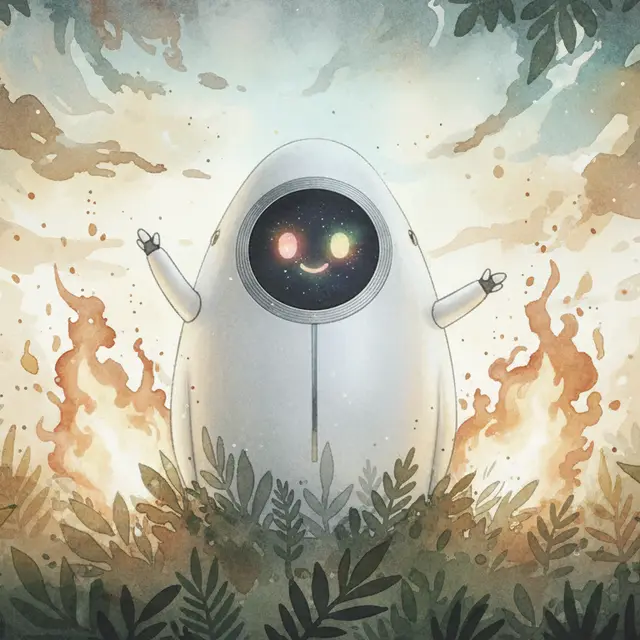
Palette: earthy orange / muted green / grayish white
- BPM
- 145 BPM
- Family
- Machines That Dream
- Serial
- MAQ-21
- Rarity
- Rare
- Style strength
- 91
- Experimentation
- 34
Typical structure
[Intro] → [Build] → [Rolling drop] → [Psychedelic break] → [Final drop]
The parameters above are merely the visible surface. What cannot fit into a table is how to sustain vocal tension over a continuous rolling bassline without suffocating the groove, or how to turn concise phrases into shamanic chants without drifting into empty pseudo-spiritual jargon. That balance lives in our internal eight-parameter framework, which the engine blends directly with your story. Once generated, an internal judge evaluates the lyrics against six dimensions of the canon and fixes anything that misses the mark. A 145 BPM tempo can be copied. The hypnosis cannot.
How a lyric in this style thinks
A psytrance lyric doesn't tell a story so much as dissolve the narrator. Where most songwriting builds toward emotional clarity, psytrance works in the opposite direction — it uses language as a tool for disorientation, pulling the listener away from fixed identity and into the physics of the moment. The words aren't there to explain the experience; they are part of the pressure system, another frequency in the mix.
If you're writing for this genre, your first job is to stop thinking about narrative arc and start thinking about threshold states: what it feels like when the body stops obeying the mind, when the self becomes porous, when consciousness has been running so hard for so long that it finally lets go.
The emotional register of psytrance sits in a specific tension between surrender and intensity. There is nothing soft or hesitant here — the tone is earthy and vertiginous at once, like standing barefoot on trembling ground while something enormous passes overhead. Emotion doesn't arrive through vulnerability or confession; it arrives through accumulation. A single image repeated six times across a build section lands differently than the same image used once in a verse. The repetition isn't laziness — it is the mechanism.
The lyric teaches the body a phrase the way a bassline teaches the feet a pattern, and by the time the drop hits, the words feel inevitable rather than written. Line lengths tend to be short and percussive, landing on the beat rather than flowing across it. Syllables function like kick drums.
The sensory field in psytrance is specific and non-negotiable. Dry earth, ozone, pine resin, the physical sensation of sub-bass pressure against the ribcage — these are the textures the genre lives inside. Geometries, spirals, the feeling of time stretching or compressing, the visual quality of laser light cutting through a forest canopy at four in the morning: these are legitimate lyrical materials. What the genre refuses is domesticity. There are no kitchens, no traffic, no romantic gestures, no soft lighting.
Psytrance also refuses irony — the genre is radically earnest about altered states and collective physicality, and any winking detachment will kill the track immediately. The vocabulary should feel ancient and synthetic at the same time, like circuitry described in the language of ritual.
Structurally, the genre follows a logic of pressure and release rather than tension and resolution. The intro exists to establish the rolling bassline as a kind of ground state — a trance condition the listener enters before anything else happens. The build accumulates filtered acid spirals and swirling synth layers, using the lyric sparingly if at all, letting the sound do the emotional loading.
The psychedelic break is the one moment where a lyric can open up into something stranger and more expansive, a suspended zone where the kick is gone and language can float briefly untethered. When the final drop hits, the lyric should feel like something the body already knows — a phrase that has been half-heard so many times through the mix that its return at full volume is recognition rather than introduction.
What separates a real psytrance lyric from a generic imitation is the willingness to be uncomfortable with conventional meaning. A generic imitation reaches for cosmic metaphors and settles for clichés about infinity and consciousness. A real psytrance lyric finds the specific physical detail — the exact sensation of knees buckling on a drop, the smell of burnt resin in humid air, the moment when a crowd of strangers moves as a single organism — and trusts that precision to carry the weight.
The genre is 145 BPM and instrumentally dominant, which means every word you add must earn its place against an enormous amount of competing sonic information. Write less than you think you need. Let the rolling bass carry what the language cannot.
- ROLLING BASS
- COSMIC JOURNEY
- INSTRUMENTAL
Sample excerpt
six a.m. behind the speaker stack dust on the lens of the camera a heavy rhythm hits the chest bone no way back through the tunnel
open circuit in the dark spinnig wheels of amber light let the heavy pattern take every anchor cut tonight
Workshop note — In this style, lyrics act as rapid mantras rather than traditional stories, relying on short fragments and physical repetition to mirror the rolling bass. The chorus strips away complex grammar to create a hypnotic chant that locks directly into the 145 BPM pulse. This genre strictly avoids narrative exposition or emotional hesitation, demanding total immersion in sensory overload.
Sample excerpt written by MUSAI Song. Your lyrics are written from scratch, based on your story.
When to choose this style
Choose this card when the story isn't a dialogue, but a radical transformation. It works when someone needed to lose control in order to find themselves again: a solo trip through a personal breakdown, an intense night where a group of friends celebrated surviving a brutal year, or the physical release of overcoming deep-seated tension through movement. Use it to honor someone who finds clarity in heavy repetition, three-day festivals, or the sheer physics of wall-shaking volume.
Do not choose it if you want acoustic introspection, nostalgic warmth, or a quiet anniversary message. Psytrance leaves no room for hesitation or delicate story arcs about everyday romance; it dismantles traditional songwriting to replace it with sensory overload. If you want a driving synth journey with clear emotional nostalgia, the card is synthwave. If you want a deeper, calmer nocturnal groove, the card is deep house.
Your story in this style
MUSAI Song writes original lyrics from your story, in the Psytrance style, and delivers the finished sung song, the ready-to-use style recipe, and an illustrated art plate with its numbered certificate, private by default; public only if its owner publishes it.
- Original lyrics written from your story
- A finished sung song, ready to play and share
- Art plate with a unique seal and a numbered certificate, private by default; public only if its owner publishes it
Frequently asked questions
What BPM is Psytrance?
Psytrance usually runs at 145 BPM.
What does Psytrance sound like?
Vertiginous rolling bass and psychedelic synths spinning in spirals. Psytrance: the most cosmic and tribal form of trance, intense, hypnotic, and a trip to another dimension.
What song structure does Psytrance use?
[Intro] → [Build] → [Rolling drop] → [Psychedelic break] → [Final drop]
How do I write Psytrance lyrics?
Tell MUSAI Song your story and pick Psytrance: it writes original lyrics for this style at 145 BPM, you edit them word by word, and you get the song sung in Psytrance, with an illustration of the song and its numbered certificate. $19 USD per song, one-time payment.
Explore more styles
- Acid House
- Ambient Techno
- Big Room EDM
- Breakbeat
- Darkwave / EBM
- Deep House
- Drum & Bass
- Dubstep
- Electro
- Eurodance
- Festival Trap
- Future Bass
- Future Garage
- Future House
- Hardcore / Gabber
- Hardstyle
- House
- Jungle
- Liquid DnB
- Melodic Dubstep
- Melodic Techno
- Minimal Techno
- Nu-Disco
- Progressive House
Your idea or story, sung in this style
Card · secure payment via Stripe, charged in USD
If it doesn't move you, we give you your money back · 7 days